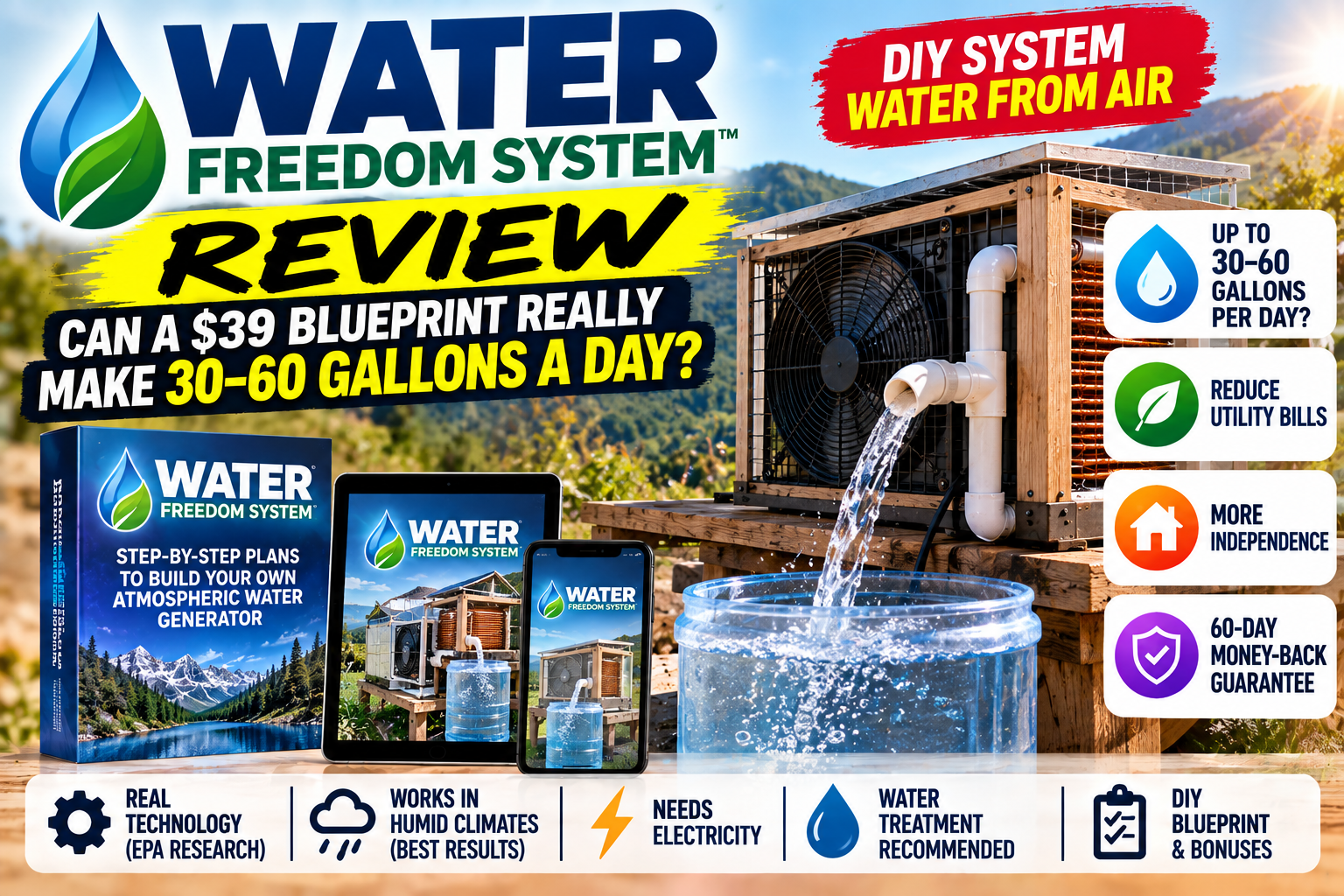
If you searched for a Water Freedom System review after seeing claims that a $39.69 DIY blueprint can produce dozens of gallons of clean water directly from the air, there is something important you should know immediately:
Atmospheric water generation is real technology.
The U.S. Environmental Protection Agency recognizes atmospheric water generators, or AWGs, as legitimate systems capable of producing water from surrounding air.
Commercial AWGs already exist.
The underlying condensation physics are straightforward.
But:
the amount of water you can extract depends enormously on temperature, humidity, machine capacity and energy consumption.
And that creates a particularly interesting problem for Water Freedom System.
Because its own current marketing does not agree on how much water the system supposedly produces.
ClickBank currently describes the system as capable of producing:
up to 30 gallons per day.
Meanwhile, the official Water Freedom affiliate center says:
up to 60 gallons per day.
That’s a twofold difference.
Both are substantial amounts of water for a DIY atmospheric water generator.
And both deserve much more context than a headline number.
So we investigated:
- how atmospheric water generation actually works;
- what the EPA says about realistic production;
- why humidity changes everything;
- how much energy condensation can require;
- whether atmospheric condensate is automatically safe to drink;
- why ClickBank and the affiliate center publish different output figures;
- who “Chris Burns” actually is;
- and what the $39.69 purchase really gives you.
- Personally Tested
- NO
- Research Type
- COMMUNITY RESEARCHED
- Official Sales Page Examined
- YES
- Official Affiliate Materials Examined
- YES
- ClickBank Offer Information Examined
- YES
- ClickBank Marketplace Data Examined
- YES
- EPA Atmospheric Water Research Examined
- YES
- EPA Water Quality Testing Examined
- YES
- Independent AWG Research Examined
- YES
- Product-Specific Independent Engineering Test Found
- NO
- Creator Uses Pen Name
- YES
- Affiliate Relationship
- YES
- Vendor Provided Access
- NO
- Last Researched
- September 2026
Water safety note: Water collected through condensation should not automatically be assumed safe to drink. Air quality, system materials, filtration, disinfection, storage and maintenance can all affect water quality. A DIY water-generation system intended for drinking should include appropriate treatment and testing.
Quick Answer: Does Water Freedom System Work?
Water Freedom System is based on legitimate atmospheric-water-generation technology, but we found no independent product-specific engineering test establishing that this particular DIY design reliably produces the 30–60 gallons per day suggested by current marketing.
The underlying mechanism is not controversial.
Air contains water vapor.
If humid air is cooled below its dew point:
water condenses.
That’s the same reason:
- water appears on a cold glass;
- air conditioners create condensate;
- dehumidifiers fill collection tanks;
- and commercial atmospheric water generators can produce drinking water.
EPA documents atmospheric water generators ranging from small home units to very large commercial machines.
The important question therefore isn’t:
“Can water be extracted from air?”
It can.
The real question is:
“Can this specific DIY design produce the amount advertised under realistic conditions and at a reasonable energy cost?”
That’s much harder to establish.
The current marketing itself gives us two different headline outputs:
- up to 30 gallons/day according to current ClickBank promotional material;
- up to 60 gallons/day according to the official affiliate center.
Neither source clearly provides standardized test conditions such as:
- ambient temperature;
- relative humidity;
- electricity consumed;
- airflow;
- hours of operation;
- or water-treatment configuration.
Without those numbers:
the gallon figure isn’t very useful scientifically.
Our early conclusion is:
Water Freedom System makes most sense as a DIY atmospheric-water-generation project, not as a guaranteed source of 30–60 gallons of drinking water every day regardless of climate.
Check the Current Water Freedom System Offer
What Is Water Freedom System?
Water Freedom System is a digital DIY guide sold through ClickBank.
You do not receive:
- a completed water generator;
- a commercial AWG;
- a dehumidifier;
- a filtration system;
- or physical water equipment.
You primarily purchase:
instructions for building your own system.
The current sales and affiliate materials describe a method using atmospheric condensation technology to pull moisture from surrounding air.
The package includes digital information such as:
- construction instructions;
- project guidance;
- materials information;
- setup instructions;
- and several preparedness-related bonuses.
Physical components are:
not included in the $39.69 purchase.
That’s important.
The $39.69 is the cost of:
the information.
Your total project cost also includes whatever hardware is required to actually build the system.
How Popular Is Water Freedom System?
Very popular by current ClickBank standards.
The vendor nickname is:
WATERFS.
The latest marketplace snapshot we examined from September 27, 2026 showed:
Gravity: 76.45.
Average affiliate earnings were approximately:
$51.66 per sale.
The same marketplace snapshot reported a conversion rate around:
1.93%.
The offer currently has no reported average rebill on the main product.
Those are strong direct-response numbers.
They tell us:
the sales funnel is currently converting traffic.
They do not tell us:
how many gallons of water buyers actually produce.
ClickBank Gravity measures affiliate sales activity.
Not engineering performance.
How Much Does Water Freedom System Cost?
The current official affiliate material lists the package price as:
$39.69
The official sales page also currently displays:
$39.69.
The purchase is digital and is marketed as:
a one-time payment.
Current marketplace data also shows:
$0 average rebill
for the main offer.
As always with ClickBank offers:
the live checkout is the final authority.
Promotional funnels can change.
Does Water Freedom System Have a Refund Policy?
Yes.
The official sales page currently advertises a:
60-day money-back guarantee.
Because this is a digital guide rather than a physical device:
the guarantee applies to:
the information product.
It does not automatically reimburse you for:
- fans;
- compressors;
- tubing;
- filters;
- containers;
- electrical equipment;
- tools;
- or other hardware you independently purchase.
That’s worth understanding before spending significant money on the build.
Is Making Water From Air Actually Real?
Yes.
Atmospheric water generators are real machines.
The U.S. EPA describes AWGs as technologies that:
produce potable water from surrounding air.
The most common active systems use:
- fans;
- cooling coils;
- condensers;
- compressors;
- collection reservoirs;
- and water treatment.
The basic process resembles:
a dehumidifier.
Air enters the machine.
It passes across a cooled surface.
The air temperature falls below its dew point.
Water vapor condenses.
The liquid is collected.
Then, if the goal is drinking water:
the water must be appropriately treated and stored.
The EPA Has Actually Tested Atmospheric Water Generators
This is important because it shows that the underlying technology is not fringe science.
EPA partnered with Watergen to evaluate a commercial atmospheric water generator.
The tested commercial system was capable of producing:
hundreds of liters of water per day under favorable conditions.
EPA also evaluated:
- microbial water quality;
- system treatment;
- storage;
- filtration;
- and disinfection.
So:
high-output atmospheric water generation is absolutely possible.
But commercial machines capable of producing hundreds of liters daily are:
not the same thing as a low-cost DIY project.
Scale matters.
Home AWGs vs Commercial AWGs
EPA’s technical guidance provides useful context.
It describes:
home-based units
capable of roughly:
1 to 20 liters per day.
Meanwhile, commercial systems may produce:
thousands of liters per day.
That tells us something important.
There is no physical law preventing:
high water production.
But output increases usually require more:
- airflow;
- cooling capacity;
- heat-exchanger area;
- compressor capacity;
- energy;
- and physical equipment.
You can’t evaluate:
30 or 60 gallons per day
without knowing the scale of the machine.
30 Gallons vs 60 Gallons: Why Do Official Sources Disagree?
This is the clearest discrepancy we found.
ClickBank Currently Says “Up to 30 Gallons”
ClickBank’s current Top Offers page describes Water Freedom System as:
“potentially up to 30 gallons a day.”
It repeats that figure later in the product description.
The Official Affiliate Center Says “Up to 60 Gallons”
The Water Freedom affiliate overview currently says:
“up to 60 gallons of water per day.”
Both are current promotional sources for the same product ecosystem.
That’s not a trivial difference.
One figure is:
double the other.
Which One Is Correct?
We don’t know.
And that’s exactly the problem.
We did not find an independent standardized test establishing either figure.
The vendor could clarify this easily by publishing:
- system dimensions;
- temperature;
- relative humidity;
- power consumption;
- runtime;
- airflow;
- and measured water output.
Until then:
30 and 60 gallons should both be treated as vendor marketing claims rather than independently verified specifications.
“Regardless of Climate” May Be the Bigger Claim
Current ClickBank copy goes beyond output.
It says the system can potentially produce water:
“regardless of the climate or region.”
This requires major qualification.
The EPA explicitly says atmospheric-water production is:
highly dependent upon temperature and humidity.
Those are not minor variables.
They determine:
how much water vapor is available to collect and how hard the system has to work to condense it.
So a condensation system may technically operate in many climates.
But:
operating is not the same as producing the same amount of water everywhere.
Humidity Changes Everything
This is the central physical limitation of atmospheric condensation.
Warm, humid air contains substantial water vapor.
Cool or dry air contains much less available moisture.
Imagine two locations.
Location A: Hot and Humid
The air contains lots of moisture.
The dew point is relatively high.
The condenser does not need to cool the air as dramatically before water begins forming.
Result:
more water with less energy per unit of water.
Location B: Hot and Dry
The air contains much less moisture.
The system must process:
much more air
to recover the same amount of water.
It may also need:
more cooling.
Result:
lower output and higher energy cost.
That’s why climate cannot be treated as irrelevant.
Can Atmospheric Water Generation Work in a Desert?
Yes — depending on the technology.
But:
condensation isn’t necessarily the best method for extremely dry conditions.
Modern atmospheric-water research includes technologies such as:
- desiccants;
- hygroscopic salts;
- metal-organic frameworks;
- solar-driven sorbents;
- and other moisture-capture materials.
These can sometimes capture water from air at much lower humidity than a conventional refrigerated condenser.
But:
that is not the same technology as an ordinary condenser-based DIY AWG.
So when marketing says:
“works in desert conditions,”
you need to ask:
at what output?
How Much Energy Does Water Freedom System Use?
This is probably the second biggest unanswered question.
Active condensation requires energy.
You typically need power for:
- air movement;
- fans;
- refrigeration;
- compressors;
- water pumps;
- controls;
- and potentially purification equipment.
EPA specifically notes that atmospheric water generators can require:
significant quantities of energy.
This matters because Water Freedom System is marketed around:
independence.
But if your independent water system depends on:
grid electricity,
then a grid outage creates another problem.
What Happens During a Blackout?
A passive rainwater barrel doesn’t need electricity to contain stored water.
An active condensation system usually needs electricity while making water.
Therefore, during a blackout the system would need something like:
- batteries;
- solar power;
- a generator;
- or another independent electrical source.
Otherwise:
water production stops when the power stops.
You could obviously store water produced beforehand.
But that changes the resilience strategy.
The more accurate framing is:
atmospheric water can support water independence, but active AWGs may still require energy independence.
Can Water Freedom System Reduce Utility Bills?
The official affiliate material says the system can:
reduce utility bills.
That is possible in principle if:
the value of water you stop purchasing
is greater than:
the cost of electricity, filters, maintenance and equipment.
But that calculation depends entirely on:
- local water prices;
- local electricity prices;
- climate;
- system efficiency;
- water output;
- and equipment cost.
In places where municipal water is inexpensive and electricity is expensive:
AWG water may cost much more.
In remote areas where clean water is expensive or unavailable:
the economics can look very different.
There is no universal answer.
The Metric We Really Want: Water Produced per Unit of Energy
A proper Water Freedom System performance test should measure:
- electricity consumed;
- water produced;
- temperature;
- relative humidity;
- and runtime.
Then calculate:
how much water was produced for each unit of electricity consumed.
That’s a useful engineering metric.
Without it:
“I made water”
doesn’t tell us whether the system is:
- efficient;
- economical;
- or practical.
A standard household dehumidifier:
also makes water.
The question is:
how efficiently?
Is Atmospheric Water Automatically Safe to Drink?
No.
This is an extremely important point.
Condensed water can appear:
crystal clear.
That does not automatically make it:
potable.
EPA has actually studied this issue.
Researchers found that atmospheric water systems need to consider:
- microbial growth;
- airborne contaminants;
- system plumbing;
- storage;
- filtration;
- and disinfection.
Air Pollution Can Affect Atmospheric Water
EPA notes that:
volatile organic compounds in the surrounding air can dissolve into condensate.
This matters enormously for emergency preparedness.
Imagine an event involving:
- wildfire smoke;
- industrial pollution;
- chemical spills;
- solvent vapors;
- or severely contaminated air.
A water-from-air system is not automatically immune to those environmental contaminants.
So:
“the municipal supply is contaminated”
does not automatically mean:
“the atmosphere is a perfectly clean alternative.”
Microbial Growth Also Matters
EPA’s AWG research found generally good water quality from the commercial unit it evaluated.
However:
microbial growth still required attention.
The commercial system used a treatment train involving:
- sediment filtration;
- carbon filtration;
- UV disinfection;
- recirculation;
- additional polishing;
- and mineralization.
That’s considerably more than:
collect condensation in a bucket and drink it.
A DIY system intended for potable use should take water treatment seriously.
Storage Matters Too
Even perfectly treated water can become contaminated after production.
Storage systems should consider:
- food-safe materials;
- clean reservoirs;
- biofilm;
- temperature;
- light exposure;
- air entry;
- and regular sanitation.
If you’re relying on Water Freedom System for emergency drinking water:
water-quality testing is far more convincing than simply judging taste or appearance.
Who Is Chris Burns?
The Water Freedom System sales presentation uses:
Chris Burns
as the author and narrator.
The official sales page itself states:
Chris Burns is a pen name used to keep the author anonymous.
That is useful transparency.
It means buyers should understand that:
Chris Burns is not a publicly verifiable identity in the normal sense.
You therefore cannot independently verify under that name:
- professional history;
- water-engineering experience;
- agricultural background;
- academic credentials;
- or the personal history described in the sales narrative.
That does not tell us whether the blueprint works.
Engineering performance should be evaluated independently of the storytelling.
What About the Military Technology Story?
The official affiliate material says the Water Freedom System is based on technology used by militaries including:
- the United States;
- the United Kingdom;
- Israel;
- and India.
Atmospheric water generation genuinely has applications in:
- military operations;
- disaster response;
- remote locations;
- and emergency water supply.
So the broader premise is believable.
But:
militaries using atmospheric water technology does not establish that they use the Water Freedom System DIY design.
We found no evidence that:
- the U.S. military;
- the U.K. military;
- the Israeli military;
- or the Indian military
has tested or endorsed this specific commercial blueprint.
Again:
technology category
and:
commercial product
should not be confused.
What About NASA?
Atmospheric moisture recovery is absolutely relevant to aerospace.
NASA systems aboard the International Space Station recover water from:
- cabin humidity;
- perspiration;
- breathing;
- and other sources.
But those systems involve:
- specialized heat exchangers;
- water processors;
- filtration;
- chemical treatment;
- microbial controls;
- and extensive engineering.
We found no evidence that:
NASA developed or endorsed Water Freedom System.
NASA’s use of water recovery demonstrates:
the broader physics works.
It does not validate:
the specific $39.69 blueprint.
What Does the System Actually Cost to Build?
This is another distinction buyers should understand.
The advertised price:
$39.69
buys:
the instructions.
It does not represent:
the complete installed system cost.
A working condensation-based AWG can require components such as:
- fans;
- cooling equipment;
- a condenser;
- electrical hardware;
- housing;
- water reservoirs;
- filters;
- tubing;
- pumps;
- and disinfection equipment.
The exact cost depends heavily on:
- whether components are new or salvaged;
- system capacity;
- what tools you already own;
- and how sophisticated the purification stage is.
So don’t compare:
$39.69
directly with:
the price of a complete commercial AWG.
One is information.
The other is finished equipment.
Could You Build a Water Generator Using Free Information?
Yes.
The physics of atmospheric condensation are not proprietary.
You can freely research:
- dew point;
- humidity;
- refrigeration;
- dehumidification;
- water filtration;
- UV disinfection;
- atmospheric water harvesting;
- and DIY AWG projects.
So what are you paying for?
Primarily:
organization and a specific blueprint.
Instead of designing an entire system yourself:
the product gives you one plan to follow.
That’s a legitimate value proposition for someone who prefers:
one structured project.
A technically experienced DIYer may prefer designing their own system from public information.
See What’s Included in Water Freedom System
Water Freedom System vs SmartWaterBox
We’ve also investigated SmartWaterBox.
The two products are remarkably similar.
Both are:
- ClickBank digital products;
- DIY guides;
- built around atmospheric water generation;
- priced around $39;
- marketed to preppers and self-reliance audiences;
- and sold using dramatic water-scarcity narratives.
Water Freedom System
Currently emphasizes:
- the Chris Burns story;
- military water technology;
- water independence;
- and headline production of 30–60 gallons per day depending on which official source you read.
SmartWaterBox
Uses a similar:
condensation-based atmospheric water generator concept.
Its own marketing has promoted:
up to 40 gallons per day.
From an engineering perspective:
both products face exactly the same fundamental constraints.
Humidity.
Temperature.
Energy.
Scale.
Water treatment.
And build quality.
Which One Is More Scientifically Plausible?
The underlying physics are essentially the same.
Neither company owns:
condensation.
So evaluating them scientifically isn’t about choosing which brand has better physics.
It’s about:
- which blueprint is better;
- which materials list is more realistic;
- which purification system is safer;
- which performance claims have better evidence;
- and which instructions are easier to follow.
We have not built both systems side by side.
Therefore:
we cannot honestly declare one design mechanically superior.
Water Freedom System vs Rainwater Harvesting
Rainwater harvesting and AWGs solve related but different problems.
Rainwater
Advantages:
- potentially enormous volume;
- little energy needed for collection;
- simple technology;
- and inexpensive storage once installed.
Disadvantages:
- requires rainfall;
- requires collection area;
- requires storage;
- and may be regulated locally.
Atmospheric Water
Advantages:
- doesn’t require a rainstorm;
- can potentially produce continuously;
- uses moisture already in the air;
- and can operate in locations without suitable roofs or catchments.
Disadvantages:
- output depends heavily on humidity;
- active systems need energy;
- daily production may be limited;
- and purification remains necessary.
For resilience:
having multiple water sources is generally stronger than depending exclusively on one technology.
Water Freedom System vs Stored Emergency Water
Stored water has one enormous advantage:
it’s already there.
It doesn’t need:
- humidity;
- electricity;
- a compressor;
- construction;
- or favorable weather.
The disadvantage is:
finite volume.
An AWG potentially solves that by:
continuously making new water.
But its production is conditional.
Therefore:
an atmospheric water generator is easier to justify as an additional layer of preparedness than as a complete replacement for stored emergency water.
How We’d Properly Test Water Freedom System
Forget testimonials.
A useful engineering test would document:
- exact system configuration;
- total hardware cost;
- ambient temperature;
- relative humidity;
- operating hours;
- electricity consumed;
- daily water production;
- filter configuration;
- microbial water quality;
- chemical water quality;
- and maintenance requirements.
Then repeat the test under:
- humid conditions;
- moderate conditions;
- and dry conditions.
That’s how you answer:
“Does this really work?”
Not with:
a stock photo of a glass of water.
The Biggest Positive We Found
The central technology is unquestionably legitimate.
Atmospheric water generation is:
- real;
- commercially deployed;
- studied by EPA;
- used in remote-water applications;
- and actively researched.
That’s substantially different from a product whose underlying mechanism violates established physics.
The price is also low.
At:
$39.69,
some DIY-minded buyers may find the blueprint worthwhile simply as:
an educational atmospheric-water project.
Even modest output could be interesting to experiment with.
The Biggest Problem We Found
The marketing output is insufficiently standardized.
One current official source says:
30 gallons per day.
Another says:
60 gallons per day.
Those numbers are meaningless without specifying:
- humidity;
- temperature;
- machine size;
- energy consumption;
- and runtime.
EPA’s guidance makes clear that:
humidity and temperature substantially affect AWG production.
So the current marketing needs much more technical context.
The Second Biggest Problem: Climate
The current ClickBank description says the method can provide water:
regardless of climate or region.
That is much too broad without qualification.
A machine can:
function
in a particular climate
without:
producing economically useful volumes.
Those are completely different standards.
In atmospheric water generation:
climate isn’t a minor detail.
It is one of the primary inputs.
The Third Biggest Problem: Water Safety
Generating condensation is:
step one.
Producing safe drinking water requires:
more.
EPA research shows why serious AWGs include:
- filtration;
- UV treatment;
- clean storage;
- recirculation;
- and microbial controls.
A DIY system should not reduce this to:
“the droplets look clear, therefore they’re safe.”
Who Might Find Water Freedom System Useful?
DIY Preppers
Atmospheric water generation is genuinely relevant to emergency preparedness.
Homesteaders
People already experimenting with:
- solar;
- rainwater;
- water storage;
- and off-grid infrastructure
may find the project particularly interesting.
People in Warm, Humid Climates
These conditions are inherently more favorable for condensation-based water generation.
HVAC and Electronics DIYers
Someone comfortable with:
- fans;
- cooling;
- airflow;
- electrical components;
- and plumbing
will be better equipped to understand and modify the project.
People Who View $39.69 as Education
If learning to build an AWG is itself valuable:
the project doesn’t need to replace your municipal water supply to justify the purchase.
Who Probably Shouldn’t Buy Water Freedom System?
Someone Expecting a Physical Machine
The purchase gives you digital information, not a completed AWG.
Someone Expecting Guaranteed 60 Gallons Per Day
We found no independent product-specific evidence establishing that output as typical.
Someone in an Arid Location Expecting Identical Output
Humidity strongly affects condensation-based atmospheric-water production.
Someone Needing Immediate Emergency Water
A stored water supply is immediately available.
A DIY generator first needs:
- construction;
- power;
- appropriate weather conditions;
- and production time.
Someone Planning to Drink Untreated Condensate
Potability requires appropriate attention to filtration, disinfection, storage and environmental contaminants.
Is Water Freedom System Legit?
This question should be divided into two parts.
Is It a Real Product?
Yes.
There is:
- an active sales funnel;
- a defined digital guide;
- a current $39.69 price;
- a ClickBank vendor;
- affiliate infrastructure;
- a 60-day guarantee;
- and current marketplace sales activity.
Are the Water-Output Claims Independently Proven?
Not based on evidence we could locate.
The broader technology is proven.
The specific blueprint’s:
30–60 gallon performance claim
is not independently validated to the level we’d want.
This distinction is crucial:
transaction legitimacy does not equal engineering validation.
Our Conclusion: Is Water Freedom System Worth It?
Water Freedom System is built around something unquestionably real:
water can be extracted from air.
EPA recognizes atmospheric water generation.
Commercial machines already produce drinking water using condensation.
Large machines can generate substantial quantities.
So we don’t need to debate:
whether the underlying physics work.
They do.
The question is:
how well does this specific DIY implementation work?
And that’s where certainty disappears.
The current marketing cannot even agree on the headline output.
ClickBank:
up to 30 gallons per day.
Official affiliate center:
up to 60 gallons per day.
That’s a major discrepancy.
Neither figure is accompanied by enough standardized technical information for us to independently evaluate it.
More importantly:
EPA says water production is:
highly dependent on humidity and temperature.
So any implication that the same system will deliver similar volumes:
regardless of climate
should be treated cautiously.
Then there is energy.
Condensation requires cooling.
Cooling requires power.
That doesn’t make an AWG impractical.
But:
water independence may require an independent energy source too.
And finally:
condensed water isn’t automatically drinking water.
EPA’s own commercial AWG testing involved:
- sediment filtration;
- carbon filtration;
- UV treatment;
- storage management;
- and microbial monitoring.
That needs to be part of the conversation.
Our Simplest Conclusion
Water Freedom System is a real $39.69 DIY guide based on legitimate atmospheric-water-generation technology, but its conflicting 30–60 gallon-per-day claims lack the temperature, humidity, power-consumption and independent testing data needed to treat those numbers as reliable household specifications.
If you’re buying it as:
“a structured DIY blueprint for experimenting with collecting water from air,”
the expectation is reasonable.
If you’re buying it because:
“$39.69 guarantees my family 60 gallons of virtually free drinking water every day regardless of climate,”
the available evidence does not support that expectation.
The technology is real.
The headline performance still needs to prove itself.
Check the Current Water Freedom System Offer & Price
Affiliate disclosure: If you purchase through this link, TestimonialBlogs may earn a commission at no additional cost to you. Affiliate revenue helps fund future product investigations. It does not change what we report.
Water Freedom System FAQ
What is Water Freedom System?
Water Freedom System is a digital DIY guide sold through ClickBank. It teaches a condensation-based atmospheric-water-generation concept designed to collect moisture from surrounding air. Buyers receive instructions rather than a completed physical machine.
How much does Water Freedom System cost?
The current official affiliate center and sales page we checked list the product at $39.69. Verify the live ClickBank checkout because promotional prices can change.
Is Water Freedom System a subscription?
The current front-end is presented as a one-time purchase, and current marketplace tracking shows no average rebill on the main Water Freedom System offer.
Does Water Freedom System have a money-back guarantee?
Yes. The current official sales page advertises a 60-day money-back guarantee for the digital product.
Do you receive a physical water generator?
No. The $39.69 purchase provides digital instructions and related materials. You must separately obtain the physical components required to build the system.
Can you really make water from air?
Yes. Atmospheric water generation is a legitimate technology recognized and studied by the U.S. EPA. Condensation-based AWGs cool humid air below its dew point and collect the resulting water.
How much water does Water Freedom System produce?
Current official marketing is inconsistent. ClickBank describes up to 30 gallons per day, while the official affiliate center describes up to 60 gallons per day. We found no independent product-specific testing establishing either figure as typical.
Why does humidity matter?
Humidity determines how much water vapor is available in the surrounding air. EPA says AWG production rates are highly dependent on both humidity and temperature, so water output can vary dramatically by location and season.
Will Water Freedom System work in a desert?
Water can be extracted from dry air, but ordinary condensation systems become less productive and more energy intensive as humidity falls. The useful question is not simply whether a system operates, but how much water it produces under those conditions.
Does Water Freedom System need electricity?
Active condensation systems generally require energy for fans, cooling and related equipment. If emergency operation during a grid outage is important, an independent power source may also be necessary.
Is water from air safe to drink?
Atmospheric water can be made potable, but untreated condensate should not automatically be assumed safe. EPA research shows that microbial growth, airborne contaminants, filtration, disinfection and clean storage all matter.
Does NASA recover water from air?
NASA recovers cabin humidity condensate aboard the International Space Station as part of a sophisticated water-recovery system. We found no evidence that NASA created or endorsed Water Freedom System.
Does the military use atmospheric water-generation technology?
Atmospheric water generation has legitimate military, disaster-response and remote-location applications. The Water Freedom System vendor uses this connection in its marketing, but we found no evidence that the specific commercial DIY blueprint is used or endorsed by the militaries named in the promotional material.
Who is Chris Burns?
Chris Burns is the name used in the Water Freedom System sales presentation. The official sales page explicitly states that Chris Burns is a pen name used to keep the author anonymous.
Is Water Freedom System the same as SmartWaterBox?
They are separate ClickBank products, but both sell DIY atmospheric-water-generation blueprints based on condensation. Both target preparedness and off-grid audiences and face the same fundamental limitations involving humidity, temperature, energy use and water treatment.
Can Water Freedom System replace stored emergency water?
We would view atmospheric water generation as an additional preparedness layer rather than an automatic replacement for stored water. Stored water is immediately available and does not depend on humidity, electricity or a functioning machine.
Is Water Freedom System worth $39.69?
It may be worth the price for DIY-minded users who want a structured atmospheric-water-generation project and understand that actual output will vary substantially with climate and build quality. It is harder to justify if the expectation is a guaranteed 30–60 gallons per day under every condition.
Sources and Methodology Notes
This investigation compared current Water Freedom System sales and affiliate materials with current ClickBank data, U.S. EPA atmospheric-water research, EPA water-quality testing and public information about atmospheric-water-generation engineering.
Representative sources examined include:
- Water Freedom System official sales presentation
- Water Freedom System official affiliate overview and promotion materials
- ClickBank Top Offers – Water Freedom System / WATERFS
- CBSnooper marketplace tracking for WATERFS
- U.S. EPA Atmospheric Water Generation Technology technical brief
- U.S. EPA Evaluation of Atmospheric Water Generation Technology: Microbial Water Quality
- U.S. EPA life-cycle and cost assessment of atmospheric water generation technologies
- public AWG engineering and preparedness research
- current public Water Freedom System review and comparison pages
Why TestimonialBlogs Calls This “Community Researched”
We did not purchase Water Freedom System, build the device and test it under controlled:
- temperature;
- humidity;
- energy;
- airflow;
- and water-quality conditions.
So we won’t tell you:
“Our machine made exactly 43 gallons yesterday.”
We didn’t measure that.
We also won’t tell you:
“water cannot be made from air.”
That would be demonstrably wrong.
Instead, we separated the questions:
1. Is atmospheric water generation real?
Yes.
2. Can condensation systems collect useful quantities of water?
Yes.
3. Does temperature and humidity strongly affect production?
Yes.
4. Do active systems consume energy?
Yes.
5. Does collected water require attention to treatment and storage?
Yes.
6. Do those facts prove this specific DIY system produces 30–60 gallons per day?
No.
That final claim requires product-specific testing.
We also investigated:
- the current $39.69 price;
- the 60-day guarantee;
- current ClickBank Gravity;
- affiliate incentives;
- the 30-gallon ClickBank claim;
- the 60-gallon affiliate claim;
- the climate-independent marketing language;
- energy requirements;
- the Chris Burns pen-name disclosure;
- military and NASA references;
- water-quality risks;
- and the similarities with SmartWaterBox.
The useful conclusion is not:
“Water Freedom System is impossible.”
Atmospheric water generation is very possible.
The useful conclusion is:
the physics are established; the specific performance claims still need independent measurement.