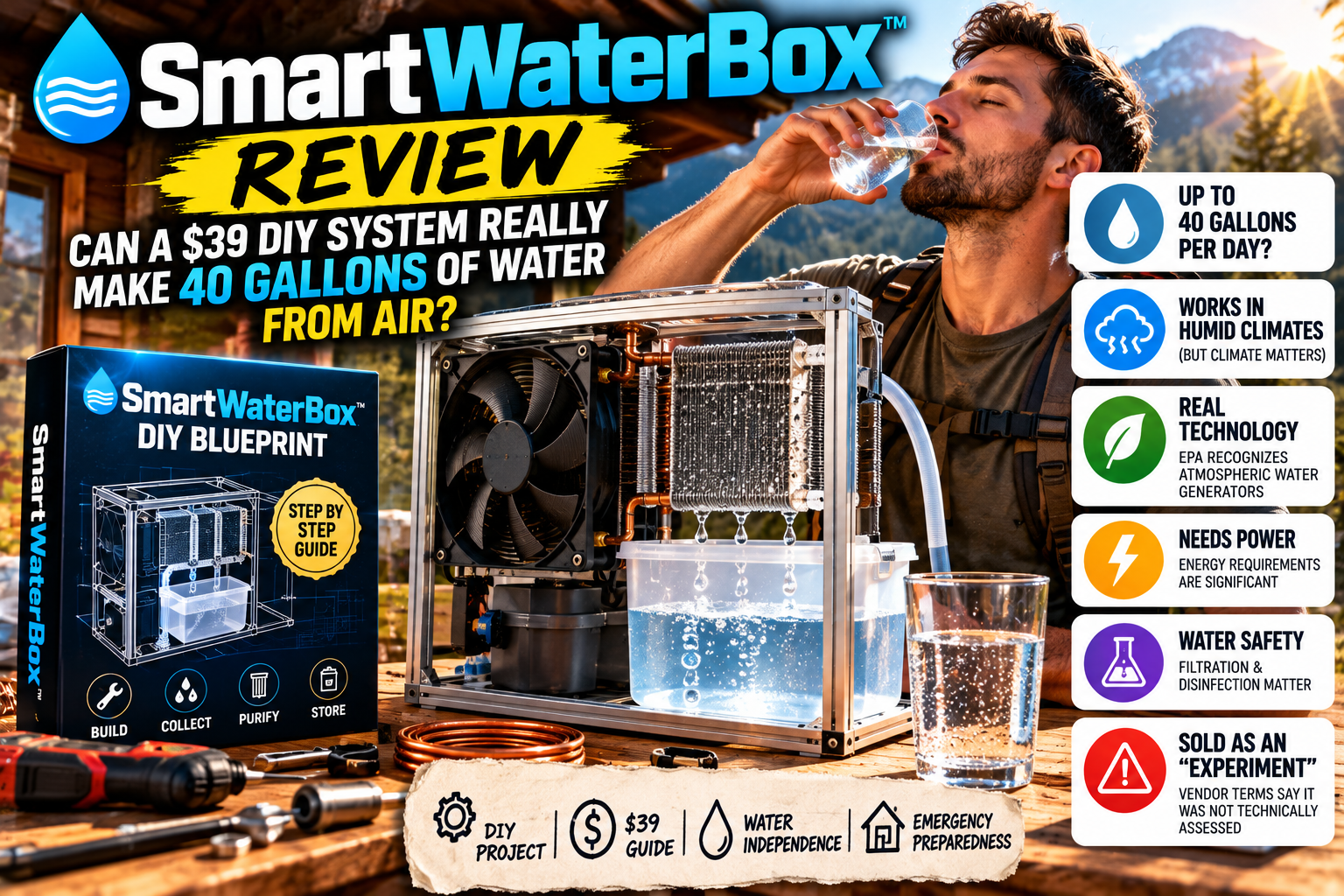
If you searched for a SmartWaterBox review after seeing claims that a homemade device can pull up to 40 gallons of clean drinking water from the air every day, there is something important you should know first:
Atmospheric water generation is real technology.
The U.S. Environmental Protection Agency has studied atmospheric water generators.
NASA recovers water from humidity condensate aboard the International Space Station.
Commercial machines can produce significant amounts of water directly from air.
So the idea itself is not science fiction.
But that doesn’t mean every claim made about a $39 DIY blueprint is automatically realistic.
SmartWaterBox currently says an ordinary person can build a system using inexpensive parts, complete it in roughly a weekend and potentially generate:
up to 40 gallons of water per day.
That’s approximately 151 liters.
And that number deserves careful scrutiny.
Water production from air depends heavily on:
- temperature;
- relative humidity;
- airflow;
- condenser efficiency;
- cooling capacity;
- power consumption;
- filtration;
- and system size.
In other words:
you cannot discuss water-from-air technology without discussing climate and energy.
That’s where this review begins.
- Personally Tested
- NO
- Research Type
- COMMUNITY RESEARCHED
- Official Product Materials Examined
- YES
- Official Terms & Disclaimer Examined
- YES
- Official Affiliate Materials Examined
- YES
- ClickBank Marketplace Data Examined
- YES
- EPA Atmospheric Water Research Examined
- YES
- 2026 Peer-Reviewed AWH Research Examined
- YES
- NASA Water Recovery Information Examined
- YES
- Independent First-Hand Buyer Evidence
- LIMITED / DIFFICULT TO VERIFY
- Affiliate Relationship
- YES
- Vendor Provided Access
- NO
- Last Researched
- September 2026
Quick Answer: Does SmartWaterBox Work?
The technology behind SmartWaterBox is legitimate, but we found insufficient independent evidence showing that this specific low-cost DIY design routinely produces the advertised 40 gallons per day.
Atmospheric water generators work by extracting water vapor from air.
The most common systems do this using cooling and condensation.
In principle, the process is similar to what happens inside:
- a dehumidifier;
- an air conditioner;
- or a cold drink covered in condensation on a humid day.
Cool humid air below its dew point and water condenses.
That part is basic physics.
The problem is scale.
Producing:
a glass of water
from humid air is one engineering problem.
Producing:
40 gallons every day
is a much larger one.
The EPA says typical home atmospheric water generators have historically produced around:
1 to 20 liters per day.
Commercial systems can produce hundreds or even thousands of liters.
So 151 liters per day is not physically impossible in the general technology category.
But output at that scale usually requires:
- substantial airflow;
- effective cooling;
- favorable humidity;
- energy;
- and significantly more hardware than a basic dehumidifier-style experiment.
Our early conclusion is therefore:
SmartWaterBox makes sense as a DIY atmospheric-water-generation project, but the 40-gallon-per-day headline should be treated as a best-case vendor claim rather than an expected result for every household.
Check the Current SmartWaterBox Offer
What Is SmartWaterBox?
SmartWaterBox is a digital DIY guide sold through ClickBank.
You are not buying a completed machine.
You are not receiving a commercial atmospheric water generator.
You are not receiving a device in the mail.
You receive:
digital instructions and blueprints.
The current seller describes the package as including:
- step-by-step construction instructions;
- blueprints;
- a materials list;
- tools guidance;
- water purification and storage information;
- troubleshooting guidance;
- lifetime support;
- and several bonuses.
The basic concept is to build a condensation-based atmospheric water generator.
The current sales narrative describes components such as:
- a condenser coil;
- fans;
- a collection tank;
- airflow components;
- and filtration or purification steps.
So the actual product is much easier to understand once you remove the dramatic marketing:
SmartWaterBox Is a DIY AWG Blueprint
AWG stands for:
Atmospheric Water Generator.
That is a legitimate technology category.
How Popular Is SmartWaterBox?
Very popular by current ClickBank standards.
The vendor nickname is:
WATERSB.
The latest September 2026 marketplace tracking we examined showed Gravity around:
90.6.
Average affiliate earnings were approximately:
$50 per sale.
SmartWaterBox was also ranking among the highest-selling Survival products tracked through ClickBank.
This tells us:
the offer is currently converting substantial affiliate traffic.
It does not tell us:
how many gallons of water the average buyer actually produces.
Gravity is a marketing metric.
Not an engineering test.
How Much Does SmartWaterBox Cost?
The default official funnel currently advertises:
$39 — one-time payment
The official affiliate area also shows that the vendor operates multiple sales funnels.
Current options include promotional pages built around:
- $39;
- $49;
- and $67.
The product itself also currently has exit offers.
We found official discount pages offering the guide for approximately:
$22
and in another funnel:
$19.79.
So don’t be surprised if two buyers report paying different amounts.
The Price Depends on the Funnel
The safest approach is simple:
judge the amount displayed on your actual ClickBank checkout.
For this review, we treat:
$39
as the standard advertised front-end price.
Is SmartWaterBox a Subscription?
The main product is currently presented as:
a one-time digital purchase.
The official sales copy explicitly says:
“No subscriptions.”
However:
SmartWaterBox has additional post-purchase offers.
Current official upsell pages include:
- a survival-related upgrade priced around $14.99;
- a 5-in-1 Smart Water Box Mega Pack priced around $39;
- and other funnel-specific upgrades.
These are optional additional purchases.
They are not required monthly fees for maintaining access to the core guide.
Does SmartWaterBox Have a Refund Policy?
Yes.
The official seller currently provides a:
60-day money-back guarantee.
The refund policy says customers can email support within the first 60 days and request their money back.
The seller says refunds typically appear within:
3 to 5 business days.
This guarantee covers the digital product purchase.
It obviously cannot refund money you independently spend buying:
- hardware;
- tools;
- filters;
- fans;
- compressors;
- containers;
- or other physical components.
That’s worth remembering before you buy hundreds of dollars in parts.
Is It Really Possible to Make Water From Air?
Absolutely.
This is not the controversial part of SmartWaterBox.
Air contains water vapor.
The amount depends on:
- temperature;
- humidity;
- atmospheric pressure;
- and weather conditions.
When humid air contacts a surface below its dew-point temperature:
water condenses.
The EPA explicitly recognizes atmospheric water generators as a real technology.
The agency explains that common AWGs use:
condenser and cooling-coil technology similar to a household dehumidifier.
There are also more advanced approaches using:
- desiccants;
- hygroscopic salts;
- metal-organic frameworks;
- radiative cooling;
- solar regeneration;
- and hybrid systems.
Atmospheric water harvesting is an active engineering research field.
NASA Really Does Recover Water From Humidity
The SmartWaterBox sales story heavily references NASA.
There is a kernel of truth behind that broader concept.
NASA’s International Space Station life-support system really does recover:
cabin humidity condensate.
Aboard the ISS, water vapor from:
- breathing;
- perspiration;
- and other cabin sources
is condensed and sent into a sophisticated water recovery and purification system.
NASA uses:
- condensing heat exchangers;
- water separators;
- filters;
- chemical treatment;
- and extensive quality monitoring.
So:
NASA does recover atmospheric moisture.
But that does not mean:
NASA developed or endorsed SmartWaterBox.
We found no NASA documentation mentioning the commercial product.
The space-station system is also far more sophisticated than a DIY weekend build.
Can SmartWaterBox Really Produce 40 Gallons Per Day?
This is the headline claim we think deserves the most scrutiny.
The official sales presentation repeatedly describes output of:
Up to 40 Gallons Per Day
Forty U.S. gallons is approximately:
151 liters.
That’s substantial.
EPA technical guidance says typical home-based atmospheric water generators historically produce around:
1 to 20 liters per day.
Commercial systems can produce:
hundreds or thousands of liters per day.
So 151 liters is absolutely possible for atmospheric-water technology in general.
But that doesn’t mean a small DIY unit can generate that amount under all conditions.
What Does Current Research Say About Water Output?
A major 2026 scientific review compared multiple atmospheric water harvesting technologies across different climates.
For active condensation systems, researchers reported dramatically different output depending on conditions.
At approximately:
30°C and 80% relative humidity
— a warm tropical environment — modeled condensation systems could produce roughly:
58 to 90 liters per day.
At:
30°C and 20% relative humidity
— an arid environment — production could fall below:
5 liters per day.
That’s more than a tenfold difference.
Same underlying technology category.
Completely different climate.
This is why statements like:
“40 gallons every day anywhere”
need qualification.
Humidity Changes Everything
Relative humidity is one of the biggest variables in atmospheric water generation.
Warm humid air contains far more recoverable water than cold or dry air.
A recent engineering review showed atmospheric water systems becoming dramatically more energy-efficient as humidity increases.
That’s basic thermodynamics.
If air is already close to saturation:
you don’t need to cool it very far before condensation begins.
If air is extremely dry:
you need to process much more air and/or cool it much more aggressively.
Both cost energy.
Phoenix Is Not Florida
The SmartWaterBox sales copy says the system can help people living in very different places, including dry regions.
But climate matters enormously.
Imagine two locations:
Hot and Humid
Air contains large amounts of water vapor.
Condensation can occur with less cooling.
Water production can be relatively high.
Hot and Dry
There may still be water in the air.
But extracting meaningful volumes becomes significantly more difficult.
Advanced sorbent-based technologies can improve low-humidity water capture.
But simple condenser systems generally perform much better in humid environments.
That’s why:
location should be one of the first questions you ask before building any atmospheric water system.
How Much Energy Does Water From Air Require?
This is the second major issue.
The sales message emphasizes:
water independence.
But condensation doesn’t happen for free.
Cooling humid air below the dew point requires energy.
You also need energy for components such as:
- fans;
- compressors;
- pumps;
- controls;
- UV treatment if used;
- and potentially water circulation.
The EPA explicitly notes that atmospheric water generators can require:
significant quantities of energy
to operate condenser and fan systems.
Recent scientific reviews report huge variation depending on:
- technology;
- climate;
- temperature;
- relative humidity;
- airflow;
- and system efficiency.
That means:
“free water from air” does not necessarily mean zero operating cost.
What Happens During a Power Outage?
This is especially important because SmartWaterBox is marketed heavily as an emergency product.
The sales story describes having water available during grid failure.
That is possible if:
- water was generated and stored beforehand;
- the device uses an independent battery system;
- solar power is available;
- a generator supplies electricity;
- or another off-grid energy source powers the system.
But a conventional active condensation system using fans and refrigeration:
needs power while producing water.
So:
water independence and energy independence are separate engineering problems.
If emergency power is part of your goal, ask exactly what will power the SmartWaterBox when the utility grid is unavailable.
Can You Really Build It for Under $110?
The current official sales presentation says the author’s build cost:
less than $106.
The FAQ then says buyers purchasing components new can potentially stay:
under $110.
It also claims some users spend less by scavenging parts.
That’s possible if you already have access to:
- old refrigeration components;
- fans;
- containers;
- tubing;
- tools;
- and reusable hardware.
But the true build cost depends heavily on what the design actually requires.
For example, purchasing new:
- compressors;
- heat exchangers;
- food-safe storage;
- filters;
- UV treatment;
- electrical controls;
- and pumps
can quickly exceed the price of the guide.
We did not find an independent standardized bill of materials proving every buyer can build the system for $110 or less.
So treat that amount as:
a vendor-reported build target rather than a guaranteed project budget.
Is Water Collected From Air Automatically Safe to Drink?
No.
This is one of the most important misconceptions around atmospheric water generation.
Condensation can look extremely clean.
That does not automatically make it potable.
The EPA has studied water produced by atmospheric water generators and found an important issue:
airborne volatile organic compounds can dissolve into condensate.
Water systems can also develop microbial growth after collection.
EPA testing of a commercial AWG found generally high-quality water, but researchers still detected elevated heterotrophic bacterial counts.
The commercial system therefore included treatment and disinfection steps.
Air Quality Affects Water Quality
If the surrounding air contains:
- smoke;
- solvents;
- industrial contaminants;
- volatile organic compounds;
- or other pollutants,
those conditions can affect collected condensate.
This is particularly important because SmartWaterBox is marketed as protection during:
- wildfires;
- chemical contamination;
- infrastructure failures;
- and disasters.
A contaminated municipal water supply does not automatically mean atmospheric collection is unsafe.
But:
a contaminated atmosphere should not be assumed to produce perfectly clean condensate either.
Filtration, Disinfection and Storage Matter
A drinking-water AWG should consider:
- air filtration;
- food-safe surfaces;
- sediment filtration;
- activated-carbon treatment where appropriate;
- microbial control;
- UV or another disinfection method;
- clean storage;
- and regular maintenance.
Water sitting inside a warm storage tank can develop microbial growth if the system is poorly maintained.
For drinking purposes, we would also want:
actual water-quality testing.
“Clear” is not the same thing as:
“tested safe.”
Water safety note: Condensed atmospheric water should not automatically be assumed safe for drinking simply because it looks clean. Air quality, system materials, filtration, disinfection, storage and maintenance all affect water quality. If you’re relying on a DIY AWG for drinking water, proper treatment and testing matter.
Who Is James Anderson?
The current SmartWaterBox sales presentation identifies its author as:
James Anderson.
But the official website itself says:
James Anderson is a pen name.
The sales story describes:
- an uncle;
- military documents;
- classified technology;
- submarines;
- NASA;
- water shortages;
- and suppressed research.
It’s a dramatic narrative.
But another section of the official website contains an unusually important disclaimer.
The site says:
the story and presentation were created strictly for promotional purposes.
That means we would not treat the story of:
- secret military files;
- suppressed patents;
- missing researchers;
- or government efforts to bury the technology
as independently verified historical fact.
The actual atmospheric water technology does not need that story anyway.
The technology exists without a conspiracy.
NASA Does Not Prove SmartWaterBox
The sales presentation repeatedly refers to:
NASA technology.
NASA genuinely recovers cabin humidity aboard the ISS.
But the space-station system includes:
- condensing heat exchangers;
- water separators;
- complex water processors;
- filtration;
- chemical treatment;
- quality testing;
- and sophisticated controls.
We found no evidence that NASA:
- developed SmartWaterBox;
- tested SmartWaterBox;
- endorsed SmartWaterBox;
- or certified the $39 blueprint.
The accurate statement is:
NASA uses humidity-condensation and water-recovery technology.
That’s not the same as:
NASA validated this commercial DIY product.
The SmartWaterBox Terms Call the Product an “Experiment”
This may be the most important transparency finding in the entire review.
The current SmartWaterBox Terms & Conditions state that:
the product is an experiment.
They also say it:
“was not technically assessed.”
The terms further say the product has not been:
- individually produced;
- small-scale produced;
- or mass-produced.
That is a surprisingly strong disclaimer.
And it creates a tension with the sales page.
The marketing talks about:
- thousands of users;
- life-changing results;
- a functioning field-tested system;
- and broad household use.
Meanwhile, the legal terms describe:
an experiment that was not technically assessed.
Both statements appear inside the same official ecosystem.
We Would Take the Terms Seriously
If the company itself labels the design experimental:
buyers should evaluate it as experimental.
That means:
build it;
measure it;
test the water;
and verify performance in your climate.
Do not treat the 40-gallon headline as a certified output specification.
What About “50,000+ Reviews”?
The current official page prominently displays:
“Based on 50,000+ reviews!”
We could not find an independent review platform containing 50,000 verified SmartWaterBox purchaser reviews.
We also noticed something unusual in the official sales page’s image assets.
Some testimonial image filenames visibly include:
“ChatGPT Image”
followed by creation dates.
That does not by itself prove that the written testimonials are fabricated.
An image could simply have been generated later to visually represent a real testimonial.
But it absolutely means:
we should not treat those photographs as independent photographic verification of the people quoted.
And without access to the underlying customer database:
we cannot independently verify the “50,000+ reviews” number.
What About the “47,537 Families” Claim?
The current official page also says approximately:
47,537 families
have discovered how to build their own water source.
Again:
that number is presented by the vendor.
We cannot independently audit it.
The ClickBank Gravity does confirm that the offer currently sells well.
But marketplace sales activity does not independently establish the exact lifetime buyer count.
What Do Real SmartWaterBox Users Actually Say?
This was more difficult than expected.
There are already many pages online titled:
- SmartWaterBox Review;
- SmartWaterBox Reviews;
- Smart Water Box Consumer Reports;
- SmartWaterBox Customer Reviews;
- Does SmartWaterBox Work?;
- and similar variations.
But many are clearly:
- affiliate articles;
- SEO pages;
- syndicated content;
- or promotional pages.
Some describe precise build costs and output numbers.
Others simply repeat the vendor’s specifications.
We did not find enough independently verifiable buyer builds with:
- temperature;
- humidity;
- power consumption;
- daily water output;
- water-quality testing;
- and exact build specifications
to calculate a trustworthy average performance figure.
That is why we are not going to tell you:
“The average customer produces 31.6 gallons per day.”
We do not have credible evidence for that number.
How Would You Properly Test SmartWaterBox?
A genuinely useful test would record:
- ambient temperature;
- relative humidity;
- hours of operation;
- electricity consumed;
- liters of water produced;
- filter configuration;
- system dimensions;
- and water-quality results.
Then calculate:
liters produced per kilowatt-hour.
That would allow buyers in different climates to make meaningful comparisons.
Without those measurements:
“it made water”
doesn’t tell us enough.
A dehumidifier makes water too.
The key question is:
how efficiently and how much?
Could You Build an AWG Using Free Information?
Yes.
Atmospheric water generation is not proprietary to SmartWaterBox.
You can find free information on:
- dew point;
- refrigeration;
- dehumidification;
- condensation;
- water treatment;
- desiccant systems;
- and DIY atmospheric water collection.
You can also buy ordinary dehumidifiers and modify collection systems.
So the $39 value proposition is primarily:
organization.
You’re paying for somebody to package:
- a specific build;
- parts guidance;
- assembly instructions;
- purification guidance;
- and troubleshooting
into one sequence.
For someone who enjoys researching everything themselves, that may not be worth much.
For a beginner who wants one project to follow, it may be more useful.
See What’s Included in SmartWaterBox
SmartWaterBox vs a Dehumidifier
At a basic physics level, a condensation-based atmospheric water generator has a lot in common with a dehumidifier.
Both:
- pull air across a cold surface;
- condense moisture;
- and collect water.
The major difference is:
water treatment and intended use.
A household dehumidifier is not normally designed to produce drinking water.
Its:
- coils;
- collection tank;
- internal surfaces;
- and microbial controls
may not be designed for potable-water standards.
A drinking-water AWG needs additional attention to:
- materials;
- filtration;
- disinfection;
- storage;
- and sanitation.
SmartWaterBox vs Rainwater Harvesting
These systems solve different problems.
Rainwater harvesting depends on:
rain.
Atmospheric water generation depends on:
air moisture and energy.
Rainwater can potentially provide very large volumes during storms with relatively little energy input.
But:
- you need collection area;
- storage tanks;
- and rainfall.
AWGs can produce water between rainfall events.
But:
- production varies with humidity;
- energy consumption can be significant;
- and daily output may be limited.
For serious resilience planning, multiple water sources are generally more robust than relying on one.
SmartWaterBox vs Stored Emergency Water
This is another important comparison.
Stored water is:
- simple;
- immediate;
- doesn’t require electricity;
- and has predictable volume.
Its weakness is finite supply.
An AWG theoretically provides ongoing production.
Its weakness is dependence on:
- environmental conditions;
- equipment;
- maintenance;
- and often power.
That makes an AWG potentially useful as:
one layer of a water plan.
We would be much more cautious treating it as:
the only emergency water source.
The Biggest Positive We Found
The central technology is unquestionably real.
This is not a product built around an imaginary physical effect.
Atmospheric water harvesting:
- works;
- has been studied extensively;
- is commercially deployed;
- is used in disaster and remote-water applications;
- and continues to improve.
The SmartWaterBox price is also relatively low compared with buying a finished commercial AWG.
For someone who wants:
a structured DIY project to experiment with atmospheric water generation,
we can understand the appeal.
The Biggest Problem We Found
The marketing treats:
“water can be extracted from air”
almost as if it automatically proves:
“this inexpensive home system will produce 40 gallons per day wherever you live.”
It doesn’t.
Output depends on:
- climate;
- machine capacity;
- power;
- airflow;
- system design;
- and treatment configuration.
The 40-gallon claim therefore needs:
specific test conditions.
Without them, “up to” can describe a best-case result that has little relationship to what a buyer in a dry climate experiences.
The Second Biggest Problem: The Seller’s Own Disclaimer
The current SmartWaterBox terms say the product:
“is an experiment.”
and:
“was not technically assessed.”
That is not something an independent critic wrote.
It’s on the vendor’s own website.
That single disclosure should fundamentally shape expectations.
An experimental project can still:
- work;
- be educational;
- produce useful water;
- and be worth $39.
But:
experimental output claims should not be treated like certified appliance specifications.
The Third Biggest Problem: The Marketing Story
The sales presentation involves:
- classified military files;
- secret programs;
- government suppression;
- NASA;
- submarines;
- silenced researchers;
- and disappearing technology.
The website itself also states:
the story and presentation were created strictly for promotional purposes.
That makes our editorial approach straightforward:
ignore the thriller story and evaluate the engineering.
The engineering is interesting enough by itself.
Who Might Find SmartWaterBox Useful?
DIY Preppers
Atmospheric water generation is genuinely relevant to emergency-water planning.
Homesteaders
People already experimenting with:
- solar;
- rainwater;
- off-grid systems;
- and water storage
may find AWG experimentation interesting.
People in Warm, Humid Climates
This is where condensation-based atmospheric harvesting tends to perform best.
Electronics and HVAC DIYers
People familiar with cooling, airflow and basic electrical systems are better positioned to understand and improve the build.
People Who View $39 as Education
If the project itself is worth $39 to you even if output is lower than advertised, the risk becomes easier to justify.
Who Probably Shouldn’t Buy SmartWaterBox?
Someone Expecting a Physical Device
You receive digital instructions.
You build the device yourself.
Someone Expecting Guaranteed 40 Gallons Per Day
Climate and system performance make that expectation unrealistic as a universal guarantee.
Someone in a Very Dry Climate Who Needs Large Output
Conventional condensation-based atmospheric water generation becomes much less productive as humidity falls.
Someone Who Needs a Certified Emergency Water Source
An experimental DIY build should not automatically replace tested emergency water storage.
Someone Who Plans to Drink Untreated Condensate
Potable-water safety requires more than simply collecting droplets.
Is SmartWaterBox Legit?
Again, this is best divided into two questions.
Is SmartWaterBox a Real Product?
Yes.
There is:
- an active official website;
- a ClickBank vendor;
- a defined $39 digital product;
- instant digital delivery;
- affiliate infrastructure;
- a refund policy;
- and current marketplace activity.
Are the Output Claims Independently Validated?
Not to the level we would want.
The seller itself describes the product as experimental and not technically assessed.
We found no independent product-specific engineering report establishing:
40 gallons per day as a typical or reliably reproducible output.
So:
transaction legitimacy
and:
technical validation
should not be confused.
Our Conclusion: Is SmartWaterBox Worth It?
SmartWaterBox is easier to evaluate once you separate three different claims.
Claim 1: Water can be extracted from air.
True.
The EPA, NASA and decades of atmospheric-water research establish that clearly.
Claim 2: A DIY device can be built to collect atmospheric water.
Also true in principle.
Condensation systems can be built from relatively accessible components.
Claim 3: This specific inexpensive DIY build will reliably produce up to 40 gallons of drinking water per day for ordinary homeowners.
That is where the evidence becomes much weaker.
Forty gallons is approximately 151 liters.
That’s a serious amount of water.
Current atmospheric-water research shows that:
- high humidity can produce substantial yields;
- low humidity can reduce output dramatically;
- active systems consume meaningful energy;
- and water quality still requires attention.
The official SmartWaterBox website also contains two disclosures that we think buyers should know:
“James Anderson” is a pen name.
And:
the product’s own terms describe it as an experiment that was not technically assessed.
Those facts do not mean the project cannot work.
They do mean the marketing should be interpreted cautiously.
Our Simplest Conclusion
SmartWaterBox is based on legitimate atmospheric-water technology, but its 40-gallon-per-day headline appears far more aggressive than the independent evidence available for this specific low-cost DIY design.
If you’re buying because:
“I want a $39 blueprint for experimenting with water-from-air technology and I’ll measure the results myself,”
the product may be interesting.
If you’re buying because:
“I am guaranteed 40 gallons of free drinking water every day, even in a dry climate or blackout,”
the evidence does not support that expectation.
And if the resulting water will be used for drinking:
filtration, disinfection, clean storage and actual water-quality testing matter just as much as making the condensation appear.
Check the Current SmartWaterBox Offer & Price
Affiliate disclosure: If you purchase through this link, TestimonialBlogs may earn a commission at no additional cost to you. Affiliate revenue helps fund future product investigations. It does not change what we report.
SmartWaterBox FAQ
What is SmartWaterBox?
SmartWaterBox is a digital DIY blueprint sold through ClickBank. It teaches users how to build an atmospheric water generator designed to condense moisture from surrounding air. Buyers receive instructions rather than a finished physical machine.
How much does SmartWaterBox cost?
The default official offer we checked in September 2026 lists $39 as a one-time purchase. The seller operates multiple funnels and official discount pages, so some buyers may see other prices.
Is SmartWaterBox a subscription?
The core product is sold as a one-time digital purchase. The funnel includes optional post-purchase offers, but the main $39 guide is not presented as a required monthly subscription.
Does SmartWaterBox have upsells?
Yes. The official vendor currently operates additional post-purchase offers, including survival and upgrade packages. These should be evaluated separately from the core guide.
Does SmartWaterBox have a money-back guarantee?
Yes. The current official refund policy provides a 60-day money-back period for the digital product.
Can you really make water from air?
Yes. Atmospheric water generation is a real technology. Cooling humid air below its dew point causes water vapor to condense. Commercial atmospheric water generators and advanced water-harvesting systems already exist.
Can SmartWaterBox produce 40 gallons per day?
The vendor markets output of up to 40 gallons per day. We did not find independent product-specific testing establishing that amount as typical or reliably reproducible. Atmospheric-water output depends heavily on temperature, humidity, airflow, machine size and energy input.
Does humidity affect SmartWaterBox?
Yes. Humidity is one of the most important factors in atmospheric water harvesting. Warm, humid conditions generally produce much more water and require less energy per liter than dry conditions.
Will SmartWaterBox work in a desert?
Water can be extracted from low-humidity air, but conventional condensation systems become significantly less productive and more energy intensive as humidity falls. Advanced sorbent technologies are better suited to some arid environments.
Does SmartWaterBox work during a power outage?
An active condensation system needs energy to run components such as fans and refrigeration equipment. It could operate during an outage if supplied by batteries, solar, a generator or another independent power source, or if water had already been stored beforehand.
Is water from an atmospheric water generator safe to drink?
It can be made potable, but untreated condensate should not automatically be assumed safe. Airborne contaminants, microbial growth, system materials and storage conditions can affect water quality. Filtration, disinfection and proper maintenance matter.
Does NASA use water-from-air technology?
NASA recovers cabin humidity condensate aboard the International Space Station and processes it into potable water through a sophisticated water-recovery system. We found no evidence that NASA developed or endorsed SmartWaterBox.
Who is James Anderson?
The SmartWaterBox sales presentation uses the name James Anderson. The official website states that this is a pen name used to keep the author anonymous.
Has SmartWaterBox been technically tested?
The current official Terms & Conditions describe the product as “an experiment” and say it “was not technically assessed.” We therefore think buyers should treat performance claims as experimental rather than certified equipment specifications.
Can you build SmartWaterBox for under $110?
The current sales presentation says the system can potentially be built for under approximately $110, especially when salvaging parts. We did not find an independent bill-of-materials study establishing that as a universal cost.
Is SmartWaterBox worth $39?
It may be worthwhile for DIY-minded users who want a structured atmospheric-water-generation project and understand that actual output will depend heavily on climate and build quality. It is less suitable for someone expecting a guaranteed 40 gallons per day or a finished certified emergency-water appliance.
Sources and Methodology Notes
This investigation compared SmartWaterBox’s current official sales materials, terms, refund policy and affiliate information with ClickBank marketplace tracking, U.S. EPA atmospheric-water research, NASA water-recovery information and recent peer-reviewed atmospheric water harvesting studies.
Representative sources examined include:
- SmartWaterBox official sales presentation
- SmartWaterBox official Terms & Conditions
- SmartWaterBox official refund policy
- SmartWaterBox official affiliate program
- SmartWaterBox current upsell and discount pages
- CBSnooper marketplace tracking for vendor WATERSB
- U.S. EPA Atmospheric Water Generation Technology technical brief
- 2026 Applied Thermal Engineering review of atmospheric water harvesting
- 2026 Next Energy review of atmospheric water harvesting technologies and economics
- NASA Environmental Control and Life Support System information
- NASA documentation on ISS humidity condensate recovery
- public SmartWaterBox review and buyer-discussion pages
Why TestimonialBlogs Calls This “Community Researched”
We did not purchase SmartWaterBox, build the unit and run a controlled test across multiple climates before publishing this review.
So we are not going to tell you:
“We got exactly 37 gallons per day.”
We didn’t.
We also won’t claim:
“Water from air is impossible.”
That would be demonstrably false.
Instead, we separated questions that are often mixed together:
1. Is atmospheric water generation real?
Yes.
2. Can a DIY system condense water from air?
Yes.
3. Is water production highly dependent on humidity and temperature?
Yes.
4. Does collected water require attention to purification and storage?
Yes.
5. Does all of that prove this particular $39 blueprint reliably produces 40 gallons every day?
No.
That final claim requires product-specific testing.
We also examined:
- the current price;
- the different vendor funnels;
- refund terms;
- upsells;
- creator transparency;
- the seller’s own experimental-product disclaimer;
- the 50,000+ review claim;
- EPA data;
- NASA humidity-condensate recovery;
- current AWH performance research;
- and water-safety concerns.
The result is much more useful than either extreme.
Water from air is real.
Forty gallons from a cheap DIY box is a separate engineering claim.
That’s the distinction buyers need to understand.