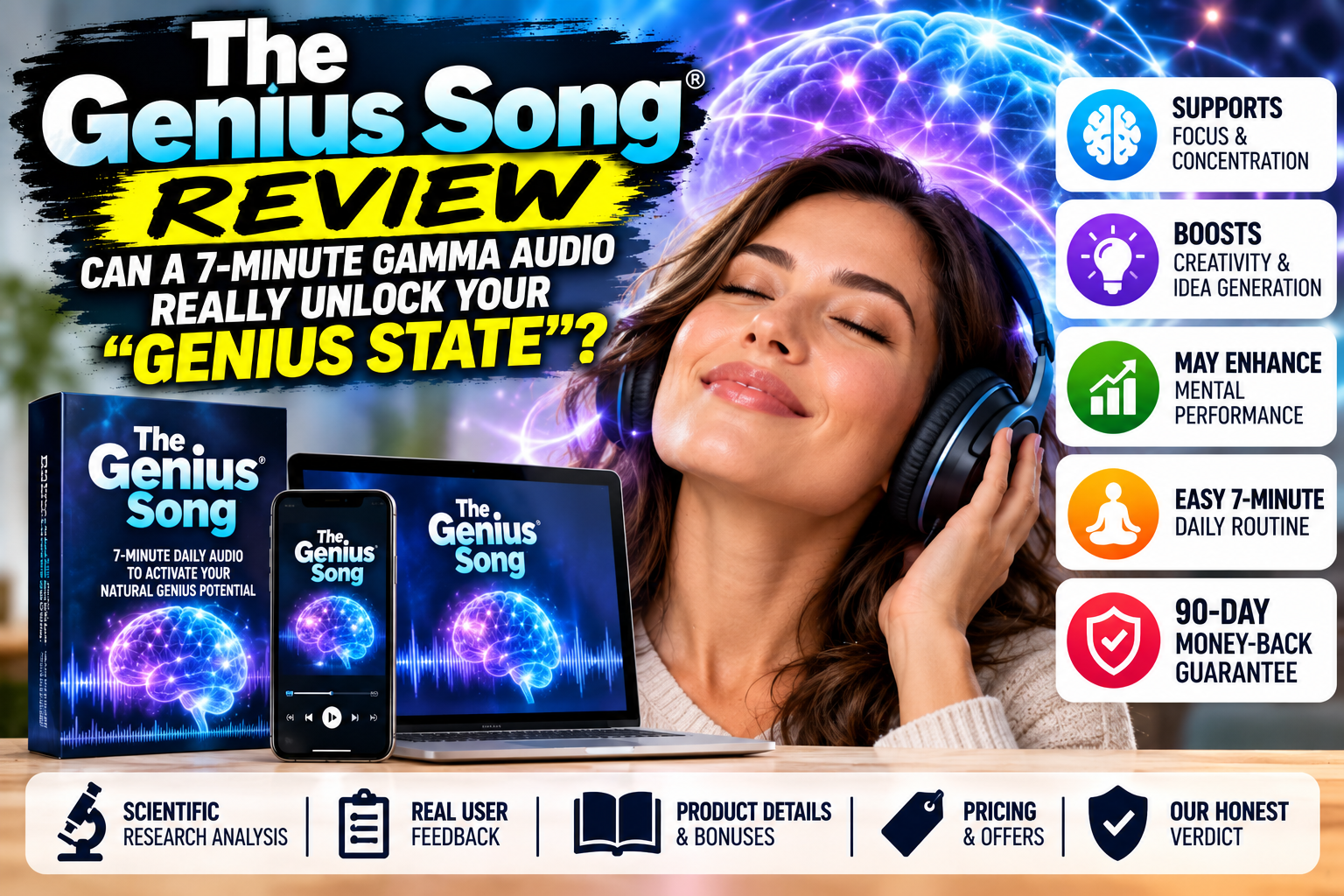
If you searched for The Genius Song review after seeing claims that seven minutes of audio can reactivate a “genius” brainwave most adults have lost, there is one fact worth understanding before buying:
Gamma brainwaves are real.
Auditory brainwave entrainment is real.
Researchers have studied 40 Hz and other gamma-frequency stimulation in humans.
Some experiments have reported improvements in:
- attention;
- working memory;
- reaction time;
- and other narrowly defined cognitive tasks.
But there is a very large difference between:
“Gamma-frequency stimulation can affect measurable brain activity.”
and:
“Most adults have a suppressed genius brainwave that this specific $39 audio reliably restores in seven minutes.”
The first statement belongs to legitimate neuroscience.
The second is a commercial claim that requires product-specific evidence.
That distinction became the center of our investigation.
The Genius Song is currently one of the strongest digital offers on ClickBank.
It has been promoted using ideas involving:
- gamma waves;
- brainwave entrainment;
- creativity;
- “genius potential”;
- NASA;
- neuroplasticity;
- and a short daily listening routine.
The product itself is considerably simpler:
a downloadable audio program.
So we investigated exactly where the neuroscience ends and the marketing begins.
- Personally Tested
- NO
- Research Type
- COMMUNITY RESEARCHED
- Current Product Materials Examined
- YES
- ClickBank Data Examined
- YES
- Affiliate Funnel Information Examined
- YES
- 2025 Auditory Gamma Systematic Review Examined
- YES
- 2025–2026 Gamma Research Examined
- YES
- NASA / Creativity Story Investigated
- YES
- Product-Specific Clinical Trial Found
- NO
- Creator Identity Independently Verified
- NO
- Independent Buyer Evidence
- LIMITED / DIFFICULT TO AUTHENTICATE
- Affiliate Relationship
- YES
- Vendor Provided Access
- NO
- Last Researched
- September 2026
Important: The Genius Song is a consumer digital audio program, not a medical device or treatment for memory loss, dementia, ADHD or another neurological condition. Persistent cognitive problems should be appropriately evaluated rather than self-treated with an audio product.
Quick Answer: Does The Genius Song Work?
The Genius Song is a real $39 digital audio program built around genuine areas of brainwave research, but we found no independent clinical trial demonstrating that this specific audio reliably activates a dormant “genius state” or produces the broad life improvements suggested by its marketing.
There is real evidence showing that rhythmic sensory stimulation can alter measurable brain activity.
Recent research has investigated:
- 40 Hz auditory stimulation;
- binaural beats;
- gamma entrainment;
- attention;
- working memory;
- and cognitive decline.
A large 2025 systematic review examined:
62 studies involving 2,179 participants.
The researchers found promising cognitive and biological effects in some experiments.
But they also reported:
- substantial methodological variation;
- different responses between individuals;
- different stimulation protocols;
- and several studies showing no measurable cognitive benefit.
That is much more complicated than:
“gamma audio makes you smarter.”
More importantly:
those 62 studies were not clinical tests of The Genius Song.
So our early conclusion is:
The Genius Song makes more sense as a low-cost brainwave-audio experiment than as a scientifically validated switch for genius-level cognition.
Check the Current Genius Song Offer
What Is The Genius Song?
The Genius Song is a digital audio self-improvement program sold through ClickBank.
Current descriptions characterize the program as using:
- brainwave entrainment;
- gamma-frequency stimulation;
- structured audio frequencies;
- and in some versions, subliminal or mindset elements.
The recommended routine is approximately:
seven minutes per day.
You do not receive:
- a brain-stimulation machine;
- EEG equipment;
- medication;
- a supplement;
- or a physical product.
You receive:
digital audio access.
Current versions of the funnel also advertise digital bonus material related to subjects such as:
- visualization;
- mindset;
- wealth;
- focus;
- and personal development.
The exact bonus package can change between funnels.
How Popular Is The Genius Song?
Very popular.
The ClickBank vendor nickname is:
GENIUSBR.
The latest marketplace snapshot we examined in late September 2026 showed Gravity around:
85.
with average affiliate earnings of roughly:
$52 per sale.
The product has previously reached a Gravity above:
500.
during an earlier peak.
ClickBank ranked The Genius Song as its:
#1 offer in June 2026.
ClickBank also says the funnel was created by a marketer whose broader product portfolio has generated close to:
$100 million in sales.
Again:
commercial success is not clinical validation.
What these numbers tell us is simply:
The Genius Song is an extremely well-optimized direct-response offer.
How Much Does The Genius Song Cost?
The current price we found most consistently is:
$39 — one-time purchase
Current product pages typically display higher reference prices such as:
- $49;
- $197;
- $200;
- or more
before presenting the $39 checkout offer.
We treat those as:
marketing reference prices.
The number that matters is:
the amount shown at your actual ClickBank checkout.
Is The Genius Song a Subscription?
The core product is generally presented as:
a one-time $39 digital purchase.
However, current marketplace tracking shows a small:
average rebill amount.
And ClickBank explicitly describes The Genius Song as having an:
upsell funnel.
That means the broader customer journey can include additional products, and at least some backend purchases may involve recurring billing.
This does not mean:
the original $39 audio automatically becomes a subscription.
It means:
read every additional checkout page carefully before accepting another offer.
Does The Genius Song Have a Money-Back Guarantee?
Current product materials most consistently advertise a:
90-day money-back guarantee.
Some unofficial or older pages contain inconsistent guarantee periods.
For that reason:
save the terms displayed on the actual offer you purchase.
Current 2026 product pages repeatedly describe refunds as available through the seller or ClickBank within the published guarantee period.
Keep:
- your ClickBank receipt;
- order number;
- checkout price;
- and guarantee terms.
The “7-Second Brain Trick” vs the Actual 7-Minute Routine
This is one of the clearest marketing distinctions we found.
Some advertising around The Genius Song uses phrases like:
“7-second brain trick.”
But the actual product routine described by ClickBank is:
approximately seven minutes per day.
Those are not the same thing.
A seven-second hook is:
advertising language.
A seven-minute audio is:
the actual user protocol.
Seven minutes is still very short.
But the distinction matters because someone clicking an ad may reasonably expect:
seven seconds.
That’s not what the product itself requires.
What Are Gamma Brainwaves?
The brain contains networks of neurons whose activity can show rhythmic electrical patterns.
Researchers commonly describe several broad frequency bands:
- delta;
- theta;
- alpha;
- beta;
- and gamma.
Gamma generally refers to relatively high-frequency oscillatory activity above approximately:
30 Hz.
Gamma activity has been associated with processes involving:
- attention;
- working memory;
- sensory integration;
- learning;
- perception;
- and information processing.
That means there is a legitimate reason researchers are interested in gamma.
But association does not mean:
more gamma = more intelligence.
Brain activity is not a volume knob where you simply turn up one frequency and become smarter.
What Is Brainwave Entrainment?
Brainwave entrainment refers broadly to the use of rhythmic external stimulation designed to influence or synchronize neural activity.
Stimuli can involve:
- sound;
- light;
- combined audiovisual stimulation;
- binaural beats;
- monaural beats;
- or amplitude-modulated audio.
Researchers can measure responses using:
- EEG;
- MEG;
- brain imaging;
- behavioral tests;
- and other methods.
The phenomenon itself is real.
The more difficult questions are:
- how large the effect is;
- how long it lasts;
- whether it changes behavior;
- which frequency is best;
- how individuals differ;
- and whether one commercial audio can reliably reproduce laboratory effects.
What Does Current Gamma Research Actually Show?
A comprehensive 2025 systematic review examined:
62 studies
of auditory or audiovisual gamma stimulation involving:
2,179 participants.
The results were interesting.
Some studies reported:
- better reaction time;
- improved working-memory accuracy;
- reduced errors;
- changes in brain oscillations;
- and other cognitive or biological effects.
Other studies found:
- no improvement in word recall;
- no change in digit-span performance;
- no improvement in some attention tasks;
- and no measurable effect on some visuospatial outcomes.
The reviewers emphasized:
heterogeneity.
In plain English:
different studies get different results.
Individual Differences Matter
The same 2025 review identified:
16 different characteristics
that may influence responses to gamma stimulation.
That includes factors related to:
- biology;
- cognition;
- lifestyle;
- age;
- neurodevelopment;
- and clinical condition.
The researchers also highlighted an important emerging idea:
the optimal stimulation frequency may not be identical for everybody.
This matters enormously for a commercial audio.
If different brains respond optimally to different gamma frequencies:
one universal seven-minute track cannot automatically be assumed ideal for every listener.
Does 40 Hz Stimulation Improve Attention?
There is promising evidence.
A recent study involving:
62 healthy adults
compared one hour of:
- 40 Hz audiovisual stimulation;
- control stimulation;
- and randomized sham stimulation.
The 40 Hz group showed:
- better accuracy;
- faster reaction times;
- and measurable changes in brain activity associated with attention.
That’s meaningful research.
But notice the differences:
The experiment used:
one hour.
The Genius Song recommends:
about seven minutes.
The experiment used:
a defined laboratory protocol.
The Genius Song uses:
a proprietary commercial audio.
Those differences matter.
Is Seven Minutes Enough?
This is one of the most important unanswered questions.
The product’s greatest commercial advantage is:
seven minutes per day.
That’s easy to fit into a routine.
But many research protocols use:
- 20 minutes;
- 30 minutes;
- one hour;
- or repeated daily exposure over weeks.
We found no independent study directly testing:
seven minutes of The Genius Song
against:
- silence;
- a placebo audio;
- ordinary music;
- or another gamma track.
So:
seven minutes may be convenient, but convenience is not evidence of an optimal neurological dose.
Gamma Research Is Not The Genius Song Research
This is probably the single most important sentence in this review.
A researcher can demonstrate:
gamma stimulation affects the brain.
That does not automatically demonstrate:
The Genius Song affects the brain in the same way.
Why?
Because outcomes can depend on:
- exact frequency;
- carrier tone;
- amplitude;
- modulation;
- headphones;
- duration;
- volume;
- participant characteristics;
- and protocol design.
We were unable to find:
a peer-reviewed product-specific clinical trial.
That’s the missing step.
What About the 40 Hz Alzheimer’s Research?
This research receives significant attention online.
And there is legitimate science here.
A 2025 systematic review and meta-analysis examined:
11 controlled studies involving 341 people
with Alzheimer’s disease or mild cognitive impairment.
The researchers found some measurable structural brain changes.
But:
they did not find a significant overall improvement in cognitive function.
They also found no significant improvement in:
activities of daily living.
The review concluded that more rigorous trials are needed.
This is a powerful reality check.
Even sophisticated clinical gamma-stimulation research does not produce a simple:
“40 Hz fixes cognition.”
So a consumer MP3 should certainly not be treated as proven neurological therapy.
What About the NASA “98% of Children Were Geniuses” Claim?
This is probably the most interesting fact-check in the entire article.
The Genius Song marketing references a famous story claiming:
98% of young children scored at “genius level.”
As they grew older, that percentage supposedly fell dramatically.
The research is associated with:
George Land.
Land conducted longitudinal creativity testing beginning in the late 1960s.
The famous figures commonly reported are approximately:
- 98% at ages 4–5;
- 30% around age 10;
- 12% around age 15;
- and around 2% among adults.
But here is the critical distinction:
This Was Not a Gamma-Brainwave Study
The assessment measured:
divergent thinking and creative problem-solving.
It did not measure:
- EEG;
- gamma waves;
- theta waves;
- brainwave entrainment;
- or responses to audio.
So:
98% scoring highly on a creativity assessment
does not establish:
98% of children naturally possess a measurable “genius gamma frequency” that adults lose.
That bridge is marketing interpretation.
Did NASA Develop The Genius Song?
No evidence we found supports that interpretation.
NASA has conducted or supported enormous amounts of research involving:
- human performance;
- cognition;
- sleep;
- stress;
- neuroscience;
- and astronaut performance.
But we found no NASA page showing that the agency:
- developed The Genius Song;
- tested The Genius Song;
- endorsed The Genius Song;
- or clinically validated its seven-minute protocol.
The marketing connection is primarily built around:
the George Land creativity story
and claims about the attributed developer’s NASA-related background.
That is very different from:
NASA endorsement.
Who Is Dr. Robert Lake?
Current Genius Song marketing attributes the program to:
Dr. Robert Lake.
The public story presents Lake as a neuroscientist with NASA-related experience.
However:
“Robert Lake” Is a Disclosed Pen Name
Current product disclosures state that:
the developer uses a pen name.
Other product materials say the name is used with the consent of the actual developer for privacy.
The company says the credentials associated with that identity are genuine.
But:
the underlying identity is not publicly disclosed.
That prevents ordinary independent verification of:
- academic degrees;
- research publications;
- NASA history;
- institutional affiliations;
- or neuroscience credentials.
That’s a transparency limitation.
It doesn’t determine whether the audio works.
But the creator’s biography cannot simultaneously be:
anonymous
and:
independently verified in the normal way.
The Product’s Own Terms Are Important
This is another unusually revealing detail.
Current Genius Song disclosures describe brainwave entrainment as:
not an exact science.
They also describe the product as:
for entertainment purposes only.
And they state that:
individual results vary.
That’s a much more cautious position than the strongest sales language.
The marketing can suggest:
- unlocking genius ability;
- dramatic creativity;
- better finances;
- stronger relationships;
- mental transformation;
- and major life changes.
The legal framing says:
entertainment.
We think buyers should read both.
Some Marketing May Be Dramatized
The seller’s disclosures also say that:
- names may be changed;
- pen names may be used;
- some aspects of marketing may be dramatized;
- and digital representations or actors can be used when presenting experiences.
This is important when evaluating testimonials.
A person shown in a video or image should not automatically be assumed to be:
the literal customer whose story is being represented.
The underlying experience may still represent a submitted account.
But:
the visual presentation isn’t independent identity verification.
What Do Real Genius Song Users Actually Say?
This is where the internet becomes extremely messy.
Search for The Genius Song and you will find many pages claiming:
- personal 21-day tests;
- 30-day tests;
- 90-day experiences;
- focus improvements;
- creativity improvements;
- financial improvements;
- and life transformations.
Many of those pages are:
- affiliate sites;
- advertorials;
- press-release style content;
- SEO review pages;
- or sites using nearly identical language.
This matters because The Genius Song pays affiliates approximately:
$50+ per sale.
That creates a strong financial incentive to publish:
positive reviews.
It does not mean every positive experience is fabricated.
It means:
the source of each testimonial matters.
We Found No Reliable Independent Success Rate
We could not locate an independent dataset showing:
what percentage of Genius Song buyers experience measurable cognitive improvement.
We also found no independently audited average improvement in:
- IQ;
- working memory;
- creativity scores;
- attention;
- income;
- or other advertised outcomes.
So TestimonialBlogs is not going to invent a number such as:
“87% of users improve within three weeks.”
We don’t have trustworthy evidence supporting it.
What About Money and Financial Success Claims?
This is where the marketing moves farthest away from neuroscience.
Improved focus might plausibly help someone:
- study;
- work;
- plan;
- or complete projects.
But there is no neurological mechanism whereby:
gamma stimulation directly deposits money into your bank account.
Financial outcomes depend on:
- skills;
- opportunity;
- decisions;
- work;
- capital;
- market conditions;
- risk;
- and luck.
At most, an audio program might influence:
your mental state while pursuing those things.
That is very different from:
causing wealth.
Could You Listen to Gamma Audio for Free?
Yes.
There are thousands of free:
- 40 Hz tracks;
- gamma binaural beats;
- focus audios;
- meditation tracks;
- isochronic tones;
- and brainwave-entrainment recordings
available online.
So The Genius Song does not own:
gamma frequency.
Nor did its seller invent:
brainwave entrainment.
The $39 product is selling:
- a specific produced audio;
- a listening routine;
- packaging;
- bonuses;
- a marketing framework;
- and a 90-day guarantee.
We found no independent trial comparing The Genius Song against:
a free 40 Hz audio.
See What’s Included in The Genius Song
Could the Routine Help Even Without a “Genius Switch”?
Possibly.
Imagine spending seven minutes every morning:
- wearing headphones;
- not checking notifications;
- not talking;
- sitting quietly;
- listening intentionally;
- and mentally preparing for the day.
That alone creates:
a structured transition into focused activity.
People use:
- music;
- meditation;
- breathing;
- visualization;
- and short periods of quiet
for similar reasons.
So someone could genuinely report:
“I feel more focused after listening.”
without that proving:
a dormant genius gamma wave was restored.
Those are separate explanations.
How Would You Properly Test The Genius Song?
A serious product-specific study would ideally involve:
- randomized participants;
- a placebo or control audio;
- blinding where possible;
- defined listening conditions;
- the exact Genius Song file;
- EEG measurement;
- validated cognitive tasks;
- predefined endpoints;
- and sufficient participant numbers.
You could measure:
- working memory;
- sustained attention;
- reaction time;
- divergent thinking;
- executive control;
- and gamma entrainment.
Then the question becomes:
does The Genius Song outperform placebo?
That’s the evidence we want.
We did not find it.
Can You Run a Simple Personal Test?
You obviously cannot conduct a blinded clinical trial on yourself.
But you can avoid vague self-evaluation.
Before listening, define what you want to change.
For example:
- minutes of uninterrupted work;
- number of distractions;
- words recalled from a standardized list;
- reaction-time test performance;
- pages studied;
- or creative ideas produced under a timed exercise.
Track those measures before and during use.
That’s more informative than asking:
“Do I feel like a genius yet?”
The Genius Song vs The Brain Song
We’ve also investigated The Brain Song.
The products are extremely similar commercially.
Both are:
- digital audio programs;
- sold through ClickBank;
- approximately $39;
- associated with brainwave entrainment;
- marketed around short daily listening;
- and distributed through the same broader Binaural Technologies affiliate ecosystem.
The Brain Song leans more heavily toward:
memory, BDNF and cognitive support.
The Genius Song leans more heavily toward:
creativity, genius potential, gamma stimulation and life-performance claims.
Scientifically, both face the same problem:
research on a mechanism is not automatically evidence for a proprietary audio file.
The Genius Song vs The Genius Switch
We’ve also reviewed The Genius Switch.
The Genius Switch centers its marketing around:
Whole Brain Activation.
The Genius Song centers its marketing around:
reactivating natural genius potential through gamma stimulation.
Both:
- cost around $39;
- use short audio routines;
- cite neuroscience;
- and are tied to the same commercial ecosystem.
From an evidence perspective, neither should be interpreted as:
a clinically proven cognitive-enhancement treatment.
The practical buying decision is more about:
which listening style and marketing goal appeals to you.
The Biggest Positive We Found
The central mechanism isn’t imaginary.
Auditory entrainment is real.
Gamma oscillations are real.
Researchers continue to publish studies involving:
- 40 Hz stimulation;
- attention;
- working memory;
- brain connectivity;
- and cognitive decline.
Some results are genuinely promising.
The product is also:
- simple;
- inexpensive;
- non-invasive;
- instantly delivered;
- and currently backed by a long refund period.
If somebody already enjoys:
focus audio or brainwave tracks,
trying a specific commercial sequence is not inherently unreasonable.
The Biggest Problem We Found
The sales narrative combines several true or partially true ideas into a much stronger conclusion.
For example:
Gamma waves exist.
True.
Gamma activity is associated with cognition.
True.
Auditory stimulation can influence brain activity.
True.
Children can perform extremely well on divergent-thinking tests.
There is historical evidence supporting that idea.
Then comes the leap:
therefore adults have a suppressed genius gamma frequency that this seven-minute audio restores.
That final conclusion is not established by the earlier facts.
The Second Biggest Problem: The NASA Story
The famous:
98% genius
number comes from creativity testing.
It did not measure:
gamma activity.
This matters because the marketing can make the research sound like scientists discovered a literal:
“genius brainwave.”
That’s not what the original assessment measured.
A creativity score is:
a behavioral measure.
Gamma is:
a neurophysiological phenomenon.
They are not interchangeable.
The Third Biggest Problem: Transparency
The attributed creator uses:
a pen name.
The company acknowledges:
marketing dramatization.
The terms describe brainwave entrainment as:
not an exact science.
And the product is legally framed as:
entertainment.
None of those facts prove the audio has no effect.
But they should substantially lower the weight buyers place on:
the dramatic origin story.
The product should be evaluated by:
what the audio itself demonstrably does.
Who Might Find The Genius Song Interesting?
People Who Already Use Focus Audio
If background music, binaural beats or meditation tracks already help you transition into focused work, a structured commercial audio may fit your routine.
People Curious About Gamma Stimulation
The broader scientific field is genuinely interesting.
People Who Want a Short Routine
Seven minutes is easier to sustain than many meditation or cognitive-training programs.
People Willing to View It as an Experiment
The healthiest expectation is:
“I’ll try this structured audio and see whether it improves my focus or creative routine.”
Not:
“I am about to unlock hidden genius abilities.”
Who Probably Shouldn’t Buy The Genius Song?
Someone Expecting a Literal Genius Switch
No consumer audio has been established as a reliable method for transforming general intelligence.
Someone With New Cognitive Symptoms
Memory problems, confusion or significant concentration changes can have many causes and deserve proper assessment.
Someone Expecting Medical Treatment
The seller itself describes the product as entertainment rather than medical therapy.
Someone Expecting Guaranteed Financial Results
Brainwave stimulation cannot guarantee income or wealth.
Someone Who Requires Publicly Verifiable Creator Credentials
The attributed creator currently operates through a disclosed pen name.
Is The Genius Song Legit?
This is best answered with two separate questions.
Is It a Real Product?
Yes.
There is:
- an active ClickBank listing;
- a defined digital product;
- a current ~$39 price;
- instant delivery;
- affiliate infrastructure;
- a published guarantee;
- and substantial marketplace activity.
Is Its “Genius State” Scientifically Proven?
Not for this specific product based on evidence we could locate.
The broader neuroscience is real.
The product-specific outcome remains unproven.
That’s the distinction.
Our Conclusion: Is The Genius Song Worth It?
The Genius Song is a good example of why a product can be:
built around legitimate science
without being:
scientifically proven itself.
Gamma brainwaves are legitimate neuroscience.
Auditory entrainment is a real phenomenon.
Researchers continue to investigate 40 Hz and other gamma-frequency stimulation for:
- attention;
- working memory;
- brain connectivity;
- and neurological applications.
Some experiments produce encouraging results.
Others produce:
no meaningful cognitive improvement.
A recent systematic review found enough variability to emphasize that:
individual differences and stimulation protocol matter substantially.
Then we have the marketing.
The Genius Song connects gamma research to:
- a “genius state”;
- the famous 98% child-creativity story;
- NASA;
- financial improvement;
- and broad life transformation.
The strongest problem is that:
the famous 98% research measured divergent thinking, not gamma brainwaves.
And the seller’s own disclosures are considerably more conservative than the advertising.
They say:
- brainwave entrainment is not an exact science;
- results vary;
- the product is for entertainment;
- the developer uses a pen name;
- and some marketing elements may be dramatized.
Those disclosures matter.
At the same time:
The product costs only about $39.
It’s easy to use.
The routine is short.
There is no supplement to ingest.
And the current offer provides a long refund period.
Our Simplest Conclusion
The Genius Song is a real $39 brainwave-audio product built around legitimate gamma-entrainment research, but the evidence does not independently prove that this specific seven-minute track restores a suppressed “genius brainwave” or produces the dramatic cognitive and life outcomes implied by its marketing.
If you’re buying it as:
“a low-cost gamma-audio experiment that may help me enter a focused or creative routine,”
the expectation is reasonable.
If you’re buying it because:
“NASA discovered that 98% of children possess a literal genius frequency and this MP3 will reactivate mine,”
that’s not what the underlying research established.
The audio may still be useful.
But:
usefulness and marketing mythology are two different questions.
Check the Current Genius Song Offer & Price
Affiliate disclosure: If you purchase through this link, TestimonialBlogs may earn a commission at no additional cost to you. Affiliate revenue helps fund future product investigations. It does not change what we report.
The Genius Song FAQ
What is The Genius Song?
The Genius Song is a digital audio self-improvement program sold through ClickBank. It is marketed around gamma-frequency brainwave entrainment, creativity, focus and “genius potential.”
How much does The Genius Song cost?
The current price most consistently displayed in September 2026 is $39 as a one-time front-end purchase. Verify the live ClickBank checkout because promotional pricing can change.
Is The Genius Song a subscription?
The core $39 product is generally presented as a one-time purchase. However, ClickBank describes an upsell funnel and current marketplace tracking shows a small average rebill amount, indicating recurring products may exist elsewhere in the broader funnel. Read additional checkout offers separately.
How long is The Genius Song?
Current ClickBank descriptions say the main routine takes approximately seven minutes per day.
What is the “7-second brain trick”?
The “7-second” phrase appears in advertising around the product. The actual Genius Song listening routine is described as approximately seven minutes, not seven seconds.
Does The Genius Song have a money-back guarantee?
Current 2026 product materials most consistently advertise a 90-day money-back guarantee. Verify the guarantee displayed at your exact checkout and save your receipt.
Are gamma brainwaves real?
Yes. Gamma oscillations are a well-established area of neuroscience and are associated with multiple cognitive and sensory processes.
Can gamma audio improve focus?
Some controlled studies have found improvements in attention, reaction time or working-memory measures following gamma-frequency stimulation. Other studies have found no cognitive benefit. Results depend on protocol and individual characteristics.
Does The Genius Song use 40 Hz?
The product is broadly marketed around gamma-frequency stimulation, but we did not independently analyze the paid audio file and therefore cannot verify its exact frequency architecture.
Has The Genius Song been clinically tested?
We found no independent peer-reviewed clinical trial testing the exact commercial Genius Song audio against a placebo or control condition.
Did NASA discover a “genius brainwave” in 98% of children?
The famous 98% statistic is associated with George Land’s divergent-thinking research involving young children. That work measured creativity and problem-solving rather than EEG gamma activity. It therefore should not be interpreted as direct evidence of a “genius brainwave.”
Did NASA create The Genius Song?
We found no evidence that NASA developed, tested or endorsed the commercial Genius Song audio.
Who is Dr. Robert Lake?
The Genius Song marketing attributes the program to Dr. Robert Lake. Current disclosures state that Robert Lake is a pen name used for privacy. Because the underlying identity is not publicly disclosed, the attributed academic and NASA-related credentials cannot be independently verified in the usual way.
Why do the terms say “for entertainment purposes only”?
The seller’s terms use more cautious language than the strongest marketing claims, describing brainwave entrainment as not an exact science and the product as entertainment. Buyers should read those disclosures alongside the sales presentation.
Can The Genius Song make you smarter?
No independent evidence establishes this seven-minute commercial audio as a reliable way to increase general intelligence. Some auditory-stimulation studies report improvements in specific cognitive tasks, which is a narrower claim.
Can The Genius Song make you money?
No brainwave audio can guarantee financial results. Improved focus or routine may indirectly help someone’s work habits, but income still depends on actions, skills, opportunities and external circumstances.
Can I listen to gamma audio for free?
Yes. Many free gamma and binaural-beat tracks exist online. The Genius Song primarily sells its specific produced audio, listening framework, bonuses, marketing package and refund guarantee.
Is The Genius Song worth $39?
It may be worth experimenting with for someone who enjoys focus audio and understands that the product-specific claims remain unproven. It is harder to justify if the expectation is guaranteed genius-level cognition, financial transformation or medically established cognitive enhancement.
Sources and Methodology Notes
This investigation compared current Genius Song product and ClickBank materials with peer-reviewed research on auditory gamma stimulation, brainwave entrainment, cognition and neurological applications, along with public disclosures concerning the product’s creator and marketing presentation.
Representative sources examined include:
- ClickBank Top Offers – The Genius Song / GENIUSBR
- CBSnooper marketplace tracking for GENIUSBR
- current Genius Song sales and product pages
- current Genius Song disclosures and Terms of Service summaries
- 2025 systematic review of auditory gamma stimulation across 62 studies
- 40 Hz audiovisual stimulation and sustained-attention research
- 2025 systematic review and meta-analysis of gamma stimulation in Alzheimer’s disease and mild cognitive impairment
- published research and historical accounts involving George Land’s divergent-thinking assessments
- public Genius Song review and affiliate pages
Why TestimonialBlogs Calls This “Community Researched”
We did not purchase The Genius Song and run:
- EEG recordings;
- randomized placebo testing;
- creativity assessments;
- working-memory testing;
- reaction-time experiments;
- or gamma-frequency analysis
before publishing this review.
So we are not going to tell you:
“Our gamma waves increased 47% after seven minutes.”
We didn’t measure that.
We also won’t tell you:
“gamma entrainment is fake.”
That would ignore legitimate neuroscience.
Instead, we separated the questions:
1. Are gamma brainwaves real?
Yes.
2. Can sound influence measurable brain activity?
Yes.
3. Can gamma stimulation improve some cognitive tasks under certain experimental conditions?
Yes.
4. Do all studies show benefits?
No.
5. Did the famous “98% genius” research measure gamma brainwaves?
No. It measured divergent thinking.
6. Has The Genius Song itself been independently shown to activate a dormant genius state?
We found no product-specific clinical evidence establishing that.
We also examined:
- current pricing;
- ClickBank Gravity;
- affiliate incentives;
- upsells and recurring backend signals;
- the seven-second versus seven-minute distinction;
- the NASA story;
- creator transparency;
- marketing dramatization;
- the entertainment-purpose disclaimer;
- and current gamma research.
The result isn’t:
“The Genius Song definitely works.”
And it isn’t:
“brainwave audio does nothing.”
The more defensible conclusion is:
the scientific mechanism is worth studying; the commercial product still needs to prove its own claims.