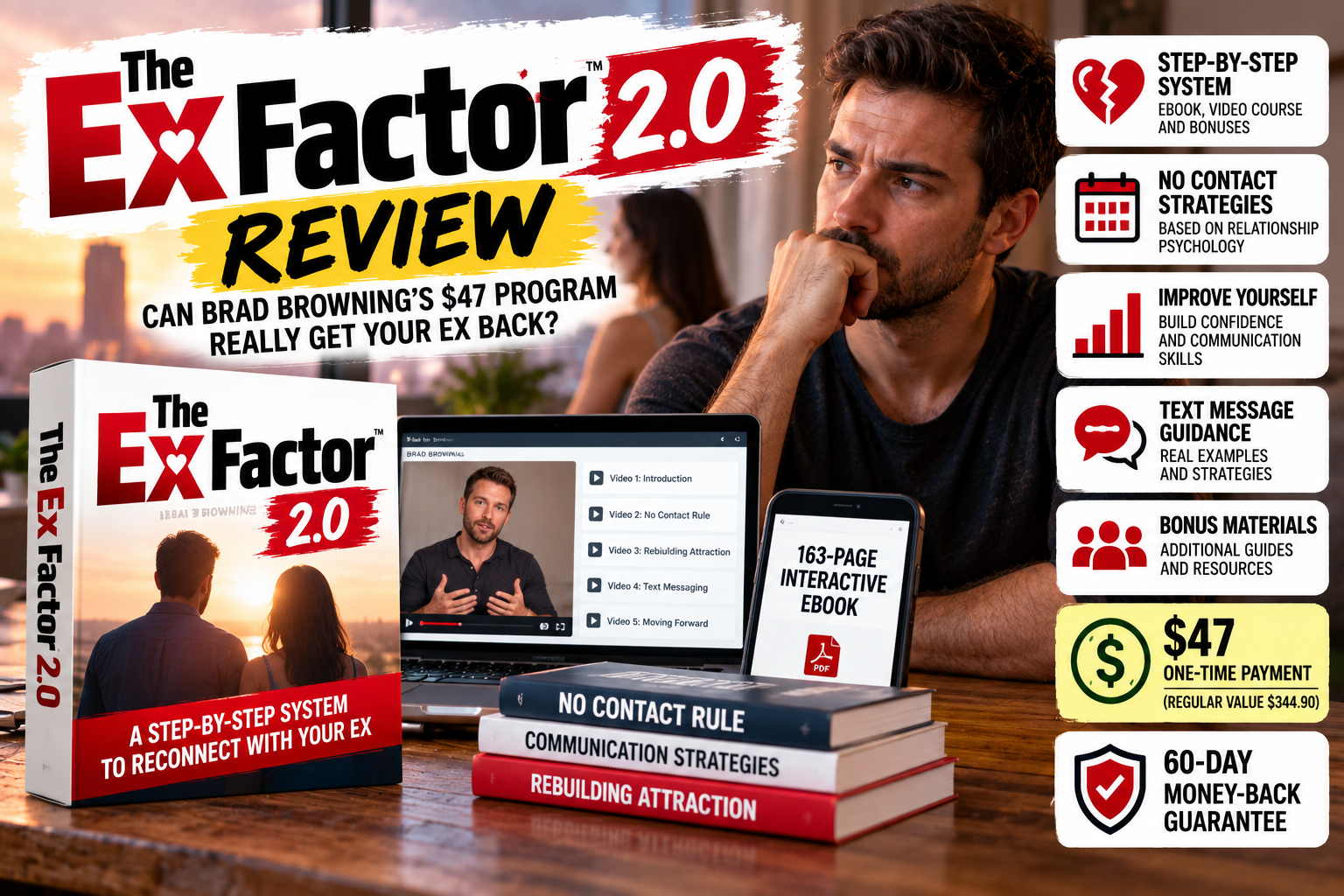
If you searched for The Ex Factor 2.0 review after a breakup, there is one fact worth establishing before discussing Brad Browning, no-contact rules or psychological attraction techniques:
No relationship program can control whether another person decides to come back.
That sounds obvious.
But it becomes surprisingly easy to forget when you’re hurting, your ex isn’t answering and a sales page starts talking about psychological techniques that can make somebody miss you.
The Ex Factor 2.0 is one of the longest-running products in the “get your ex back” market.
It currently costs:
$47
and teaches a process involving temporary distance, self-improvement, communication, attraction and eventual reconnection.
Some of those concepts are perfectly reasonable.
Research on breakups even supports the broader idea that constantly contacting or monitoring an ex can interfere with emotional recovery.
But there is an enormous difference between saying:
“Giving each other space after a breakup can sometimes be healthy.”
and saying:
“Thirty days of no contact will make your ex miss you and want you back.”
The first idea has some research behind it.
The second is a much stronger marketing claim.
That’s the distinction at the center of this investigation.
- Personally Tested
- NO
- Research Type
- COMMUNITY RESEARCHED
- Official Product Materials Examined
- YES
- Official Order Pages Examined
- YES
- ClickBank Marketplace Data Examined
- YES
- Company Background Examined
- YES
- Independent Breakup Research Examined
- YES
- Public User Discussions Examined
- YES
- Independent First-Hand Buyer Evidence
- LIMITED
- Affiliate Relationship
- YES
- Vendor Provided Access
- NO
- Last Researched
- September 2026
Quick Answer: Does The Ex Factor 2.0 Work?
The Ex Factor 2.0 is a real relationship program sold by an established digital publisher, but there is no credible evidence that any program can reliably make another person return to a relationship.
That distinction matters.
Some parts of the program make practical sense.
For example:
- stopping desperate repeated messages;
- taking time away from an emotionally intense breakup;
- rebuilding your social life;
- working on problems that contributed to the breakup;
- communicating more calmly;
- and avoiding obsessive monitoring of an ex.
Those behaviors may be useful whether reconciliation eventually happens or not.
There is even independent research associating frequent contact and social-media surveillance of an ex with greater breakup-related distress and poorer adjustment.
But that research does not demonstrate that disappearing for 30 days causes an ex to regain attraction.
It certainly does not guarantee reconciliation.
The other person’s feelings, circumstances, choices and boundaries remain outside your control.
So our early conclusion is:
The Ex Factor 2.0 makes more sense as a structured breakup-recovery and communication program than as a system that can predictably “get your ex back.”
Check the Current Ex Factor 2.0 Offer
What Is The Ex Factor 2.0?
The Ex Factor 2.0 is a digital relationship program created and marketed under the Brad Browning brand.
It is designed specifically for people who have experienced a breakup and want to explore reconnecting with their former partner.
The program has separate versions and sales funnels aimed at different audiences.
The current official order pages list a core package containing:
- a 163-page interactive ebook;
- a 20-part video course;
- a 3-part bonus video series;
- additional relationship and attraction ebooks;
- and immediate digital access.
Bonus titles differ depending on which version of the funnel you enter.
The men’s package currently lists bonuses including:
- 10 Commandments of Sexual Attraction;
- 7 Steps to Sex Appeal;
- and a fitness-related guide.
The women’s package currently includes titles such as:
- How To Read A Man;
- Why Men Pull Away;
- and another lifestyle-related bonus.
Some product materials also reference audio content.
The central program, however, is the written and video relationship system.
What Does The Ex Factor Actually Teach?
The program is built around a multi-stage approach rather than a single message or trick.
Its major themes include:
- understanding why the breakup happened;
- avoiding panic immediately afterward;
- limiting contact for a period;
- working on yourself;
- changing how your ex perceives you;
- rebuilding attraction;
- re-establishing communication;
- using text messages strategically;
- and gradually exploring reconciliation.
Brad Browning’s public content repeatedly emphasizes what he calls:
No Contact.
The basic version involves intentionally avoiding unnecessary communication with an ex for several weeks.
During that period, users are encouraged to focus on themselves rather than repeatedly trying to convince the other person to reconsider.
This is arguably the least controversial part of the system.
Repeated pleading, arguing and constant messaging immediately after a breakup rarely creates a calm environment for either person.
But The Ex Factor goes further.
It presents No Contact partly as a way to change the ex-partner’s perception and potentially create renewed interest.
That’s where we need to distinguish relationship advice from proven psychological effects.
How Much Does The Ex Factor 2.0 Cost?
The official order pages we checked in September 2026 display:
$47 — one-time front-end purchase
The checkout pages display a reference value of:
$344.90
for the complete bundle before presenting the $47 sale price.
We would not interpret $344.90 as evidence that buyers normally pay that amount.
It is the vendor’s stated combined reference value for the included components.
The amount that matters to a buyer is the actual checkout price:
$47.
Does The Ex Factor Have a Refund Policy?
Yes.
The current official order pages advertise a:
60-day, 100% money-back guarantee.
Payments are processed through ClickBank.
The current checkout language says customers can request a refund within that period if they are not satisfied.
As always, we recommend saving:
- your receipt;
- the price displayed at checkout;
- the guarantee terms;
- and documentation of any additional offer you accept afterward.
Who Is Brad Browning?
Brad Browning is the public-facing relationship coach and author associated with The Ex Factor.
He has maintained a public presence around breakup and relationship advice for more than a decade.
His website contains a large archive of:
- breakup articles;
- videos;
- relationship advice;
- coaching offers;
- and material connected to The Ex Factor and other LoveLearnings products.
This is not a case where the supposed expert behind a digital product appears nowhere outside a sales page.
There is a substantial public content history attached to the Brad Browning name.
The current Brad Browning biography describes him as a:
breakup and divorce coach.
The same biography currently states that he has a Bachelor of Arts in Psychology from the University of British Columbia.
However:
We did not independently verify that academic credential.
For that reason, TestimonialBlogs is not presenting Brad Browning as a licensed psychologist, therapist or clinical mental-health professional.
We are presenting him according to what can clearly be established from his public business activity:
a relationship and breakup coach with a long-running online publishing and coaching business.
Who Owns The Ex Factor?
The broader company behind the program is:
LoveLearnings Media Inc.
This is one of the stronger legitimacy signals surrounding the product.
LoveLearnings is not an anonymous website with no company information.
The Better Business Bureau currently lists LoveLearnings Media Inc. in Victoria, British Columbia.
BBB records currently show:
- business operations beginning in 2012;
- incorporation in 2014;
- LoveLearnings Media Inc. as a corporation;
- The Ex Factor Guide among its listed products;
- and identifiable business management.
BBB currently shows the company as:
not accredited
and:
not rated because BBB says it does not currently have sufficient information to assign a rating.
Those distinctions matter.
A BBB profile does not mean BBB endorses the business.
But it does help establish that a real operating company exists behind the offer.
How Long Has The Ex Factor Been on ClickBank?
The ClickBank vendor nickname is:
BRBROWNING.
Third-party ClickBank marketplace tracking shows the offer has been present for well over a decade, with records going back to at least 2014 and other tracking histories suggesting earlier activity.
That makes The Ex Factor considerably older than most digital relationship products.
Current marketplace data also shows continued sales activity.
Different ClickBank trackers changed rapidly during our September 2026 research, showing Gravity roughly in the:
9–13 range.
Gravity is not a customer satisfaction rating.
It primarily reflects recent affiliate sales activity.
The more relevant conclusion is:
people are still buying this product many years after launch.
Does The Ex Factor Have Upsells or Recurring Charges?
Yes, the broader funnel contains additional offers.
This is important.
The $47 front-end product itself is sold as an individual purchase.
But ClickBank’s own affiliate materials describe The Ex Factor funnel as including:
- an order bump;
- upsells;
- downsells;
- and continuity products that can generate recurring commissions.
Current marketplace tracking also reports meaningful average rebill revenue associated with the vendor funnel.
That does not mean your initial $47 purchase automatically creates an unwanted subscription.
It means:
Additional products can be offered after the main purchase.
Some of those additional offers may have recurring billing.
So read every post-purchase checkout page carefully before accepting it.
The core program should be judged independently from optional extras.
Does the No Contact Rule Really Work?
This is probably the most important question surrounding The Ex Factor.
Brad Browning frequently recommends a period of little or no unnecessary contact after a breakup.
His public materials often frame approximately:
30 days
as a common period.
There are legitimate reasons why temporary distance can make sense.
Research has found associations between ongoing exposure to an ex and more difficult breakup adjustment.
Social Media Monitoring an Ex Can Prolong Distress
A peer-reviewed study involving 464 participants examined Facebook surveillance of former partners.
Greater monitoring of an ex was associated with:
- more breakup distress;
- more negative feelings;
- greater longing;
- greater sexual desire for the former partner;
- and lower personal growth.
That’s relevant.
Constantly checking whether your ex:
- posted a photo;
- followed somebody new;
- went out Saturday night;
- liked your story;
- or appears to be dating someone
may keep you psychologically tied to the breakup.
Frequent Contact Can Also Be Associated With More Distress
A later study followed recently separated adults and found that greater in-person contact with an ex predicted more separation-related psychological distress two months later in part of the sample.
Other research suggests the relationship between contact and recovery can depend on factors such as:
- acceptance of the separation;
- attachment;
- children;
- and the nature of the ongoing relationship.
So the research is not:
“Never speak to an ex under any circumstances.”
It is more nuanced.
But there is enough evidence to say that constant exposure and monitoring can make moving forward more difficult for some people.
What the Research Does NOT Prove
This is where many articles discussing No Contact make a leap.
The studies above investigate:
post-breakup adjustment.
They do not show that:
- 30 days is scientifically optimal;
- your ex will start missing you after a specific number of days;
- reduced contact makes attraction return;
- your ex will become afraid of losing you;
- or No Contact increases the probability of reconciliation by a known percentage.
Those are different questions.
We could not find controlled research showing that:
The Ex Factor’s specific No Contact strategy causes ex-partners to come back.
This matters enormously.
Giving somebody space may be healthy.
Using space as a guaranteed psychological mechanism for generating attraction is a much stronger claim.
Does “Absence Make the Heart Grow Fonder” Apply Here?
Sometimes people do miss somebody after losing regular contact.
That’s an ordinary human experience.
But sometimes distance has the opposite effect.
People can also use separation to:
- heal;
- adjust;
- realize the relationship wasn’t right;
- meet somebody else;
- or become increasingly comfortable with being apart.
There is no universal psychological law guaranteeing:
distance = renewed romantic attraction.
That’s why any responsible evaluation of The Ex Factor has to leave room for:
the ex-partner making a different choice.
The Self-Improvement Part Makes More Sense Than the Manipulation Part
One recurring theme in Brad Browning’s public material is to stop focusing exclusively on the ex and spend time rebuilding your own life.
That can involve:
- reconnecting with friends;
- improving health;
- addressing personal problems;
- building confidence;
- developing interests;
- and understanding what went wrong in the previous relationship.
This part of the program has value regardless of whether reconciliation happens.
The strongest version of the advice is:
“Become healthier and more stable because that is good for you.”
The weaker version is:
“Become healthier so your ex sees what they’re missing.”
The same behavior can come from very different motivations.
For long-term recovery, the first is considerably more sustainable.
What About “Psychological Triggers” and Attraction Techniques?
Relationship marketing often turns ordinary social dynamics into proprietary-sounding techniques.
You will encounter phrases involving:
- psychological triggers;
- attraction;
- emotional responses;
- curiosity;
- jealousy;
- scarcity;
- and specific text-message patterns.
Some of the underlying concepts may describe real human behavior.
For example, desperation can be unattractive.
Constant reassurance-seeking can place pressure on another person.
People respond differently when interactions are calm rather than emotionally explosive.
But:
Human beings are not buttons.
You cannot reliably input:
Message A + 30 Days Silence + Social Media Post B
and predict:
reconciliation.
The other person has agency.
Any course that deals with attraction has to be judged with that reality in mind.
What About the Text Message Scripts?
Scripts can sometimes be useful as examples.
Someone who is highly emotional after a breakup may genuinely benefit from seeing what:
short, calm, low-pressure communication
looks like.
But copying a template word-for-word can become awkward.
Your ex knows how you normally communicate.
A perfectly optimized relationship-marketing script can sound strange if it does not resemble your personality.
Our advice would be to treat scripts as:
examples of tone and structure
rather than:
magic phrases guaranteed to create a response.
What Do Real Ex Factor Users Say?
This is more difficult to establish than the number of review pages suggests.
Search Google for The Ex Factor and you will find many:
- reviews;
- “honest reviews”;
- personal success stories;
- Reddit posts;
- forum articles;
- and affiliate pages.
But a large portion of those pages contain affiliate links or read like promotional copy.
We found Reddit posts claiming personal experience with the program.
We also found clearly promotional Reddit posts making extreme claims, including assertions that almost any relationship can supposedly be salvaged.
We do not consider those posts reliable evidence of a success rate.
Organic discussions are more useful but relatively sparse.
Some real users describe:
- using the No Contact strategy;
- working on themselves;
- receiving personal coaching;
- or attempting to reconnect later.
What we did not find was a trustworthy independent dataset allowing us to say:
“X% of Ex Factor buyers got their ex back.”
No honest review should invent that number.
What About Brad Browning’s Success Stories?
The official websites contain many success stories from people saying:
- they reconciled;
- their ex contacted them;
- they got engaged;
- they married;
- or coaching helped repair their relationship.
Those stories are relevant as:
vendor-presented testimonials.
They are not the same thing as:
an independently audited success rate.
We cannot know:
- how many total customers attempted reconciliation;
- how many did not reconcile;
- how many success stories involved coaching versus the $47 course;
- or how long the reconciled relationships ultimately lasted.
That doesn’t mean the testimonials are false.
It means they cannot answer the statistical question:
“How likely is this to work for me?”
Reconciliation Happens — But That Doesn’t Mean It Is Always Healthy
Getting back together with an ex is not rare.
Research on young-adult relationships has found substantial levels of breakup-and-reconciliation cycles.
One study involving hundreds of young adults found that nearly half reported at least one reconciliation.
So:
people absolutely do get back together.
But that same research also describes:
relationship churning.
This refers to relationships repeatedly cycling through:
together → breakup → reconnect → breakup → reconnect.
Reconciliation itself does not prove that the relationship’s underlying problems were fixed.
That’s another distinction worth making.
Getting Your Ex Back Is Not the Same as Building a Better Relationship
The sales outcome is:
reconciliation.
But the life outcome you actually want is probably:
a healthy relationship.
Those are not identical.
If the breakup happened because of:
- communication problems;
- emotional distance;
- poor conflict resolution;
- neglect;
- different life goals;
- trust problems;
- infidelity;
- substance problems;
- financial conflict;
- or incompatible expectations,
simply restoring attraction will not automatically solve those issues.
A second attempt at the relationship needs something to be different.
Otherwise:
you haven’t solved the breakup.
You’ve postponed the next one.
Could You Learn This Information for Free?
Yes.
Breakup recovery is one of the most heavily discussed subjects on the internet.
You can find free information about:
- No Contact;
- attachment;
- breakup recovery;
- communication;
- relationship boundaries;
- social media after a breakup;
- reconciliation;
- and emotional regulation.
Brad Browning himself publishes a large amount of free material.
So the $47 price should not be interpreted as payment for secret psychological knowledge that exists nowhere else.
What you’re primarily paying for is:
organization.
The Ex Factor gives somebody who feels overwhelmed one sequence to follow instead of:
reading 200 Reddit threads, watching 75 breakup videos and trying 14 contradictory strategies at once.
That can have value.
Especially during a breakup, when emotional decision-making is often at its worst.
See What’s Included in The Ex Factor 2.0
When You Should NOT Try to Get an Ex Back
This section matters more than any text-message technique.
A reconciliation guide should not be interpreted as permission to ignore another person’s boundaries.
If an ex clearly says:
“Do not contact me.”
that boundary should be respected.
No psychological technique overrides consent.
Abuse and Violence
If the previous relationship involved:
- physical violence;
- sexual coercion;
- threats;
- stalking;
- intimidation;
- controlling behavior;
- or serious emotional abuse,
the priority should be safety rather than a strategy for re-attraction.
Domestic-violence organizations specifically warn that the period after a breakup can be dangerous in abusive relationships.
They recommend safety planning and respecting boundaries rather than attempting manipulative reconnection.
Your Ex Has Explicitly Refused Contact
A relationship requires:
two people choosing the relationship.
Repeatedly contacting somebody after they have explicitly asked you to stop is not romantic persistence.
It is a boundary violation.
You Only Want Them Back Because You Cannot Tolerate the Loss
Breakups can create intense emotional distress.
That doesn’t automatically mean the relationship itself was healthy.
Sometimes the immediate goal shouldn’t be:
“How do I get them back?”
It should be:
“What do I actually want once the panic settles?”
The Biggest Positive We Found
The program discourages one of the most common post-breakup mistakes:
panic-driven pursuit.
Repeated texting, begging, demanding explanations and obsessively checking an ex’s social media can keep somebody trapped in the emotional intensity of the breakup.
Independent research provides some support for reducing that exposure.
The Ex Factor also encourages users to:
- rebuild confidence;
- improve their lives;
- think about why the relationship failed;
- and wait until emotions settle before attempting serious reconnection.
Those concepts can be useful regardless of whether the ex ultimately returns.
The Biggest Problem We Found
The product exists in a category built around a result that:
the customer cannot control.
You can control:
- whether you stop begging;
- whether you improve your behavior;
- whether you communicate respectfully;
- whether you apologize;
- whether you work on yourself;
- and whether you offer a healthier second chance.
You cannot control:
whether the other person wants it.
Any marketing that makes reconciliation sound predictable therefore deserves skepticism.
The Second Biggest Problem: The Funnel
The front-end price is straightforward:
$47.
But the broader ClickBank offer is considerably more elaborate.
Official ClickBank affiliate information describes:
- order bumps;
- multiple upsells;
- downsells;
- and recurring backend products.
This explains why current marketplace tracking can show average affiliate earnings far above the initial $47 transaction.
That does not mean the original course costs $100+.
It means some customers buy more after entering the funnel.
Our advice:
Judge every extra offer separately.
Do not assume you need coaching, another course or a recurring membership simply because it appears after checkout.
Is The Ex Factor 2.0 a Scam?
Based on the evidence we reviewed, we do not have a basis to characterize The Ex Factor 2.0 as a scam.
There is:
- a defined digital product;
- a current official checkout;
- immediate digital delivery;
- an operating company behind the program;
- a BBB business profile;
- a business history extending more than a decade;
- an established ClickBank vendor;
- a 60-day refund guarantee;
- a public coaching brand;
- and substantial free content associated with the creator.
The legitimate criticism is not:
“You pay $47 and receive nothing.”
The legitimate criticism is:
relationship marketing can imply much more control over another person’s feelings than any program can realistically provide.
Those are different issues.
Who Might Find The Ex Factor Useful?
Someone Who Is Panicking After a Breakup
A structured plan may help prevent impulsive messages and emotionally charged decisions.
Someone Who Keeps Contacting Their Ex
The No Contact structure may provide a useful boundary while emotions settle.
Someone Who Wants to Understand What Went Wrong
The self-reflection component may be more valuable than the attraction techniques.
Someone Who Wants One Organized System
The internet contains enormous amounts of breakup advice.
A paid guide can reduce information overload.
Who Probably Shouldn’t Buy The Ex Factor?
Someone Expecting a Guaranteed Reconciliation
No program can make another adult return to a relationship.
Someone Whose Ex Has Clearly Said “No Contact”
Respect the boundary.
Someone Coming Out of an Abusive Relationship
Safety planning and professional support are more appropriate than attraction tactics.
Someone Looking for Therapy
The Ex Factor is a digital relationship self-help program.
It is not a substitute for individualized mental-health treatment or couples therapy.
Someone Who Only Wants Manipulation Tactics
Trying to manufacture jealousy or engineer somebody’s emotions is a poor foundation for a healthy second relationship.
Our Conclusion: Is The Ex Factor 2.0 Worth It?
The Ex Factor 2.0 becomes considerably more useful when you stop viewing it as:
“a system that makes an ex come back.”
and start viewing it as:
“a structured framework for handling a breakup without panicking, improving yourself and deciding whether respectful reconciliation is possible.”
Those sound similar.
They are not.
The first promises influence over another person’s romantic decisions.
The second focuses on the part you can actually control:
your behavior.
There is legitimate research suggesting that constant exposure to and monitoring of an ex can interfere with breakup recovery.
That gives the broad concept of taking space some credibility.
But we found no scientific evidence establishing that The Ex Factor’s specific No Contact strategy reliably causes former partners to regain attraction.
There is also no trustworthy independent success-rate dataset showing what percentage of customers reconcile.
The program nevertheless has several meaningful legitimacy signals.
It is sold by a company operating for more than a decade.
It has an established ClickBank history.
The current $47 product is clearly defined.
The guarantee is published.
And Brad Browning has a substantial public history producing relationship content.
Our biggest reservation is therefore not whether the product exists.
It does.
Our reservation is about expectations.
Our Simplest Conclusion
The Ex Factor 2.0 is a legitimate $47 breakup and reconciliation program containing several sensible ideas, but no course can guarantee or psychologically engineer another person’s decision to resume a relationship.
If you use it to:
- stop impulsive behavior;
- give both people space;
- work on yourself;
- understand the breakup;
- and eventually communicate more respectfully,
there may be useful value in the structure.
If you’re buying because you believe a particular text message or 30-day silence will force your ex to return:
adjust that expectation before spending the $47.
And if your former partner has clearly rejected further contact, respect that decision regardless of what any relationship guide says.
Check the Current Ex Factor 2.0 Offer & Price
Affiliate disclosure: If you purchase through this link, TestimonialBlogs may earn a commission at no additional cost to you. Affiliate revenue helps fund future product investigations. It does not change what we report.
The Ex Factor 2.0 FAQ
Is The Ex Factor 2.0 legit?
The Ex Factor 2.0 is a real digital relationship program sold through ClickBank and published by LoveLearnings Media Inc. The company has operated for more than a decade and the current offer includes defined digital materials and a refund policy.
How much does The Ex Factor 2.0 cost?
The official order pages we checked in September 2026 list the core program at $47.
Is The Ex Factor 2.0 a subscription?
The $47 core purchase is presented as an individual front-end transaction. However, the broader ClickBank funnel includes optional additional products, and some backend offers can involve recurring billing. Read each additional checkout page separately.
Does The Ex Factor have upsells?
Yes. ClickBank’s own affiliate materials describe order bumps, upsells and downsells in the funnel, along with continuity offers. These are separate from the core $47 program.
Does The Ex Factor have a money-back guarantee?
Yes. The current official checkout advertises a 60-day, 100% money-back guarantee.
Who is Brad Browning?
Brad Browning is the public-facing breakup and relationship coach associated with The Ex Factor and LoveLearnings Media. He has published relationship content and offered coaching online for many years. His official bio claims a psychology degree, although we did not independently verify that academic credential and do not present him as a licensed psychologist.
What is the No Contact Rule?
No Contact involves intentionally limiting unnecessary communication with an ex for a period after a breakup. Brad Browning commonly recommends several weeks. Independent research suggests frequent contact and social-media monitoring can sometimes interfere with breakup recovery, but research does not establish that No Contact guarantees renewed attraction.
Does No Contact make your ex miss you?
It can happen, but there is no reliable scientific rule saying a particular period of silence will cause an ex to miss you or want the relationship back. People respond to separation differently.
Does The Ex Factor really get your ex back?
No program can guarantee another person’s decision. The Ex Factor may help users manage their own post-breakup behavior, communication and self-improvement, but reconciliation still depends on both people.
Does The Ex Factor work if your ex is dating someone else?
The program discusses various breakup situations, but another person’s new relationship substantially changes the circumstances. No strategy can guarantee that somebody will leave another relationship and return to a previous partner.
Should you contact an ex who asked you to stop?
No relationship course overrides another person’s boundary. If an ex explicitly asks you not to contact them, that request should be respected.
Should you use The Ex Factor after an abusive relationship?
A strategy for winning someone back is not an appropriate substitute for safety planning after abuse, violence, stalking or serious coercive control. In those situations, prioritize safety and qualified support.
Can you learn this information for free?
Yes. Much of the general information about breakups, No Contact, communication and relationship recovery is available free online. The main potential value of The Ex Factor is organization, sequencing and having one structured framework.
Is The Ex Factor 2.0 worth $47?
It may be useful for someone who wants a structured plan for stopping impulsive post-breakup behavior, reflecting on the failed relationship and eventually exploring respectful reconciliation. It is unlikely to satisfy someone expecting a guaranteed method for making another person return.
Sources and Methodology Notes
This investigation compared The Ex Factor’s current official sales and order pages with LoveLearnings Media company information, Better Business Bureau records, current ClickBank marketplace and affiliate data, Brad Browning’s public materials, peer-reviewed breakup research and public user discussions.
Representative sources examined include:
- The Ex Factor official product and order pages
- Brad Browning official website and biography
- LoveLearnings Media Inc. company and customer-support pages
- Better Business Bureau profile for LoveLearnings Media Inc.
- ClickBank official affiliate-program coverage
- CBSnooper and CBEngine marketplace tracking for vendor BRBROWNING
- peer-reviewed research on contact with former romantic partners
- peer-reviewed research on social-media surveillance after breakups
- peer-reviewed research on relationship reconciliation and relationship cycling
- National Domestic Violence Hotline safety guidance
- organic and promotional Reddit discussions involving The Ex Factor
Why TestimonialBlogs Calls This “Community Researched”
We did not personally experience a breakup, buy The Ex Factor 2.0 and then attempt to reunite with an ex for this review.
So we are not going to publish a fabricated story saying:
“I followed Brad’s method and my ex texted me on day 23.”
There are already plenty of pages on the internet presenting dramatic personal experiences that are difficult or impossible to verify.
Instead, we investigated questions that can actually be researched:
- Does the product exist?
- What does it currently cost?
- What does the buyer receive?
- Who is the company behind it?
- How long has the vendor been active?
- Does the funnel include recurring products?
- Is there research supporting reduced contact after breakups?
- Does that research prove an ex will return?
- Are customer success rates independently available?
- And where should healthy boundaries override reconciliation strategies?
The answer is more nuanced than either extreme.
The Ex Factor is not imaginary.
And No Contact is not inherently nonsense.
But neither fact turns another person’s romantic feelings into something that can be reliably engineered.
That is the distinction we think matters most.
A useful breakup program can help you control your next move.
It cannot control your ex’s.