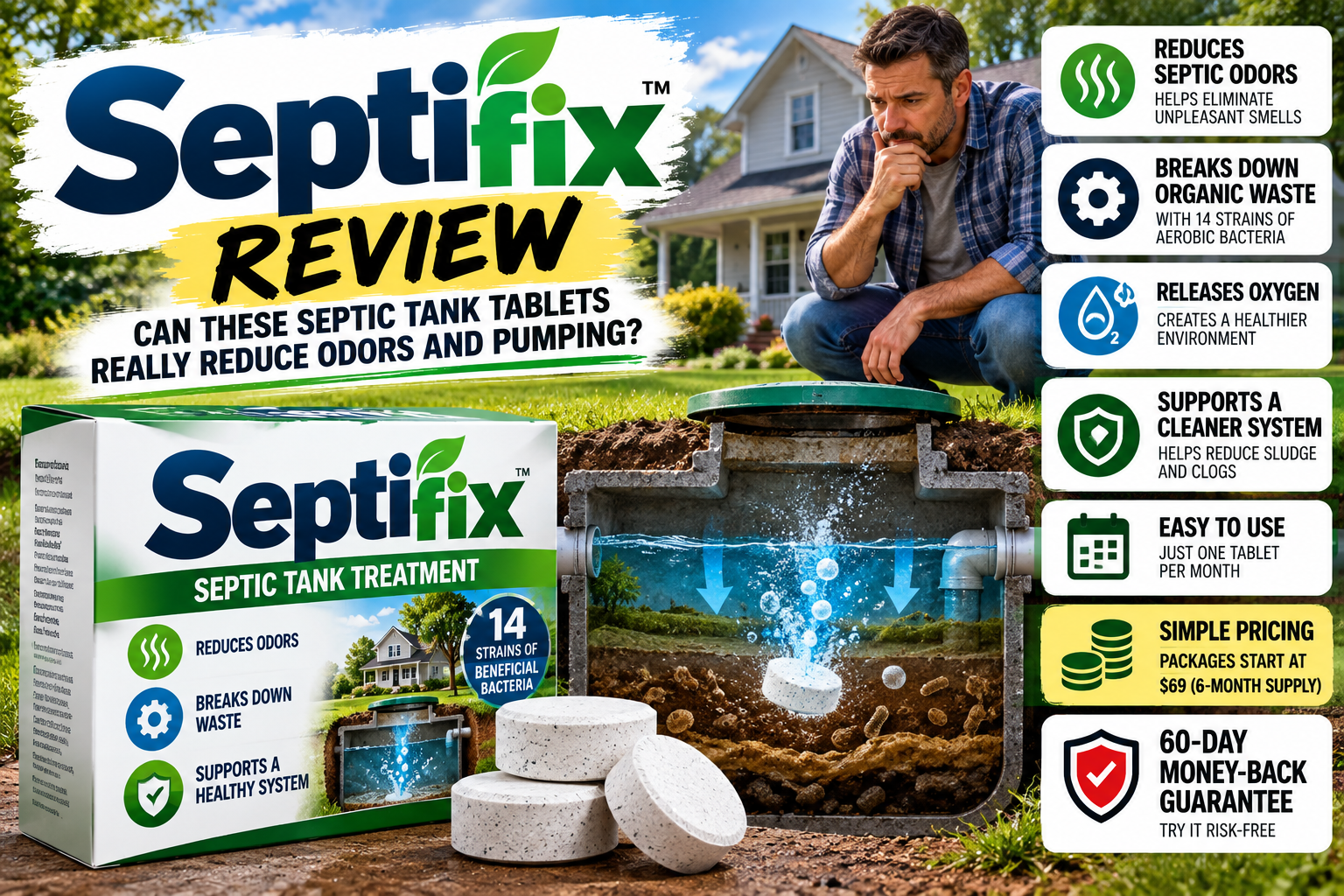
If you searched for a Septifix review because you’re tired of septic odors, pumping bills or worrying about what is happening underground, there is one unusually important fact to understand before buying any septic tank additive:
The U.S. Environmental Protection Agency does not generally recommend septic tank additives for domestic systems.
That includes products containing bacteria, enzymes or chemicals.
The EPA’s reasoning is straightforward:
A properly functioning residential septic system already contains enormous populations of bacteria, enzymes, yeasts, fungi and other microorganisms capable of breaking down household wastewater.
So where does that leave Septifix?
Because Septifix isn’t marketed as an ordinary bacterial starter.
Its seller says each tablet combines:
- 14 strains of aerobic bacteria;
- oxygen-releasing compounds;
- sodium carbonate for pH buffering;
- and a slow-dissolving tablet format.
The idea is that adding oxygen creates conditions where aerobic bacteria can break down organic waste more efficiently while reducing odor-producing compounds.
That mechanism is not inherently absurd.
Aerobic wastewater treatment is real.
pH affects microbial activity.
And oxygen can influence how organic waste is processed.
But there is a large difference between:
“This mechanism is scientifically plausible.”
and:
“This specific monthly tablet will eliminate your need for septic pumping.”
The second claim requires much stronger evidence.
And that is where our investigation became interesting.
- Personally Tested
- NO
- Research Type
- COMMUNITY RESEARCHED
- Official Product Materials Examined
- YES
- Official Affiliate Rules Examined
- YES
- ClickBank Marketplace Data Examined
- YES
- EPA Septic Guidance Examined
- YES
- University Extension Guidance Examined
- YES
- Product-Specific Independent Research Found
- LIMITED
- Independent Buyer Evidence
- LIMITED / MIXED
- Affiliate Relationship
- YES
- Vendor Provided Access
- NO
- Last Researched
- September 2026
Quick Answer: Does Septifix Work?
Septifix is a real physical septic-treatment product with a plausible biological mechanism, but we found insufficient independent product-specific evidence to confirm its strongest marketing claims.
The current product is a flushable tablet designed to introduce:
- aerobic bacteria;
- oxygen;
- and pH-buffering compounds
into a septic tank.
The company says this combination can:
- reduce odors;
- digest organic waste;
- reduce sludge buildup;
- reduce clogs;
- protect septic components;
- and reduce how frequently the tank needs pumping.
Some parts of that mechanism are reasonable in wastewater-treatment terms.
But the EPA’s current position is substantially more cautious.
The EPA says domestic septic systems already contain the microorganisms they need, does not recommend routine additives and warns that some additive products may be ineffective or may negatively affect the system or environment.
Importantly, the EPA does not evaluate or recommend individual commercial septic additives.
So EPA guidance does not establish that Septifix specifically is ineffective.
But it does mean we should not assume that a monthly bacterial tablet is necessary for every functioning septic system.
Our early conclusion is therefore:
Septifix may make more sense as an optional maintenance product than as a replacement for inspection, pumping or repair.
Check the Current Septifix Offer
What Is Septifix?
Septifix is a physical septic tank treatment sold primarily online through ClickBank.
Instead of pouring liquid or powder directly into a septic system, you flush a compressed tablet down a toilet.
The tablet then reaches the septic tank and gradually dissolves.
The official product pages currently describe each tablet as weighing approximately:
55 grams.
According to the seller, each tablet contains:
- 14 strains of aerobic bacteria;
- more than 10 billion bacteria per gram;
- oxygen-releasing compounds;
- and sodium carbonate or related pH-regulating compounds.
The seller also claims one tablet can release:
up to 10 liters of oxygen.
Those are manufacturer claims.
We found them repeatedly across the current official Septifix pages.
We did not locate a publicly available independent laboratory report verifying the exact bacteria count, oxygen-release figure or comparative performance against competing products.
That distinction matters.
Who Is Behind Septifix?
The official Septifix contact page currently identifies the site as:
owned and operated by SEPTIFIX LLC.
The listed office address is in Sheridan, Wyoming.
The product’s origin story revolves around a founder identified publicly as:
Richard V.
The sales material says Richard owned a plumbing business with more than 200 employees operating across nine states.
The company says he became interested in developing a preventive septic treatment after seeing homeowners face expensive repairs.
The story continues by claiming that:
- Richard partnered with a prestigious U.S. university;
- a team of 14 scientists worked on the formula;
- development took more than three years;
- and more than $1.5 million was invested in research.
Those are unusually specific claims.
However:
We Could Not Independently Verify the Research Team
The public sales materials we examined do not identify:
- the university;
- the 14 scientists;
- the published research;
- the journal;
- a DOI;
- or a publicly accessible laboratory report documenting the claimed development process.
That doesn’t demonstrate the development story is false.
It means:
we cannot independently verify it from the evidence currently made public.
For TestimonialBlogs, that is the appropriate distinction.
How Long Has Septifix Been on ClickBank?
The ClickBank vendor nickname is:
SEPTIFIX.
Current marketplace tracking dates the product to:
August 25, 2021.
As of late September 2026, the latest marketplace snapshot we examined showed a Gravity of approximately:
29.21.
It also showed average affiliate earnings around:
$75.40 per sale.
Gravity is not a product rating.
It reflects recent affiliate sales activity.
But it does establish that Septifix remains actively sold through ClickBank years after launch.
How Is Septifix Supposed to Work?
The concept behind Septifix has three main components.
1. Aerobic Bacteria
Most conventional septic tanks operate primarily under low-oxygen or anaerobic conditions.
Septifix attempts to temporarily introduce additional aerobic bacterial activity.
Aerobic bacteria use oxygen while metabolizing organic material.
The company says its selected bacterial strains digest substances such as:
- toilet paper;
- organic sludge;
- grease;
- oil;
- soap residue;
- and other biodegradable material.
2. Oxygen Release
The seller says the tablet slowly releases oxygen after entering the tank.
This creates an environment that can support the aerobic bacteria added by the product.
Oxygen can also change odor chemistry.
Hydrogen sulfide is one of the compounds associated with the familiar “rotten egg” smell around wastewater systems.
Oxidation can convert sulfide compounds into less odorous forms.
So the general idea that oxygen can influence odors and aerobic microbial activity is scientifically plausible.
3. pH Buffering
The official formula description includes sodium carbonate.
Sodium carbonate is alkaline and can act as a buffer.
The company’s theory is that moving wastewater toward a more favorable pH helps bacterial activity and reduces corrosive acidic conditions.
Again:
the components make chemical and biological sense.
The unanswered question is not whether oxygen, bacteria and pH affect wastewater treatment.
They do.
The more difficult question is whether this specific dosage creates enough meaningful change inside a residential septic tank to produce all of the benefits advertised.
Aerobic Treatment Is Real — But a Septic Tank Is Not a Wastewater Plant
Municipal and engineered wastewater treatment systems frequently use aeration.
Aerobic treatment units designed for homes also exist.
These systems intentionally supply oxygen continuously or repeatedly using mechanical equipment.
That is very different from adding a dissolving tablet to a conventional septic tank once per month.
The fact that:
aerobic wastewater treatment works
does not automatically prove:
one Septifix tablet creates the same treatment conditions as a purpose-built aerobic treatment system.
Those are different levels of aeration and system design.
So we consider the mechanism plausible without assuming equivalence.
What Does the EPA Say About Septic Tank Additives?
This was the single most important external source in our investigation.
The U.S. Environmental Protection Agency currently says:
septic tank additives are generally not recommended for domestic wastewater treatment.
The EPA explains that ordinary household wastewater already introduces large populations of:
- bacteria;
- enzymes;
- yeasts;
- fungi;
- and other microorganisms
into septic systems.
In other words:
a properly functioning septic tank is already biologically active.
It does not normally require somebody to “seed” it with bacteria before decomposition can occur.
The EPA Does Not Say Every Additive Does Nothing
This is an important nuance.
The EPA’s 2024 Septic Tank Additives Fact Sheet notes that some biological additives can reduce septic tank scum and sludge.
But it also says:
the long-term effect of those products on the ability of surrounding soils to treat wastewater is unknown.
The agency also says:
- many additive claims have limited third-party research;
- some additives may interfere with treatment processes;
- some may contribute to clogging;
- and certain chemical additives can threaten soil or groundwater.
Again, this is category-level guidance.
The EPA is not saying that it independently tested Septifix and rejected it.
It says it does not recommend commercial additives as necessary for a normally functioning residential septic system.
What Do University Extension Programs Say?
The EPA position is not isolated.
University extension programs publish similar guidance.
University of Maryland Extension
Its septic guidance says research has shown bacterial and enzymatic additives do not improve the performance of a typical septic system.
It notes that household wastewater contains enormous bacterial populations naturally.
NC State Extension
NC State similarly says research on bacterial additives has not shown reductions in the rate of solids buildup or meaningful increases in bacterial activity sufficient to eliminate regular pumping.
University of Arizona Cooperative Extension
Arizona’s guidance says there is no conclusive evidence that septic additives prevent failure or improve performance and emphasizes that additives do not eliminate the need for regular tank cleaning.
That’s a significant body of mainstream homeowner guidance pointing in the same direction:
routine additives should not be treated as a substitute for actual septic-system maintenance.
Can Septifix Help With Septic Odors?
This is one of the product’s most plausible use cases.
The seller says odors can improve within:
3 to 5 days.
The proposed mechanism involves:
- oxygen release;
- oxidation of odor-producing compounds;
- and changes in bacterial activity.
That mechanism is chemically reasonable.
However:
Persistent Septic Odor Can Also Signal a Problem
Odor around a septic system can be related to:
- ventilation problems;
- full tanks;
- blocked plumbing;
- damaged seals;
- drainfield problems;
- leaks;
- or system malfunction.
Suppressing an odor is not the same thing as diagnosing why it appeared.
If a septic odor is persistent, severe or associated with:
- slow drains;
- backups;
- standing water;
- soggy ground;
- or sewage surfacing outside,
a septic professional should inspect the system.
Can Septifix Replace Septic Pumping?
This is where our view differs most sharply from the strongest promotional language.
The official sales material repeatedly suggests that users may dramatically reduce pumping frequency and in some cases may no longer need regular pump-outs.
The EPA does not support treating additives as a replacement for pumping.
Why?
Because a septic tank performs a physical separation process.
Wastewater enters.
Solids settle into:
sludge.
Lighter fats and floatable material form:
scum.
Liquid effluent exits toward the drainfield.
Microorganisms digest part of the organic material.
But they do not transform every solid entering the system into nothing.
Non-digestible solids and residual material accumulate.
Eventually:
the tank has to be pumped.
EPA homeowner guidance describes regular pumping as one of the fundamental maintenance tasks for septic systems.
Reducing Pumping Frequency Is Different From Eliminating Pumping
Could improved digestion of some organic material potentially affect sludge accumulation?
Possibly.
Even EPA literature acknowledges that some biological additives can reduce scum and sludge under certain conditions.
But that is not equivalent to proving:
“You will never need to pump your tank again.”
We found no independent product-specific long-term study supporting that universal expectation for Septifix.
How Much Does Septifix Cost?
Septifix pricing is slightly more complicated than it initially appears because the company currently operates multiple official sales funnels.
When we checked the official pages in September 2026, one current offer displayed:
6-Month Supply
$69
plus shipping.
12-Month Supply
$118 total
with free shipping.
18-Month Supply
$147 total
with free shipping.
However, another current official Septifix funnel displayed:
- 6 months for $69;
- 18 months for $177;
- and a 30-month package for $247.
So:
Septifix Pricing Can Vary by Funnel
That doesn’t necessarily mean something is wrong.
Direct-response products frequently test different:
- bundle sizes;
- discounts;
- landing pages;
- and promotions.
It does mean you should judge the price shown on the actual page you reach rather than assuming a review’s package table will remain correct indefinitely.
An Interesting Dosage Detail
The main product pages commonly describe maintenance as:
one tablet per month.
A box containing six tablets is therefore marketed as:
a six-month supply.
But Septifix’s current refund-policy page also recommends:
using at least three tablets the first time.
Other official materials similarly describe starting with three tablets before continuing with one monthly.
That creates an obvious practical question:
If you use three tablets immediately, does a six-tablet box really last six months for a new customer?
The public pages do not explain that issue as clearly as we would like.
Tank size and condition may affect dosing.
So if exact supply duration matters to your purchase decision, we would ask Septifix support what starting dose applies to your tank before ordering.
Is Septifix a Subscription?
Current ClickBank marketplace tracking shows Septifix as:
a single-payment physical product.
We did not find a mandatory recurring billing structure attached to the primary purchase.
So buying a Septifix package should not be confused with enrolling in a required monthly subscription.
However, the offer has:
upsells.
Does Septifix Have Upsells?
Yes.
This is confirmed directly by the official affiliate page.
The affiliate material currently promotes additional products including:
Septifix Drain Dissolver Treatment
A granular bacterial drain-cleaning product marketed toward septic-system owners.
Septifix Garbage Disposal Tablets
Tablets intended for organic buildup and odors in garbage disposals.
The existence of upsells does not mean you need them to use the main Septifix tablets.
Evaluate each extra product separately.
What Is the Actual Cost Per Month?
If you purchase a larger package at approximately:
$49 per six-month box
the headline cost works out to roughly:
$8.17 per month
under the one-tablet-per-month maintenance schedule.
At the $69 single-box price:
about $11.50 per month.
However, the initial three-tablet recommendation can change the effective cost during the first months.
So the advertised “under $9 per month” number is most representative of larger discounted bundles under ongoing maintenance dosing.
What Is the Septifix Refund Policy?
Septifix currently advertises a:
60-day money-back guarantee.
But because this is a physical product, the refund process is more complicated than refunding an ebook.
The official refund policy currently says buyers must:
- contact Septifix support;
- provide order information;
- describe what is being returned;
- return all boxes, including used or empty boxes;
- provide shipment tracking;
- and pay the cost of return shipping.
The policy also says:
shipping and handling costs may be deducted from the refund.
This is important.
“60-day guarantee” does not necessarily mean:
you click one button and every dollar including shipping is instantly refunded.
There is a physical return process.
Keep all packaging until you’re sure you want to keep the product.
How Much Is Septifix Shipping?
The current official shipping policy lists:
$9.95 shipping
for a single unit in the United States.
Larger packages are currently promoted with:
free shipping.
The company says U.S. delivery typically takes:
5 to 7 business days.
Always verify current shipping terms at checkout because promotions can change.
What Can Septifix NOT Fix?
This may be the most important practical section of the review.
A biological septic additive cannot repair:
- a collapsed pipe;
- a cracked tank;
- a broken baffle;
- a failed pump;
- a damaged distribution box;
- tree-root intrusion;
- hydraulic overload;
- an improperly designed system;
- a saturated drainfield;
- compacted soil;
- or a drainfield that has physically reached the end of its service life.
If a system has a mechanical, structural or soil-absorption problem:
a tablet cannot rebuild the hardware.
This sounds obvious.
But marketing phrases about solving septic “issues” can blur the distinction between:
maintenance problem
and:
system failure.
Signs You Need a Septic Professional Instead
Contact a qualified septic professional if you notice symptoms such as:
- sewage backing up into the house;
- wastewater surfacing over the drainfield;
- persistently wet or unusually green areas over the drainfield;
- multiple fixtures draining slowly;
- structural tank damage;
- repeated backups;
- or strong persistent odors combined with drainage problems.
Those symptoms deserve diagnosis.
You don’t want to mask a symptom while a failing system gets worse underground.
Can Septifix Prevent Clogs?
Possibly some kinds of organic buildup.
The bacteria-and-enzyme concept makes sense for biodegradable:
- fat;
- grease;
- food-derived material;
- soap residue;
- and toilet paper.
But not every septic blockage is organic.
A product cannot biologically digest:
- plastic wipes;
- sanitary products;
- tree roots;
- broken pipes;
- collapsed plumbing;
- rocks;
- or physical obstructions.
Again, diagnosis matters.
Can Septifix Protect Your Drainfield?
The company argues that reducing solids leaving the tank can help protect the drainfield.
Conceptually, preventing excessive solids from reaching the drainfield is absolutely important.
The tank’s job is partly to keep sludge and scum from entering the soil treatment area.
But there is a complication.
The EPA cautions that some additives can keep organic material suspended in the wastewater rather than allowing it to settle.
If additional suspended solids move into the drainfield, that could potentially contribute to clogging or biomat formation.
This is one reason the EPA says the long-term effects of some additives require caution.
We did not find independent product-specific field data showing whether long-term Septifix use measurably improves or worsens drainfield performance.
What About the 21,374 Customer Claim?
The current official sales material says more than:
21,374 septic tank owners
have used Septifix.
It also states that:
87% are repeat buyers.
Those are vendor-reported figures.
We did not locate:
- an independent audit;
- a published methodology;
- or third-party transaction data
allowing us to verify those exact percentages.
The product has been actively sold through ClickBank since 2021, so a substantial customer base is plausible.
But:
we treat the precise customer count and repeat-purchase percentage as manufacturer claims rather than independent statistics.
Why We Are Not Reproducing Septifix Testimonials
The official Septifix website contains multiple customer stories.
Normally, TestimonialBlogs would analyze those separately from independent user feedback.
In this case, there is another reason we aren’t reproducing them.
The official Septifix affiliate terms explicitly say affiliates:
may not use Septifix customer testimonials or customer photos in their promotions.
We’re following that rule.
More importantly, vendor-selected testimonials would not establish an independent success rate anyway.
So this investigation focuses on:
- the product itself;
- its mechanism;
- its published terms;
- independent septic-system guidance;
- and public technical discussion.
What Do Independent Septic Professionals Say About Additives?
Public discussion among septic installers, pumpers and system owners is divided.
Many experienced septic professionals argue that:
proper pumping and responsible household use matter far more than additive products.
This is consistent with EPA and university-extension recommendations.
Other homeowners report using biological additives and believe they see:
- reduced odors;
- less visible sludge;
- or longer intervals between service.
The problem is that homeowner anecdotes rarely include:
- before-and-after sludge measurements;
- tank size;
- household wastewater volume;
- pump history;
- drainfield condition;
- or controlled comparison periods.
That’s why anecdotes can suggest possibilities but cannot tell us how reliably a product works.
The Scientific Evidence Gap
The company repeatedly describes Septifix as:
scientifically tested.
It also references:
- 14 scientists;
- a prestigious university;
- more than three years of development;
- and over $1.5 million invested in research.
Those claims would become much more persuasive if the company publicly linked to:
- the institution;
- the scientists;
- the protocol;
- laboratory reports;
- peer-reviewed research;
- or independent field trials.
We did not find those materials published on the current official pages.
That doesn’t prove they do not exist.
But it prevents us from independently evaluating the research behind the claims.
Is the Septifix Formula Plausible?
Yes, in the limited sense that:
- microorganisms break down organic waste;
- oxygen supports aerobic organisms;
- oxygen can affect odor-producing compounds;
- and pH influences microbial activity.
Those principles are established.
But:
plausible mechanism does not equal proven consumer outcome.
Imagine a skincare product containing an ingredient known to work under laboratory conditions.
That tells you something.
It does not automatically tell you that the finished product, at its actual concentration and dosage, produces every claim on the package.
The same evidentiary distinction applies here.
Is Septifix Necessary for a Healthy Septic System?
According to current EPA guidance:
no commercial bacterial additive is necessary for a normally functioning residential septic system.
Your household is continuously adding bacteria through wastewater.
That doesn’t mean a specialized biological additive can never produce any effect.
But “can have an effect” and “is required for healthy operation” are very different statements.
If your septic system is currently functioning well, the highest-priority maintenance practices remain things such as:
- regular inspection;
- pumping when needed;
- avoiding wipes and inappropriate solids;
- limiting grease;
- protecting the drainfield;
- managing household water use;
- and avoiding harsh chemicals that disrupt the system.
Can Septifix Save You Money?
Potentially, but the answer depends entirely on what it actually changes in your system.
If the tablets:
- reduce nuisance odors;
- help digest certain organic material;
- or genuinely extend a safe pumping interval based on professional inspection,
then a monthly cost in roughly the $8–12 range could be financially reasonable.
But the comparison becomes misleading if somebody assumes:
buying Septifix means they no longer need pumping or inspections.
Deferred maintenance can turn an inexpensive pump-out into an expensive drainfield problem.
So the safest financial argument for Septifix is not:
“never pay a septic professional again.”
It is:
“this may be a relatively inexpensive optional maintenance product if you understand that normal septic care still matters.”
Could You Buy Other Septic Additives for Less?
Yes.
The septic-treatment market already contains:
- bacterial powders;
- enzyme products;
- monthly packets;
- flushable tablets;
- liquid treatments;
- and products from major household brands.
Many cost less than Septifix.
Septifix differentiates itself primarily through:
- its high claimed bacteria concentration;
- 14 bacterial strains;
- oxygen release;
- pH buffering;
- and tablet format.
We did not find an independent head-to-head trial showing Septifix outperforming major competing bacterial treatments.
So claims that it is objectively the best treatment on the U.S. market should be treated as:
vendor positioning rather than an independently established ranking.
See the Current Septifix Packages & Price
The Biggest Positive We Found
Septifix is more technically interesting than an ordinary bacterial starter.
The product is not simply saying:
“Your tank needs bacteria, so add bacteria.”
Its formula attempts to modify the tank environment using:
- oxygen;
- pH buffering;
- and aerobic bacterial cultures.
Those are legitimate wastewater-treatment concepts.
The tablets are also:
- simple to use;
- a physical product rather than vague information;
- sold through an established checkout platform;
- backed by a published 60-day return policy;
- and supported by an identifiable operating company.
If the primary goal is easy monthly maintenance and odor management, we can understand the appeal.
The Biggest Limitation We Found
The strongest marketing claims go considerably beyond the strongest independent evidence we found.
In particular:
- eliminating the need for pumping;
- eliminating all organic sludge;
- preventing essentially all major septic problems;
- and saving every homeowner hundreds of dollars per year
are much broader claims than:
“a bacterial and oxygenating additive may influence organic decomposition and odor.”
EPA guidance remains skeptical of septic additives as a category.
And we did not find independent product-specific trials demonstrating that Septifix consistently delivers those broader outcomes across residential systems.
The Second Biggest Limitation: A Tablet Cannot Diagnose Your System
Two homes can both have:
slow drains.
In one house, the problem may be:
organic buildup.
In another, it may be:
a crushed pipe.
Two yards can both smell like sewage.
One may have temporary odor buildup.
The other may have a failed drainfield.
Those symptoms look similar to a homeowner.
But they require completely different solutions.
That is why maintenance products should not replace diagnosis.
Who Might Find Septifix Useful?
Homeowners Looking for Simple Optional Maintenance
Flushing a tablet is considerably easier than measuring liquid products or powders.
People Mainly Concerned About Septic Odor
The oxygenating mechanism makes odor control one of the more technically plausible reasons to try the product.
People Who Understand It Does Not Replace Service
Septifix makes more sense when used as a possible supplement to proper maintenance rather than an excuse to avoid pumping indefinitely.
People Willing to Use the 60-Day Test Window
The company itself recommends using the product for at least two months before evaluating the result.
That essentially gives the refund period the role of a practical trial.
Just remember the physical-product return requirements.
Who Probably Shouldn’t Rely on Septifix?
Someone With a Failing Drainfield
A biological tablet cannot reconstruct saturated or physically failed soil treatment infrastructure.
Someone With Sewage Backing Up Into the House
That situation needs diagnosis rather than waiting several weeks to see what a maintenance product does.
Someone Trying to Avoid Pumping Forever
Mainstream septic guidance does not support replacing pumping with additives.
Someone Who Believes a Normal Tank Has No Bacteria Without Additives
Residential septic tanks already contain enormous microbial populations.
Someone Expecting Structural Repair
Broken pipes, cracked tanks, failed pumps and damaged drainfields need actual repair.
Our Conclusion: Is Septifix Worth It?
Septifix is one of those products where:
the underlying mechanism is more credible than the strongest marketing claims.
Adding:
- aerobic bacteria;
- oxygen-releasing compounds;
- and a pH buffer
to wastewater is not an inherently irrational concept.
Aerobic biological treatment is widely used in wastewater engineering.
Oxygen can affect odors.
pH matters to microbes.
And organic waste can be degraded biologically.
But a conventional residential septic tank already contains substantial microbial life.
That’s why the EPA does not generally recommend bacterial or chemical septic additives for normal domestic systems.
The EPA also warns that:
- some additives may be ineffective;
- some may adversely affect system performance;
- and independent research supporting commercial claims is often limited.
So we would not buy Septifix because we believed:
“My septic tank cannot work without these tablets.”
It can.
We also would not buy it expecting:
“I will never need to pump my tank again.”
Independent septic-maintenance guidance does not support that expectation.
The more reasonable buying case is:
“I understand this is an optional bacterial/oxygenating maintenance product, I want to see whether it helps with odors or organic buildup in my particular functioning system, and I will continue normal inspection and pumping based on actual tank conditions.”
Viewed that way, the decision becomes much easier.
The cost is modest relative to septic service.
The product is simple to use.
The mechanism is plausible.
And a 60-day refund policy exists.
But:
the publicly available evidence is not strong enough for us to independently confirm the broadest claims about eliminating pumping, eliminating all sludge or preventing major system failure.
Our Simplest Conclusion
Septifix is a real oxygen-releasing bacterial septic treatment with a plausible maintenance mechanism, but it should be treated as an optional additive — not a replacement for inspection, pumping or repair.
If your system is healthy and you’re curious whether the product helps with odors or organic buildup, the 60-day guarantee creates a defined test period.
If your system is already showing signs of physical failure:
call a septic professional first.
No tablet can repair a collapsed pipe or failed drainfield.
Check the Current Septifix Offer & Packages
Affiliate disclosure: TestimonialBlogs may receive a commission if you purchase through this link, at no additional cost to you. This is an independent review page and not the official Septifix website. Affiliate revenue helps fund future product investigations and does not change what we report.
Septifix FAQ
What is Septifix?
Septifix is a physical septic tank treatment supplied as flushable tablets. The seller says each tablet combines aerobic bacterial cultures, oxygen-releasing compounds and pH-buffering ingredients intended to support organic waste breakdown and odor control.
How much does Septifix cost?
Current official Septifix funnels show several packages. The lowest-entry package we found was $69 for a six-month box, while larger bundles reduce the per-box price. Package combinations and discounts vary between official sales pages, so verify the current checkout before purchasing.
How many Septifix tablets come in a box?
The current official offer describes one box as containing six tablets and markets that as approximately a six-month maintenance supply under a one-tablet-per-month schedule.
How often do you use Septifix?
The company commonly recommends one tablet per month after an initial startup dose. Current official materials also recommend using approximately three tablets initially in some situations, so buyers should confirm dosing for their tank size and condition.
Does Septifix release oxygen?
The manufacturer says each tablet can release up to 10 liters of oxygen while dissolving. We found this figure consistently on official product pages but did not locate an independent laboratory report publicly verifying the exact amount.
What bacteria are in Septifix?
The manufacturer says each 55-gram tablet contains 14 strains of aerobic bacteria at a concentration exceeding 10 billion bacteria per gram. We treat those as manufacturer specifications because we did not find an independent public assay confirming the formulation.
Does the EPA recommend Septifix?
The EPA does not recommend individual commercial septic additives. Its general guidance says additives containing bacteria or chemicals are not normally necessary for residential septic systems and are not generally recommended for domestic wastewater treatment.
Does a septic tank need added bacteria?
A normally functioning residential septic tank already contains large populations of bacteria and other microorganisms from household wastewater. EPA and university-extension guidance therefore say bacterial starters are generally unnecessary for normal operation.
Can Septifix eliminate septic odor?
The company says odors can improve within three to five days through oxygen release and biological activity. The mechanism is plausible, but persistent odors can also indicate ventilation, drainage or system problems that should be professionally diagnosed.
Can Septifix replace septic pumping?
Mainstream EPA and university-extension guidance does not recommend replacing regular inspection and pumping with septic additives. Biological treatments may affect some organic material, but residual sludge and non-digestible solids still accumulate.
Can Septifix fix a failing drainfield?
A tablet cannot physically repair a failed drainfield, broken pipe, cracked tank, damaged pump or other structural failure. Symptoms such as sewage surfacing, repeated backups or persistent saturated soil require professional evaluation.
Does Septifix have upsells?
Yes. The official affiliate materials identify additional products including Septifix Drain Dissolver Treatment and garbage-disposal tablets. Those offers are separate from the main Septifix package.
Is Septifix a subscription?
The current ClickBank offer is tracked as a single-payment physical product rather than a required recurring subscription.
Does Septifix have a money-back guarantee?
Septifix currently advertises a 60-day refund period. Because it is a physical product, the official policy requires returning the boxes, including opened or empty boxes, and buyers pay return shipping. Shipping and handling may be deducted from the refund.
Who owns Septifix?
The current official contact page identifies SEPTIFIX LLC as the owner and operator of the website and lists an office address in Sheridan, Wyoming.
Who created Septifix?
The company identifies a founder named Richard V. and says he worked with 14 scientists associated with a prestigious university to develop the formula. We did not find the university, scientists or resulting study publicly identified, so those details remain vendor-reported.
Is Septifix worth it?
It may be worth trying for a homeowner who views it as an optional maintenance product and understands that normal septic inspection and pumping still matter. The publicly available evidence is not strong enough for us to confirm claims that it can universally eliminate pumping or prevent major structural system failures.
Sources and Methodology Notes
This investigation compared current Septifix sales pages, pricing, refund terms, affiliate rules and ClickBank data with independent septic-system guidance from government agencies, university extension programs and public septic-system discussions.
Representative sources examined include:
- Septifix official product and sales pages
- Septifix official refund policy
- Septifix official shipping policy
- Septifix official affiliate program and traffic restrictions
- Septifix official contact page
- ClickBank marketplace tracking for vendor SEPTIFIX
- U.S. Environmental Protection Agency Septic Tank Additives Fact Sheet
- U.S. EPA septic system maintenance guidance
- University of Maryland Extension septic guidance
- NC State Extension septic-system maintenance guidance
- University of Arizona Cooperative Extension septic guidance
- public septic-owner and industry discussions
Why TestimonialBlogs Calls This “Community Researched”
We did not install Septifix into our own controlled septic system and measure:
- sludge depth;
- scum depth;
- dissolved oxygen;
- bacterial populations;
- effluent quality;
- and pumping intervals
before and after treatment.
So we are not going to claim that we did.
We also are not reproducing customer testimonials because the Septifix affiliate rules specifically prohibit affiliates from using those testimonials in promotions.
Instead, we investigated:
- what the product contains according to the manufacturer;
- how the proposed mechanism works;
- what independent septic guidance says about additives;
- whether the company’s strongest research claims can be independently verified;
- what current packages actually cost;
- how the refund policy actually works;
- what the product can plausibly affect;
- and what no biological tablet can physically repair.
The result is not a simple yes-or-no story.
The biological mechanism behind Septifix is plausible.
But EPA guidance says septic additives are generally unnecessary for a healthy domestic system.
Those two facts can coexist.
The key is expectations.
A maintenance additive may influence biological activity.
It does not replace a functioning septic system, good household practices, regular inspection or physical repairs.
That’s the distinction we think a homeowner should understand before buying.