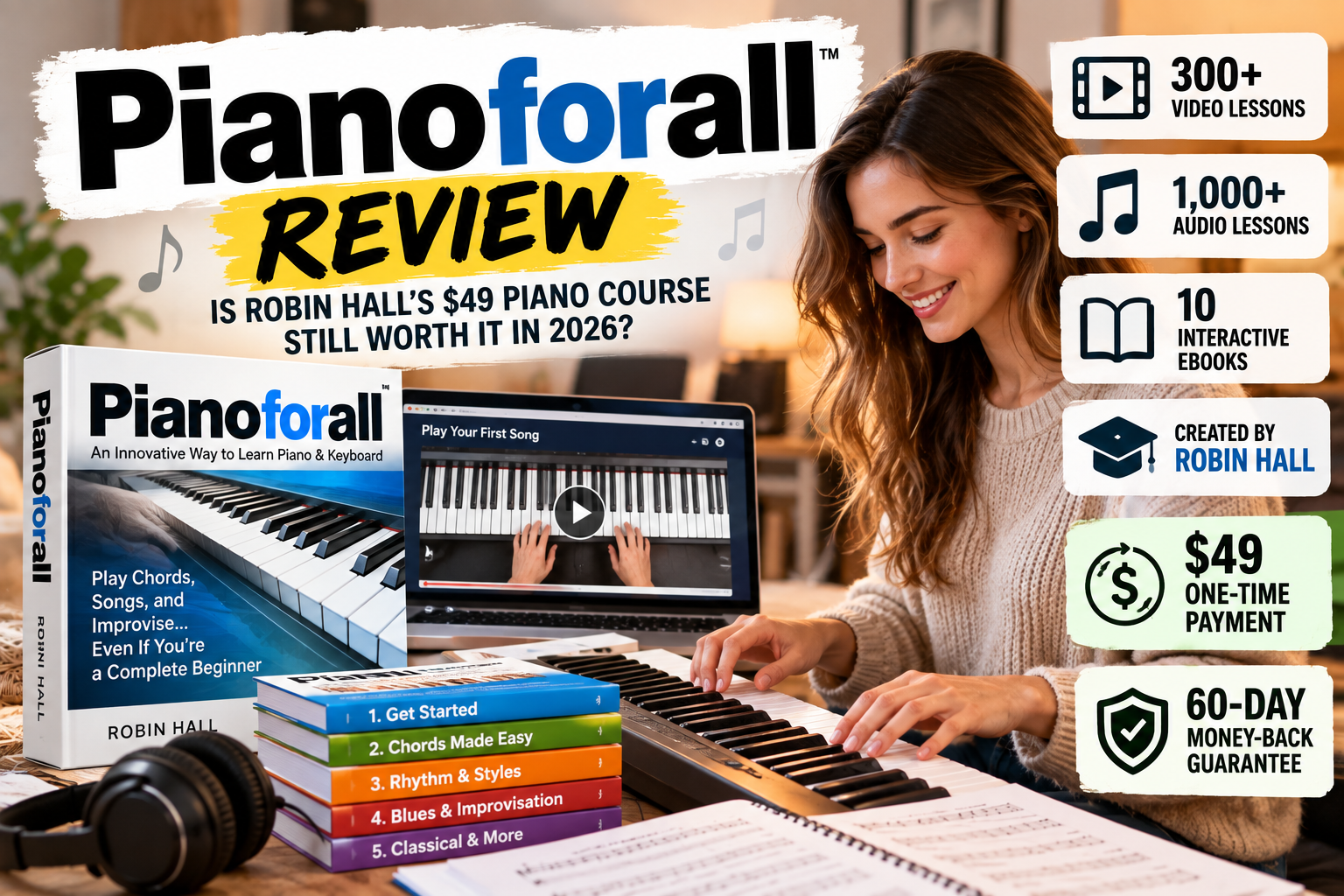
If you searched for a Pianoforall review because you want to learn piano without paying for weekly private lessons, there is one fact that makes this course unusual:
Pianoforall has been selling online for almost two decades.
Robin Hall launched the method in 2006, and the ClickBank offer has been tracked since 2008.
In an industry where online courses routinely disappear after a year or two, that’s a surprisingly long history.
But longevity doesn’t automatically make a piano course good.
And in 2026, Pianoforall faces a completely different competitive landscape than it did when it launched.
Today beginners can choose between interactive apps that listen to every note, enormous YouTube libraries, subscription platforms, AI-assisted tools and online teachers offering real-time feedback.
Meanwhile, Pianoforall still centers much of its method around interactive ebooks, video, audio, chords, rhythm patterns and playing by ear.
So the real question isn’t whether Pianoforall exists.
It clearly does.
The more interesting question is:
Has Robin Hall’s $49 chord-first method aged well enough to remain worth buying in 2026?
We investigated the current official offer, pricing, refund policy, ClickBank history, Udemy student data, independent piano-course reviews and organic discussions from people who have actually used the program.
- Personally Tested
- NO
- Research Type
- COMMUNITY RESEARCHED
- Official Product Materials Examined
- YES
- ClickBank Marketplace Data Examined
- YES
- Independent Expert Review Examined
- YES
- Udemy Student Data Examined
- YES
- Public Piano Community Discussions
- YES
- Independent First-Hand Accounts
- AVAILABLE, BUT MIXED
- Affiliate Relationship
- YES
- Vendor Provided Access
- NO
- Last Researched
- September 2026
Quick Answer: Is Pianoforall Worth It?
Pianoforall is a legitimate, established online piano course with a remarkably large student history.
The current official offer costs $49 as a one-time payment and includes lifetime access, interactive ebooks, video instruction, extensive audio material, updates and a 60-day money-back guarantee.
Robin Hall’s main teaching philosophy is simple:
get beginners playing chords, rhythms and recognizable musical patterns quickly instead of making them spend months reading notation before the piano sounds enjoyable.
For a certain kind of learner, that approach makes a lot of sense.
It appears particularly well suited to adults who want to:
- play pop accompaniment;
- understand chords;
- play by ear;
- learn blues and rhythm piano;
- improvise;
- and start making recognizable music quickly.
However, Pianoforall is not the strongest option for every piano goal.
An independent 2026 review by pianist, composer and music educator James Michael Nugent described the course as good value with some genuinely useful material, but criticized its dated presentation, confusing structure, shortcuts and weaker technical foundations.
Organic piano-community discussions raise similar concerns about sight-reading, classical development, technique and progression between lessons.
Our simplest early conclusion is therefore:
Pianoforall still offers a lot of piano education for $49, but its greatest strength is fast, chord-based practical playing — not replacing a complete traditional piano education.
Check the Current Pianoforall $49 Offer
What Is Pianoforall?
Pianoforall is a self-paced piano and keyboard course created by Robin Hall.
The method originally launched around 2006 and has remained commercially active ever since.
ClickBank marketplace tracking dates vendor PIANO4ALL to December 2008.
As of our September 2026 research, marketplace tracking showed a Gravity of approximately 34.34, meaning affiliates are still generating recent sales almost eighteen years after the ClickBank offer first appeared.
Gravity is not a customer-satisfaction score.
It simply indicates recent affiliate sales activity.
The official course currently combines:
- 10 structured interactive ebooks;
- hundreds of video lessons;
- extensive audio demonstrations and exercises;
- keyboard diagrams;
- music notation;
- rhythm exercises;
- chord patterns;
- blues;
- jazz;
- ballads;
- improvisation;
- and later classical material.
The current affiliate materials describe approximately 300 videos totaling more than 25 hours and more than 1,000 audio lessons.
More importantly, the course is not structured like a modern game-style piano app.
There is no animated character congratulating you for a five-day streak.
The core learning experience is much closer to:
an enormous multimedia piano method book with embedded demonstrations.
For some students, that is refreshingly straightforward.
For others, it may immediately feel old-fashioned.
Who Is Robin Hall?
Robin Hall is the creator and instructor behind Pianoforall.
Unlike many creators attached to old ClickBank products, Hall has a substantial public teaching footprint outside the sales page.
His Udemy instructor profile currently shows more than 450,000 total learners across his courses.
The main Pianoforall course on Udemy alone currently displays more than:
426,000 students
and approximately:
53,000 ratings with an average around 4.7/5.
The Udemy course was also updated in February 2026.
This is useful evidence because it shows that a very large number of students have interacted with Robin Hall’s teaching outside the direct ClickBank sales page.
There is an important qualification, however.
The Udemy version and the current direct-site package should not automatically be assumed to be identical in every detail.
They are different distribution environments, and course structure or included downloads can vary.
Still, the Udemy enrollment history provides much stronger evidence of real student adoption than the anonymous testimonials attached to many information products.
How Much Does Pianoforall Cost?
The current official Pianoforall order page displays:
$49 — one-time payment
with a crossed-out reference price of $79.
The current purchase includes:
- full course access;
- interactive ebooks;
- step-by-step video lessons;
- 1,000+ audio lessons;
- multi-device use;
- email support;
- lifetime updates;
- and a 60-day money-back guarantee.
The official FAQ is unusually direct about subscriptions.
It says the main Pianoforall purchase is charged only once and explicitly states that Robin Hall does not want the main program to operate as a subscription.
That is a meaningful difference from modern piano-learning platforms that may cost $10, $20 or more every month for as long as you want access.
What Does “Lifetime Access” Mean?
The current Pianoforall terms define lifetime access more carefully than the marketing headline.
It means access for:
the lifetime of the course while Pianoforall continues to offer and support it.
That’s worth knowing.
It is not literally a contractual promise that a server will remain online for the rest of your natural life regardless of what happens to the business.
But considering Pianoforall has already existed for close to two decades, the course has a much longer operating record than most digital programs making similar lifetime-access promises.
Does Pianoforall Have Upsells?
Yes.
The official affiliate page currently identifies a post-purchase product called:
Classics By Ear
at approximately:
$49.
There is also a current official post-purchase offer presenting access to current and future Classics By Ear courses.
So while the main Pianoforall product itself is a $49 one-time purchase, buyers should expect that at least one additional offer may appear.
You do not need to assume the upsell is required to use the main Pianoforall curriculum.
Does Pianoforall Have a Refund Policy?
Yes.
The official order page and current Terms of Use state a:
60-day money-back guarantee.
The FAQ says a customer can request a refund from Pianoforall directly or through ClickBank.
As with any digital purchase, we recommend keeping your receipt and the terms displayed when you order.
How Does Pianoforall Teach Piano?
This is the most important part of deciding whether the course fits you.
Pianoforall deliberately does not begin the same way many traditional piano methods do.
Instead of spending the first several weeks primarily on:
- individual note names;
- simple sight-reading;
- scales;
- finger drills;
- and basic classical exercises,
Robin Hall tries to get beginners playing useful rhythm patterns quickly.
Students learn chord shapes and reusable patterns that can be applied across many songs.
The idea is psychologically appealing:
sound musical first, then gradually learn why what you’re playing works.
Hall describes the keyboard in terms of shapes and patterns, which can make harmony feel less intimidating to visual learners.
The course then expands from basic rhythm piano toward:
- blues;
- rock;
- chord inversions;
- ballads;
- jazz;
- improvisation;
- melody;
- sheet music;
- and classical repertoire.
This structure explains both why some students love Pianoforall and why some traditional pianists criticize it.
The Big Advantage: You Play Music Early
Traditional beginner piano methods can feel slow to adults who simply want to sit down at a keyboard and produce something recognizable.
Pianoforall attacks that motivation problem directly.
Instead of treating chords and rhythm as advanced concepts, they become the starting point.
This can be particularly effective for people who want to:
- accompany themselves while singing;
- play pop music;
- understand chord progressions;
- play with other musicians;
- improvise;
- or learn music by ear.
Recent organic discussion in piano-learning communities supports this distinction.
One experienced commenter summarized Pianoforall as particularly effective for someone who wants to build from zero toward chord-based accompaniment, while warning that it is much less suitable as a primary classical sight-reading curriculum.
That seems consistent with the actual design of the product.
The Chord-First Method Is Not the Same as Complete Piano Training
This is where expectations matter.
Being able to play:
C – Am – F – G
in multiple rhythm patterns can make you sound musical relatively quickly.
That’s valuable.
But piano technique also involves issues that are difficult for any self-paced digital course to assess:
- posture;
- hand position;
- wrist tension;
- finger movement;
- touch;
- pedaling;
- balance between hands;
- timing;
- and physical efficiency.
A video can demonstrate these things.
It cannot look at your hands and tell you that you’re developing tension.
This is one of the fundamental limitations of Pianoforall compared with a good teacher.
It is also a limitation shared by many online courses.
What Do Real Pianoforall Students Say?
Compared with many ClickBank products, Pianoforall has an unusually large amount of public student activity.
But the quality of that evidence varies considerably.
Udemy Has the Largest Visible Dataset
The current Udemy listing shows more than 426,000 students and approximately 53,000 ratings, averaging around 4.7/5.
That is a much larger visible dataset than the direct website’s testimonial page.
Recent 2026 student feedback visible through Udemy-related course listings includes adults describing Robin’s explanations as clear and saying they are making progress despite beginning later in life.
Again, we would not convert the Udemy rating into:
“Pianoforall.com is rated 4.7/5 by customers.”
The rating belongs to the Udemy course listing.
But it does establish that large numbers of real users have enrolled in and rated a version of Robin Hall’s curriculum.
Trustpilot Is Not Useful Yet
Trustpilot currently has only one review associated with Pianoforall.
That single review is positive.
But one review is not a meaningful customer-satisfaction sample.
We therefore would not use Trustpilot to judge the program either positively or negatively.
Reddit Feedback Is More Mixed
Organic piano-community discussions are much more interesting.
Some users say the chord-based approach is fun and gets them playing quickly.
Others describe frustration when Hall demonstrates chord inversions or more advanced variations before they feel fully comfortable with the underlying concept.
Another recurring criticism is that the program is much stronger for rhythm/chord piano than for someone whose primary goal is classical playing and fluent sight-reading.
That doesn’t mean one side is right and the other is wrong.
It suggests something more useful:
Pianoforall produces very different reactions depending on what the student believes “learning piano” should mean.
One of the Best Independent Reviews Is Not Particularly Flattering
One of the more useful 2026 reviews we found came from James Michael Nugent at Pianist’s Compass.
Nugent identifies himself as a pianist, composer and music educator with more than 25 years of industry experience.
Unlike many affiliate-style pages, his evaluation is fairly critical.
He described Pianoforall as:
good value with some useful content, but increasingly old-fashioned compared with modern learning platforms.
His main criticisms included:
- confusing structure;
- weaknesses in building technical foundations;
- too many shortcuts;
- limited engagement compared with newer platforms;
- and an overall presentation that shows its age.
His overall rating was 2.8/5.
We are not adopting that score as our own.
But we consider the underlying criticism useful because it comes from someone evaluating the curriculum from a music-education perspective rather than simply repeating the sales page.
Where Pianoforall Falls Short
1. The Format Feels Dated
The world of online education has changed dramatically since Pianoforall launched.
Modern piano apps can:
- listen through your microphone or MIDI connection;
- detect notes;
- track progress;
- gamify practice;
- build daily streaks;
- automatically repeat difficult passages;
- and visually guide students in real time.
Pianoforall’s multimedia ebooks are functional.
But functionally good and technologically modern are different things.
If you’re accustomed to slick app interfaces, the course can feel like an older generation of online learning.
2. There Is No Real-Time Correction
This is probably the biggest educational disadvantage versus a teacher or interactive listening app.
Pianoforall can show you what Robin plays.
It cannot hear what you just played and say:
“Your rhythm is late.”
“Your wrist is tense.”
“You’re using the wrong fingering.”
“That chord should be softer.”
That feedback loop matters more as technique becomes advanced.
3. Sight-Reading Is Not the Primary Foundation
Pianoforall does eventually teach reading and includes classical material.
But its philosophy deliberately prioritizes patterns, chords, playing by ear and practical harmony first.
If your number-one goal is:
becoming a strong classical sight-reader from the beginning,
a traditional method may align better with your goals.
4. Progression Can Feel Fast
Some learners appreciate that the course avoids moving painfully slowly.
Others report moments when demonstrations introduce inversions, voicings or musical variations they don’t yet feel prepared to reproduce.
This is the tradeoff behind “learn faster.”
Moving quickly is motivating when you’re keeping up.
It can become frustrating when you aren’t.
Pianoforall vs Modern Piano Apps
This is probably the most important purchasing comparison in 2026.
Pianoforall costs:
$49 once.
Many modern piano-learning platforms use recurring subscriptions.
That creates two very different value propositions.
What Modern Apps Do Better
- interactive feedback;
- slick interfaces;
- automatic progress tracking;
- gamification;
- real-time note recognition;
- guided practice sessions.
What Pianoforall Does Better
- one-time purchase;
- less dependence on subscription access;
- strong chord and rhythm focus;
- ear training;
- practical harmony;
- a large amount of material for relatively little money;
- freedom to work through the curriculum without an app constantly grading you.
One approach isn’t universally superior.
Some students find real-time app feedback motivating.
Others find it irritating.
A recent Reddit comparison, for example, described Flowkey’s insistence on repeating phrases until the software judged them correct as frustrating, while Pianoforall felt more flexible.
That is a preference issue as much as a curriculum issue.
Pianoforall vs a Real Piano Teacher
A $49 course obviously cannot provide the same service as individualized instruction.
A good teacher can:
- watch your hands;
- correct tension;
- adapt exercises to your weaknesses;
- choose repertoire appropriate to your level;
- hear timing and articulation problems;
- and stop bad habits before they become deeply established.
Pianoforall cannot do those things.
But the financial comparison is also obvious.
A single private piano lesson can cost as much as — or more than — the entire Pianoforall course.
That makes the program potentially useful as:
a low-cost starting point or supplement
rather than necessarily:
a permanent replacement for all human instruction.
What About the “500,000+ Students” Claim?
The official website currently says Pianoforall has taught more than half a million students worldwide.
We cannot independently audit every direct sale made since 2006.
But there is unusually strong evidence that the audience is genuinely large.
Udemy alone currently shows more than 426,000 enrollments for the main Pianoforall course, while Robin Hall’s overall Udemy instructor profile reports more than 450,000 learners.
That does not independently prove exactly 500,000 unique paid Pianoforall students worldwide.
But unlike many marketing claims we investigate, the scale is at least directionally supported by a major third-party learning platform.
What About the Official Testimonials?
Pianoforall publishes a large number of testimonials on its own website.
The affiliate page even claims potential customers can request contact information for certain testimonial contributors in order to verify their experiences.
That’s more transparent than simply displaying anonymous first names and stock photos.
But they are still:
vendor-selected testimonials.
We therefore do not use them to calculate an independent customer-satisfaction rate.
The larger Udemy dataset and organic piano-community conversations are more useful for balancing the official presentation.
Is Pianoforall a Scam?
We found no evidence that would justify characterizing Pianoforall as a scam.
The product has:
- operated online since 2006;
- been tracked on ClickBank since 2008;
- a current operating website;
- an identifiable creator;
- a company identified in its current legal terms;
- hundreds of thousands of visible Udemy students;
- tens of thousands of Udemy ratings;
- a clearly published price;
- and a 60-day refund policy.
The legitimate debate is not:
“Does the course exist?”
It clearly does.
The legitimate debate is:
“Is its teaching style still the right way for me to learn piano in 2026?”
That’s a much more useful question.
Can You Learn Piano for Free Instead?
Absolutely.
YouTube contains an enormous amount of high-quality piano instruction.
There are also:
- free method resources;
- public-domain sheet music;
- music-theory websites;
- free practice tools;
- and communities where experienced musicians answer questions.
So you are not paying Pianoforall because Robin Hall possesses secret knowledge unavailable anywhere else.
You are paying for:
organization.
The course creates a sequence.
Instead of asking every day:
“Which YouTube video should I watch next?”
you have a defined path from basic rhythm patterns through progressively broader musical concepts.
For self-directed learners, that structure can be worth considerably more than the raw information itself.
See What’s Included in Pianoforall
Who Is Pianoforall Best For?
We think Pianoforall is particularly well suited to:
Adult Beginners
Especially adults who don’t want their first months at the piano to feel like children’s music lessons.
People Who Want to Play Popular Music
The chord-and-rhythm method maps naturally to pop accompaniment and many familiar song structures.
Guitarists and Other Musicians
Someone who already understands chords, rhythm and song structure may adapt particularly quickly to Hall’s approach.
People Who Want to Play by Ear
Pianoforall explicitly emphasizes understanding patterns and harmony rather than relying exclusively on notation.
Self-Motivated Learners
There are no weekly appointments forcing you to practice.
That flexibility is valuable only if you actually use it.
Who Should Probably Choose Something Else?
Serious Classical Students
If your long-term goal is rigorous classical technique, exams, conservatory preparation or advanced repertoire, Pianoforall should probably not be your only method.
Students Who Need Live Feedback
If you need someone to correct every mistake as it happens, consider a teacher or interactive platform.
People Who Love Gamification
Pianoforall is not primarily a modern app experience with points, badges, leaderboards and automatic assessment.
Students Who Want Sight-Reading First
The course eventually teaches notation, but its fundamental philosophy begins somewhere else.
Is Pianoforall Worth $49?
At $49 one-time, Pianoforall is relatively inexpensive compared with almost every form of structured piano instruction.
The amount of content is substantial.
The creator has an unusually long teaching history.
The course has a huge visible student base on Udemy.
And the chord-first approach can make early practice more enjoyable for people who are primarily interested in popular music.
But price alone doesn’t determine whether a course is right for you.
A $49 program you abandon after three lessons is more expensive than a free resource you practice consistently for a year.
The real question is whether Pianoforall’s learning style matches how you want to play.
If your goal is:
“I want to understand chords, accompany songs, play by ear and start sounding musical quickly,”
the value proposition is strong.
If your goal is:
“I want rigorous classical technique and sight-reading development from lesson one,”
the same $49 course becomes much less compelling.
Our Conclusion: Is Pianoforall Worth It in 2026?
Pianoforall has survived online long enough to become almost a different category of digital product.
It predates modern app stores.
It predates today’s subscription-heavy learning platforms.
And somehow, almost two decades later, people are still buying it.
There are good reasons for that.
The $49 one-time price is attractive.
The library is substantial.
Robin Hall’s chord-first approach can get an adult beginner making recognizable music much faster than some traditional methods.
And there is unusually strong public evidence that large numbers of students have actually gone through his teaching, particularly through Udemy.
But the program also shows its age.
It does not provide the instant feedback, polished interfaces or gamified progression modern piano apps can offer.
Independent expert criticism also raises legitimate questions about technical foundations, course structure and shortcuts.
So we think the fairest description is:
Our Simplest Conclusion
Pianoforall is still a legitimate and unusually affordable way to learn practical chord-based piano, but in 2026 it feels more like a very large multimedia method book than a modern interactive learning platform.
That isn’t necessarily a disadvantage.
For someone who wants pop, blues, chords, improvisation and playing by ear — and who can practice independently — the simplicity may actually be part of the appeal.
For someone who needs live correction, gamification or a traditional classical foundation, there are better-fitting options.
At the current $49 one-time price, we think Pianoforall remains easiest to justify when you judge it for what it does best instead of expecting it to replace every kind of piano instruction.
Check the Current Pianoforall Offer & Price
Affiliate disclosure: If you purchase through this link, TestimonialBlogs may earn a commission at no additional cost to you. Affiliate revenue helps fund future product investigations. It does not change what we report.
Pianoforall FAQ
Is Pianoforall legit?
Yes. Pianoforall is an established online piano course created by Robin Hall. It has operated since 2006, has been tracked through ClickBank since 2008 and has a very large visible student history on Udemy.
How much does Pianoforall cost?
The official order page we checked in September 2026 displayed $49 as a one-time payment, reduced from a displayed reference price of $79.
Is Pianoforall a subscription?
The main Pianoforall course is currently sold as a one-time purchase. The official FAQ explicitly says the main program is not a subscription. Optional additional products may be offered separately.
Does Pianoforall include lifetime access?
Yes. The current offer advertises lifetime access. The current Terms of Use clarify that lifetime means the lifetime of the course while it continues to be offered and supported by Pianoforall.
Does Pianoforall have a money-back guarantee?
Yes. The current official terms and order page advertise a 60-day money-back guarantee.
Does Pianoforall have upsells?
Yes. Current official affiliate materials identify an optional Classics By Ear offer after the main course purchase. Buyers should evaluate any additional offer separately.
Who created Pianoforall?
Pianoforall was created by Robin Hall, who has taught hundreds of thousands of students online. His main Udemy Pianoforall course currently shows more than 426,000 enrolled students.
Is Pianoforall good for complete beginners?
It can be, particularly for adult beginners who want to start with chords and rhythm rather than extensive note-reading exercises. Some students find its progression fast, so learners who need slower, highly structured feedback may prefer another method.
Does Pianoforall teach sheet music?
Yes, but reading music is not the first emphasis. The program begins more heavily with chords, patterns, rhythm and playing by ear before expanding into notation and classical material.
Can Pianoforall teach classical piano?
The later material includes classical pieces and reading, but Pianoforall is not primarily designed as a rigorous classical-piano curriculum. Serious classical students will likely need additional instruction.
Does Pianoforall listen to you play?
Not in the way modern interactive apps can use a microphone or MIDI connection to evaluate each note. Pianoforall demonstrates material through text, diagrams, audio and video, but the student largely evaluates their own playing.
Is Pianoforall better than Simply Piano or Flowkey?
They emphasize different learning experiences. Modern apps generally provide more interactive feedback and progress tracking, while Pianoforall emphasizes a one-time purchase, chords, rhythm, ear training and self-paced study without a recurring subscription.
Can you really learn piano online?
You can learn substantial musical skills through online courses, but self-study does not provide the individualized technical correction of a good teacher. Many learners combine online resources with occasional in-person instruction.
Is Pianoforall worth it?
It is potentially good value for self-motivated adult beginners interested in practical chord-based playing, pop, blues and improvisation. It is less compelling for students whose primary goals are classical technique, intensive sight-reading or real-time feedback.
Sources and Methodology Notes
This investigation compared Pianoforall’s current official product pages and legal terms with ClickBank marketplace tracking, its public affiliate materials, the current Udemy course listing, an independent 2026 review by pianist and music educator James Michael Nugent, Trustpilot and organic discussions in piano-learning communities.
Representative sources checked for this update include:
- Pianoforall official website and current order page
- Pianoforall current FAQ and Terms of Use
- Pianoforall official affiliate program materials
- CBSnooper marketplace tracking for vendor PIANO4ALL
- Robin Hall’s current Udemy instructor profile
- The Pianoforall Udemy course listing
- Pianist’s Compass 2026 Pianoforall review by James Michael Nugent
- Trustpilot Pianoforall profile
- Organic r/piano and r/pianolearning discussions
Why TestimonialBlogs Calls This “Community Researched”
We did not personally complete Pianoforall before publishing this investigation.
So we are not going to tell you:
“We practiced for 60 days and went from complete beginner to pianist.”
We found plenty of pages online making variations of that claim.
Some may be genuine.
Others are clearly affiliate content or cannot be independently authenticated.
Instead, we examined evidence that can actually be checked:
- the current official product;
- current price and guarantee;
- ClickBank history;
- course structure;
- Robin Hall’s public teaching footprint;
- hundreds of thousands of visible Udemy enrollments;
- tens of thousands of Udemy ratings;
- an independent professional pianist’s assessment;
- organic student discussions;
- and recurring strengths and criticisms across those sources.
Pianoforall is actually easier to investigate than many digital courses because it has existed long enough to accumulate a real public history.
That history does not produce one unanimous verdict.
Some students love the practical, chord-first approach.
Some musicians think it skips too much.
Both reactions can be genuine.
The useful question is not:
“Does everybody like Pianoforall?”
No course can answer that.
The useful question is:
“Does Pianoforall’s teaching philosophy fit what you actually want to learn?”
That’s the distinction we think matters.