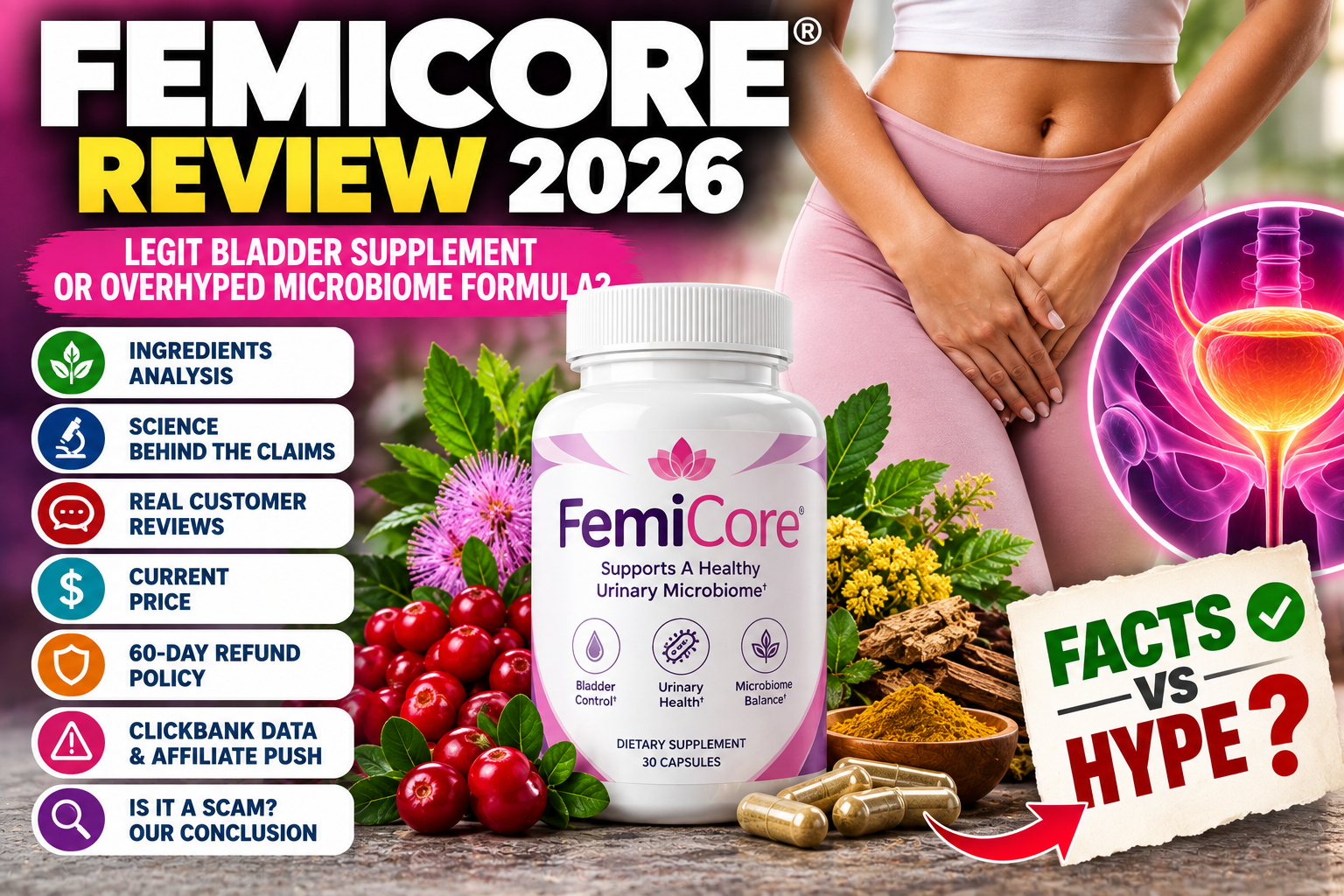
If you searched for a FemiCore review after seeing claims about bladder leaks, sudden urinary urgency or restoring your “urinary microbiome,” there is one thing you should understand before anything else:
the urinary microbiome is real.
Modern research has shown that the female bladder is not necessarily sterile.
Researchers have identified:
- bacterial communities in the urinary tract;
- differences between women with and without certain forms of urinary incontinence;
- and potentially important differences involving Lactobacillus species.
That part of the FemiCore story is based on a legitimate and developing area of science.
But FemiCore goes significantly further.
The current official sales page says:
“toxic dioxins” can throw the urinary microbiome out of balance and lead to uncontrollable pee leaks.
Then it says FemiCore helps by:
repopulating the urinary microbiome with beneficial bacteria.
That sounds like a clean scientific chain:
Dioxins → microbiome imbalance → bladder contractions → leaks → probiotics fix the problem.
But when we investigated the research behind each part of that chain:
the evidence became much less straightforward.
We found human research supporting the existence of the urinary microbiome.
We found studies showing associations between urinary bacterial communities and urinary incontinence.
We found research involving Lactobacillus and recurrent urinary infections.
We found evidence that cranberry may reduce recurrent UTI risk in some women.
We even found research showing that very high experimental dioxin exposure can affect urinary function in animals.
What we did not find was:
human clinical evidence demonstrating that ordinary female bladder leakage is primarily caused by toxic dioxins disrupting the urinary microbiome — or that taking FemiCore reverses that process.
That’s a much bigger claim.
And it isn’t the only interesting thing we discovered.
FemiCore is currently one of:
the highest-performing women’s health offers on ClickBank.
Current marketplace tracking shows Gravity around:
90.
Average affiliate earnings are roughly:
$200 per sale.
That creates an enormous financial incentive for affiliates to publish:
positive FemiCore reviews.
And some of the supposed first-person reviews we found online describe:
ingredients that aren’t even present on FemiCore’s current official label.
So instead of repeating the sales presentation, we investigated:
the actual label.
The actual ingredients.
The urinary microbiome research.
The dioxin claim.
The probiotic evidence.
The cranberry evidence.
The pricing.
The 60-day refund process.
And whether the thousands of glowing reviews surrounding FemiCore should be taken at face value.
- Personally Tested
- NO
- Research Type
- COMMUNITY RESEARCHED
- Current Official Sales Page Examined
- YES
- Current Supplement Facts Label Examined
- YES
- Current Ingredient Formula Examined
- YES
- Current Pricing Examined
- YES
- Current Refund Terms Examined
- YES
- ClickBank Marketplace Data Examined
- YES
- Urinary Microbiome Research Examined
- YES
- Lactobacillus Research Examined
- YES
- Cranberry Research Examined
- YES
- Dioxin Evidence Examined
- YES
- Independent Clinical Trial of Complete FemiCore Formula Found
- NO
- Independent First-Hand Reviews Verified
- LIMITED
- Affiliate Relationship
- YES
- Vendor Provided Access
- NO
- Last Researched
- September 2026
Health note: FemiCore is a dietary supplement, not an FDA-approved treatment for urinary incontinence, overactive bladder or urinary tract infection. New or worsening urinary symptoms, pain, blood in the urine, inability to urinate, recurrent infections or significant incontinence should be evaluated by a qualified healthcare professional.
Quick Answer: Is FemiCore Legit?
FemiCore appears to be a real physical dietary supplement sold through an active ClickBank operation.
The current official FemiCore page identifies:
ClickBank as the retailer.
We can also verify:
- a current Supplement Facts label;
- a physical 30-capsule bottle;
- an active product-support address;
- a current ClickBank marketplace listing;
- multi-bottle purchase options;
- and a 60-day refund policy.
So the main concern is not:
“Does FemiCore exist?”
It does.
The harder question is:
“Does the scientific evidence establish that FemiCore works the way its marketing says it works?”
There, the answer becomes:
much less certain.
The basic concept that bladder health may be connected to microbial communities is legitimate.
But:
association is not the same thing as proving cause.
And even if changes in the urinary microbiome contribute to certain types of incontinence:
that does not automatically establish that:
an oral probiotic capsule will rebuild the bladder microbiome and stop leakage.
Most importantly:
we did not find an independent randomized clinical trial testing the complete FemiCore product against placebo.
See the Current FemiCore Offer & Price
What Is FemiCore?
FemiCore is a once-daily dietary supplement marketed primarily toward:
women dealing with urinary urgency, bladder leaks and reduced bladder confidence.
The formula combines:
a botanical blend
with:
a five-strain Lactobacillus probiotic blend.
Unlike many bladder supplements that focus on:
- pumpkin seed;
- soy isoflavones;
- D-mannose;
- or cranberry alone,
the current official FemiCore formula is primarily built around:
- Mimosa pudica;
- cranberry;
- bearberry;
- berberine;
- and five Lactobacillus strains.
The company’s central marketing idea is:
microbiome restoration.
What Does the Actual FemiCore Label Say?
This is one of the most useful pieces of evidence we found.
The current manufacturer label lists:
Serving Size: 1 capsule.
Each bottle contains:
30 servings.
Herbal Blend — 350 mg
The label lists:
- Mimosa pudica Seed Extract;
- Cranberry Extract standardized to 30% proanthocyanidins;
- Bearberry / Uva Ursi leaf;
- and Granular Berberine Hydrochloride Extract 8%.
Probiotic Blend — 50 mg
The label lists:
- Lactobacillus crispatus LCr86;
- Lactobacillus acidophilus LA88;
- Lactobacillus plantarum N13;
- Lactobacillus gasseri LG08;
- and Lactobacillus casei LC16.
Other ingredients include:
- gelatin;
- brown rice flour;
- magnesium stearate;
- olive oil;
- and silicon dioxide.
That means the current capsule is:
not vegetarian.
It contains a gelatin shell.
The Biggest Label Limitation
Although FemiCore lists nine active ingredients:
it does not publish the amount of each individual ingredient.
Instead:
four botanicals share:
350 mg.
Five probiotic strains share:
50 mg.
That creates a major evidence problem.
Suppose a clinical study uses:
36 mg of cranberry proanthocyanidins.
To compare FemiCore fairly:
we would need to know:
how much cranberry is actually inside the 350 mg blend.
We don’t.
The same issue becomes even more important for probiotics.
Probiotics are normally evaluated by:
colony-forming units — CFUs.
The FemiCore label gives:
50 mg.
But it does not disclose:
the CFU count.
So we cannot meaningfully compare its probiotic dose with:
the dose used in clinical research.
Is the Female Urinary Microbiome Really a Thing?
Yes.
This is one area where FemiCore’s marketing is built on real modern science.
For decades:
healthy urine was often described as:
sterile.
More sensitive sequencing and culture techniques changed that picture.
Researchers have identified:
resident bacterial communities in the female urinary tract.
Studies involving women with:
urgency urinary incontinence
have found differences between microbial communities in women:
with and without symptoms.
One influential study found:
less Lactobacillus and more Gardnerella
in women with urgency urinary incontinence compared with controls.
That is fascinating.
And it provides a scientifically plausible reason to continue researching:
microbiome-based approaches to bladder health.
But Does That Mean Microbiome Imbalance Causes Bladder Leaks?
Not necessarily.
This is the point where:
association and causation
must be separated.
If researchers find different bacteria in:
women with incontinence
versus:
women without incontinence,
several explanations are possible.
The microbial difference could:
- contribute to symptoms;
- result from the condition;
- be influenced by age;
- be influenced by hormones;
- be influenced by treatment;
- or reflect another biological factor entirely.
In fact:
a study involving women with mixed urinary incontinence found that:
overall Lactobacillus predominance was not significantly different between cases and controls.
Differences appeared mainly in:
younger subgroups.
That makes the science:
interesting but still developing.
What About FemiCore’s “Toxic Dioxins” Claim?
This was probably the most surprising part of the entire investigation.
The current FemiCore FAQ says:
toxic dioxins can throw the urinary microbiome out of balance and lead to uncontrollable pee leaks.
Dioxins are:
real toxic environmental pollutants.
The World Health Organization says high dioxin exposure can:
- affect reproduction;
- affect development;
- damage immune function;
- interfere with hormones;
- and increase cancer risk.
So:
dioxin toxicity itself is not invented.
There is also animal research showing that developmental exposure to TCDD:
a highly toxic dioxin
can affect urinary function under experimental conditions.
But:
that is a very different statement from saying dioxins are the underlying cause of everyday bladder leakage in women.
What We Did NOT Find
We did not find convincing human evidence demonstrating the full chain:
normal environmental dioxin exposure → urinary microbiome disruption → involuntary bladder contractions → urinary leakage.
We also did not find a human clinical trial showing that:
FemiCore removes dioxins from the urinary system.
And we did not find evidence showing that:
FemiCore’s probiotics reverse dioxin-induced urinary microbiome changes in humans.
This is therefore one of the parts of the marketing where:
the story appears substantially more specific than the available direct evidence.
FemiCore Ingredients: What Does the Evidence Actually Say?
Let’s separate:
ingredient research
from:
FemiCore product evidence.
Cranberry Extract
Cranberry has:
the clearest urinary-health evidence among the botanical ingredients in the formula.
Research suggests cranberry products may reduce:
recurrent symptomatic urinary tract infections
in some women.
The U.S. National Center for Complementary and Integrative Health currently says cranberry may reduce recurrent UTI risk by approximately:
25% overall in some populations.
FDA also allows a:
qualified health claim
for certain cranberry products.
But the evidence is described as:
limited.
And cranberry has:
not been shown to treat an existing UTI.
More importantly for this review:
UTI prevention is not the same thing as treating urinary incontinence.
Bearberry / Uva Ursi
Bearberry has a long history of:
traditional urinary use.
It contains compounds related to:
arbutin.
But traditional use should not automatically be interpreted as:
proof that bearberry stops bladder leakage.
And because FemiCore doesn’t publish:
the individual bearberry dose,
we cannot compare the capsule directly with a specific research dose.
Berberine
Berberine has become extremely popular in supplement research.
It has been studied in relation to:
- glucose metabolism;
- lipids;
- gut microbiota;
- and several metabolic conditions.
But FemiCore is not primarily sold as:
a glucose supplement.
The important question is whether its berberine dose has been shown to:
reduce female urinary incontinence.
We did not find strong evidence establishing that.
Mimosa Pudica
Mimosa pudica is probably:
the weakest-evidence major botanical in the current FemiCore blend.
It appears frequently in:
“detox” and gut-cleansing supplements.
But we found little convincing human clinical evidence supporting it as:
a treatment for urinary urgency or incontinence.
That matters because:
Mimosa pudica is listed first in the 350 mg proprietary blend.
Under normal supplement-label conventions:
that means it is present in:
the largest amount by weight among those four ingredients.
What About the Five Lactobacillus Strains?
This is probably the most scientifically interesting part of FemiCore.
FemiCore contains:
- Lactobacillus crispatus;
- Lactobacillus acidophilus;
- Lactobacillus plantarum;
- Lactobacillus gasseri;
- and Lactobacillus casei.
Research has shown:
Lactobacillus species can be important components of the female urogenital microbiome.
Lactobacillus crispatus is particularly interesting.
Researchers have studied:
intravaginal L. crispatus
for preventing recurrent urinary tract infections.
A randomized placebo-controlled trial found:
a potentially lower recurrence of UTI.
More recent systematic-review evidence also suggests:
probiotic strategies may have potential in recurrent UTI prevention.
But:
there are three enormous differences between that evidence and FemiCore.
The Three Differences That Matter
1. The Clinical Condition Is Different
Much of the better probiotic evidence involves:
recurrent urinary tract infections.
FemiCore is primarily marketed around:
bladder leaks and urinary control.
Those are:
not the same condition.
2. The Route of Administration Is Different
The stronger L. crispatus research we found used:
intravaginal administration.
FemiCore is:
swallowed orally.
An oral probiotic must:
- survive the digestive tract;
- interact with intestinal ecosystems;
- and somehow influence the urogenital microbiome.
That does not mean:
it cannot have an effect.
It means:
you cannot assume an intravaginal study proves an oral capsule works the same way.
3. FemiCore Doesn’t Publish a CFU Count
This might be:
the biggest practical limitation.
The label says:
50 mg Probiotic Blend.
But probiotics are normally characterized by:
live organism count.
Without a CFU figure:
we cannot tell whether the product delivers:
a clinically meaningful probiotic dose.
Does FemiCore Really Work for Bladder Leaks?
Based on what we found:
there is not enough independent product-level evidence to say FemiCore has been clinically proven to stop bladder leakage.
There is:
biological plausibility.
There is:
urinary microbiome research.
There is:
Lactobacillus research.
There is:
cranberry research.
But these pieces do not automatically equal:
clinical evidence for FemiCore itself.
That would require testing:
this exact formula
at:
this exact dose
against:
a placebo
while measuring:
- urinary leakage episodes;
- urgency;
- frequency;
- quality of life;
- and adverse effects.
We did not find that trial.
Can You Trust FemiCore Reviews Online?
This became one of the most interesting parts of our research.
The current official FemiCore page claims:
more than 19,000 customer reviews.
But the page does not provide:
19,000 independently searchable customer accounts.
And the broader independent review footprint we found is:
surprisingly thin for such a high-volume ClickBank product.
That makes evaluating:
real-world customer experience
more difficult.
Some “First-Hand” Reviews Describe the Wrong Formula
We found supposedly personal FemiCore reviews on Reddit claiming the reviewer used a formula containing:
- pumpkin seed extract;
- soy germ isoflavones;
- and other bladder-support ingredients.
The reviewer also described taking:
two capsules per day.
There is a problem.
The current official FemiCore label says:
one capsule per day.
And it lists:
- Mimosa pudica;
- cranberry;
- bearberry;
- berberine;
- and five Lactobacillus strains.
It does not list:
pumpkin seed or soy isoflavones.
This doesn’t allow us to prove:
why the Reddit post is inaccurate.
Perhaps the author confused:
FemiCore with another bladder supplement.
Perhaps the product formula changed.
Perhaps the review wasn’t actually based on the current product.
But whatever the explanation:
we would not treat that account as reliable evidence for today’s FemiCore formula.
Why This Matters for Google Reviews
When an affiliate product pays:
roughly $200 per average sale,
there is:
a very large incentive to create review content.
That does not automatically make affiliate reviews dishonest.
TestimonialBlogs also uses:
affiliate links.
But a page should at minimum demonstrate:
that the writer knows which product they’re reviewing.
If the ingredient list doesn’t even match the bottle:
that should reduce your confidence in the rest of the article.
How Much Does FemiCore Cost in 2026?
The current FemiCore offer uses:
multi-bottle packages.
2 Bottles
$79 per bottle.
Total:
$158.
Current U.S. shipping:
$9.99.
This is approximately:
a 60-day supply.
3 Bottles
$69 per bottle.
Total:
$207.
Current U.S. shipping:
free.
This is approximately:
a 90-day supply.
6 Bottles
$49 per bottle.
Total:
$294.
Current U.S. shipping:
free.
The current package also includes:
three digital bonuses.
This is approximately:
a 180-day supply.
Check Today’s FemiCore Price & Packages
What About the Huge “Savings” Numbers?
The FemiCore offer compares its current package pricing with:
a much higher stated retail price.
That creates savings claims such as:
- $200 saved;
- $330 saved;
- and $780 saved.
Consumers should understand:
the meaningful price is what the product actually sells for today.
A comparison against:
a theoretical list price
does not necessarily mean people regularly paid:
that higher price.
What Are the FemiCore Bonuses?
The current six-bottle package advertises three digital guides:
- 7 Days To Rekindle The Passion In Your Marriage;
- Reset Your Gut: Perfect Digestion While Eating Your Favorite Foods;
- Unlock Painless Hips & Legs: The Complete Lower Body Mobility Blueprint.
These are:
digital bonus guides.
They are not:
additional FemiCore bottles.
And they should not be treated as:
independent medical treatments.
Does FemiCore Have a Money-Back Guarantee?
Yes.
The current official offer advertises:
a 60-day money-back guarantee.
But buyers should know:
you must return the bottles.
The current seller FAQ says:
to receive the full refund, return:
ALL bottles.
That includes:
- empty bottles;
- partially used bottles;
- and unopened bottles.
You also need:
the packing slip.
Return postage is generally:
the customer’s responsibility.
Do Not Throw Away Your FemiCore Bottles
This is practical advice worth highlighting.
If you’re trying FemiCore under the guarantee:
keep every bottle.
Don’t throw away:
an empty bottle after finishing the month.
If you later decide the product isn’t worth the cost:
the return terms require:
the physical bottles.
Also keep:
- your packing slip;
- your ClickBank order number;
- the original email receipt;
- and tracked return-shipping proof.
The Guarantee Creates an Interesting Buying Decision
A 2-bottle package provides:
approximately 60 days of product.
The guarantee also lasts:
60 days.
That means if someone wants to evaluate the supplement through nearly the entire 60-day supply:
they need to pay extremely close attention to the refund deadline.
Don’t assume:
you can finish two full bottles and then casually begin the return process afterward.
The guarantee clock is already running.
Why Is FemiCore Suddenly Everywhere?
The simplest answer:
affiliate economics.
As of late September 2026:
FemiCore is among:
the highest-ranking Health & Fitness products tracked on ClickBank.
Current marketplace tracking places it around:
Gravity 90.
Average affiliate earnings are around:
$200 per sale.
That is:
an exceptionally attractive payout.
It tells us:
the funnel is generating real affiliate commissions.
It does not tell us:
the percentage of women whose urinary leakage improves.
Those are completely different measurements.
ClickBank Gravity Does NOT Measure Medical Effectiveness
This is worth stating directly.
ClickBank Gravity roughly tells affiliates:
how many affiliates have recently generated commissions from an offer.
High Gravity can suggest:
- a popular offer;
- active affiliates;
- recent sales;
- and a converting funnel.
It does not measure:
- bladder leakage reduction;
- urinary microbiome changes;
- clinical outcomes;
- adverse effects;
- or long-term effectiveness.
A supplement can:
sell extremely well
without having:
strong clinical evidence.
Is FemiCore FDA Approved?
No.
This distinction matters because several FemiCore-looking websites use wording or graphics that can imply:
“FDA approved.”
The actual product label says:
manufactured in an FDA-registered facility.
It also contains the standard disclaimer that:
the statements have not been evaluated by the Food and Drug Administration.
An:
FDA-registered facility
is not the same as:
FDA approval of FemiCore.
The FDA has not approved FemiCore as:
a treatment for urinary incontinence.
There Are a Lot of FemiCore Lookalike Websites
This became surprisingly obvious during our research.
Search for FemiCore and you’ll find:
many domains calling themselves “official.”
Some publish:
different ingredient lists.
Some say FemiCore contains:
- D-mannose;
- pumpkin seed;
- hibiscus;
- vitamin C;
- or other ingredients.
But the current vendor label we examined lists:
a completely different nine-ingredient formula.
This creates real consumer confusion.
When researching FemiCore:
use the actual bottle label as the source of truth for the formula you’re purchasing.
Not All Bladder Leakage Is the Same
This is another major weakness of:
one-size-fits-all supplement marketing.
Urinary incontinence includes different conditions.
For example:
Stress Urinary Incontinence
This involves leakage associated with:
- coughing;
- sneezing;
- laughing;
- jumping;
- or physical exertion.
Urgency Urinary Incontinence
This involves:
a sudden intense need to urinate followed by involuntary leakage.
Mixed Incontinence
This includes:
features of both.
The underlying factors:
can differ substantially.
That means a single supplement mechanism may not logically address:
every type of bladder leakage equally.
What Established Approaches Exist?
Depending on the type and cause of urinary incontinence:
evidence-based approaches can include:
- pelvic-floor muscle training;
- bladder training;
- lifestyle adjustments;
- management of contributing medications or conditions;
- prescription treatments;
- pelvic-floor physical therapy;
- devices;
- or procedures.
That doesn’t mean:
a supplement can never provide useful support.
It means:
supplementation should not replace finding out what kind of urinary problem you actually have.
What We Like About FemiCore
The Urinary Microbiome Concept Is Scientifically Real
This isn’t:
completely invented biology.
Research in this area is:
active and genuinely interesting.
The Cranberry Extract Is Standardized
The label specifies:
30% proanthocyanidins.
That’s more useful than simply saying:
“contains cranberry.”
Specific Probiotic Strains Are Named
The product doesn’t simply say:
“probiotic blend.”
It identifies:
strain codes.
That is helpful.
Simple Dosage
The current label says:
one capsule per day.
No Mandatory Autoship on the Current Offer
The official FAQ currently describes FemiCore as:
a one-time purchase.
What We Don’t Like About FemiCore
No Independent Clinical Trial of FemiCore Itself
This is:
the biggest weakness.
The marketing tells a very specific biological story.
The finished product:
does not appear to have been clinically validated to the same level of specificity.
The Dioxin Story Appears to Overreach the Evidence
Dioxins are real pollutants.
Urinary microbiomes are real.
Bladder leakage is real.
But:
putting three true concepts into one sentence does not prove the causal chain between them.
The Proprietary Blends Hide Individual Doses
We know:
350 mg + 50 mg.
We do not know:
how much of each ingredient is actually inside.
No Probiotic CFU Count
This makes comparison with:
clinical probiotic research
extremely difficult.
Independent Customer Evidence Is Weak
For a product generating:
large ClickBank affiliate volume,
we expected:
a stronger independent consumer-review footprint.
Instead:
many search results appear:
promotional or affiliate-driven.
Some “Reviews” Don’t Match the Current Product
If someone claims to have personally tested FemiCore but describes:
ingredients that aren’t on the bottle,
that is:
a serious credibility problem.
Who Might Consider FemiCore?
Someone Specifically Looking for Supplemental Bladder Support
If you understand:
this is a dietary supplement rather than a proven treatment,
the formula contains:
some genuinely interesting urinary-health ingredients.
Someone Interested in Microbiome-Oriented Approaches
The underlying science is:
still developing.
But it’s:
a legitimate research area.
Someone With Realistic Expectations
Think:
possible nutritional support.
Not:
guaranteed elimination of urinary incontinence.
Who Should Be More Cautious?
Someone With Significant or New Urinary Symptoms
Bladder leakage can have:
multiple causes.
It deserves:
proper assessment.
Someone With Possible UTI Symptoms
Cranberry and probiotics should not replace:
diagnosis and treatment of an active urinary tract infection.
Someone Taking Medication
Berberine and herbal ingredients can:
interact with medications.
Discuss supplementation with:
a qualified healthcare professional.
Someone Buying Primarily Because of the “Dioxin Detox” Story
We did not find adequate human evidence supporting:
that specific mechanism as presented.
Is FemiCore a Scam?
We can verify that:
- FemiCore is a real physical supplement;
- a current manufacturer label exists;
- the seller identifies ClickBank as the retailer;
- ClickBank marketplace activity is substantial;
- a refund policy exists;
- and the product contains identifiable botanical and probiotic ingredients.
So we do not have evidence supporting the claim that:
FemiCore is a fake product that takes money and sends nothing.
But:
legitimate product does not mean scientifically proven product.
That’s the key distinction.
Our concerns are primarily about:
- the strength of the causal story in the marketing;
- undisclosed individual ingredient doses;
- the missing probiotic CFU count;
- the lack of an independent finished-product clinical trial;
- and the poor quality of some supposed independent reviews.
Our Conclusion: Is FemiCore Worth It?
FemiCore turned out to be:
one of the more interesting supplement investigations we’ve done.
Not because:
the product has proven a breakthrough treatment.
It hasn’t.
And not because:
everything in its marketing is nonsense.
It isn’t.
The truth sits:
somewhere in between.
The female urinary microbiome:
is real.
Researchers have found:
differences in bacterial communities associated with urinary incontinence.
Lactobacillus species:
are genuinely relevant to urogenital health.
Lactobacillus crispatus:
has even been studied experimentally for recurrent urinary infections.
Cranberry:
has limited but real evidence for reducing recurrent UTI risk in some women.
So FemiCore is not built entirely on:
fictional biology.
But the marketing then takes several additional steps.
It says:
toxic dioxins disturb the urinary microbiome.
That leads to:
involuntary bladder contractions.
Those contractions cause:
pee leaks.
And FemiCore’s ingredients supposedly:
restore the microbiome and stop the cycle.
That’s a:
very specific causal model.
We did not find strong human clinical evidence validating:
that complete chain.
And we did not find:
a randomized controlled clinical trial showing the finished FemiCore product reduces urinary leakage.
The label also makes clinical comparison difficult.
It gives us:
350 mg of botanicals
and:
50 mg of probiotics.
But no individual doses.
No probiotic CFU count.
That makes it impossible to answer:
“Does FemiCore contain the same clinically studied dose?”
because:
we don’t know the dose.
Then there is the review problem.
FemiCore is currently generating:
roughly $200 average affiliate earnings per sale.
That naturally creates:
a lot of enthusiastic review content.
But when supposedly first-hand reviews describe:
a completely different ingredient formula,
we have to question:
how much of the search-result ecosystem is genuinely based on using the current product.
Our Simplest Conclusion
FemiCore appears to be a legitimate ClickBank bladder-support supplement built around a genuinely interesting area of urinary microbiome research, but its marketing turns early and associative science into a much more certain “dioxins → microbiome imbalance → bladder leaks” story than the human evidence currently supports.
If you’re buying because:
“I understand the evidence is preliminary, I want to try a botanical/probiotic bladder supplement and I know the 60-day guarantee terms,”
then you understand the offer reasonably well.
If you’re buying because:
“science has proven toxic dioxins caused my bladder leaks and FemiCore will repopulate my urinary microbiome and fix them,”
we did not find evidence supporting that level of certainty.
FemiCore may be:
an interesting supplement.
It is not:
a clinically proven replacement for diagnosing and treating urinary incontinence.
Check the Current FemiCore Offer, Price & Guarantee
Affiliate disclosure: If you purchase through this link, TestimonialBlogs may earn a commission at no additional cost to you. Affiliate revenue helps fund future product investigations. It does not change what we report.
FemiCore FAQ
What is FemiCore?
FemiCore is a dietary supplement marketed toward women seeking bladder-control, urinary-comfort and urinary-microbiome support. The current product combines a four-ingredient botanical blend with five Lactobacillus probiotic strains.
Is FemiCore legit?
FemiCore appears to be a real physical dietary supplement sold through ClickBank. A current label, physical product, seller support and marketplace activity can all be verified.
Is FemiCore a scam?
We did not find evidence that FemiCore is a fake-product scam. Our concerns center on how strongly the product’s marketing presents its scientific mechanism compared with the direct clinical evidence available.
Does FemiCore work?
We did not find an independent randomized clinical trial demonstrating that the complete FemiCore formula reduces urinary incontinence. Some individual ingredients and probiotic concepts have relevant urinary-health research, but that is not the same as proving the finished product works.
What ingredients are in FemiCore?
The current label lists Mimosa pudica seed extract, cranberry extract standardized to 30% proanthocyanidins, bearberry leaf, berberine hydrochloride extract, Lactobacillus crispatus LCr86, L. acidophilus LA88, L. plantarum N13, L. gasseri LG08 and L. casei LC16.
How much of the herbal blend is in FemiCore?
The current label lists 350 mg total for the four-ingredient Herbal Blend. Individual ingredient amounts are not disclosed.
How much probiotic is in FemiCore?
The label lists a 50 mg five-strain Probiotic Blend. It does not publish an individual amount or CFU count for each strain.
Does FemiCore contain cranberry?
Yes. The current label includes cranberry extract standardized to 30% proanthocyanidins.
Does FemiCore contain pumpkin seed?
The current official label we examined does not list pumpkin seed extract. Some third-party FemiCore websites and supposed user reviews describe different formulas, which is one reason we recommend checking the current physical label rather than relying on search results.
Does FemiCore contain D-mannose?
The current official label we examined does not list D-mannose.
Is the urinary microbiome real?
Yes. Modern research has identified bacterial communities in the female urinary tract and found associations between certain microbial community patterns and forms of urinary incontinence.
Does an imbalanced urinary microbiome cause urinary incontinence?
The research is still developing. Associations have been identified, but those studies do not yet establish a simple universal causal relationship for all women or all types of incontinence.
Do toxic dioxins cause bladder leaks?
Dioxins are genuine toxic environmental pollutants and experimental animal research has examined urinary effects of high TCDD exposure. We did not find convincing human evidence establishing everyday dioxin exposure as a primary cause of common female urinary leakage through disruption of the urinary microbiome.
Do FemiCore probiotics work?
Some Lactobacillus strains have relevant urogenital research, particularly around recurrent urinary infections. However, the stronger evidence we found often involved intravaginal probiotics rather than the oral FemiCore product, and the FemiCore label does not publish a CFU count.
Does cranberry help urinary health?
Cranberry may reduce the risk of recurrent symptomatic UTIs in some women, although evidence is limited and inconsistent. It has not been established as a treatment for existing UTI or as a proven treatment for urinary incontinence.
How do you take FemiCore?
The current label recommends one capsule daily with 6–8 ounces of water, or as directed by a healthcare professional.
How much does FemiCore cost?
The current offer shows two bottles at $79 each, three bottles at $69 each and six bottles at $49 each. This equals approximately $158, $207 and $294 respectively before any applicable shipping.
Does FemiCore have a money-back guarantee?
Yes. The current seller advertises a 60-day money-back guarantee.
Do you have to return FemiCore bottles?
Yes. The current seller FAQ says customers seeking a full refund must return all bottles, including empty bottles, along with the packing slip.
Is FemiCore a subscription?
The current official FAQ describes FemiCore as a one-time purchase without hidden autoship or recurring charges. Always confirm the final checkout terms before submitting payment.
Is FemiCore FDA approved?
No. The label says the product is manufactured in an FDA-registered facility, but that does not mean FDA has approved FemiCore as safe or effective for treating urinary incontinence.
Why are there so many FemiCore reviews online?
FemiCore currently has high ClickBank Gravity and average affiliate earnings of roughly $200 per sale. That provides substantial financial incentive for affiliates to publish review content.
Can FemiCore replace treatment for urinary incontinence?
We found no evidence supporting FemiCore as a replacement for appropriate medical evaluation or established treatments for urinary incontinence.
Sources and Methodology Notes
This investigation compared FemiCore’s current product materials with published urinary-microbiome research, government health guidance and marketplace data.
Representative sources examined include:
- FemiCore current official sales page
- FemiCore current Supplement Facts label
- FemiCore current FAQ and guarantee language
- FemiCore current shipping and product-support information
- ClickBank marketplace / affiliate tracking for vendor FEMICORE
- National Center for Complementary and Integrative Health cranberry guidance
- published female urinary microbiome studies
- published urgency and mixed urinary incontinence microbiome research
- randomized Lactobacillus crispatus research
- 2026 systematic review of probiotic prophylaxis for recurrent UTI
- World Health Organization dioxin fact sheet
- published experimental TCDD urinary-function research
- public FemiCore reviews, forum posts and Reddit discussions
Prices, marketplace metrics, product formulas and policies can change.
This investigation reflects:
the information available when we researched FemiCore in September 2026.
Why TestimonialBlogs Calls This “Community Researched”
We did not personally consume FemiCore for six months.
We did not measure:
- our urinary microbiome;
- bladder leakage frequency;
- urinary urgency;
- pelvic-floor strength;
- urinary bacterial composition;
- or blood dioxin levels
before and after taking the product.
So we will not tell you:
“FemiCore restored our urinary microbiome.”
We don’t have evidence for that.
We also won’t tell you:
“FemiCore is fake because its science isn’t conclusive.”
That would be equally unreasonable.
Instead, we separated the questions.
1. Does FemiCore exist?
Yes.
2. Is it currently sold through ClickBank?
Yes.
3. Is the female urinary microbiome real?
Yes.
4. Have researchers found urinary microbiome differences associated with urinary incontinence?
Yes.
5. Does that prove microbiome imbalance causes every woman’s bladder leaks?
No.
6. Are Lactobacillus species relevant to female urogenital health?
Yes.
7. Does that prove orally taking FemiCore restores the bladder microbiome?
No.
8. Has Lactobacillus crispatus been studied for urinary health?
Yes.
9. Was that evidence generated using the complete FemiCore product?
No.
10. Does cranberry have some evidence for urinary health?
Yes.
11. Does cranberry research prove FemiCore stops bladder leakage?
No.
12. Are dioxins real toxic pollutants?
Yes.
13. Did we find strong human evidence proving ordinary female bladder leaks are caused by dioxins disrupting the urinary microbiome?
No.
14. Does FemiCore disclose the individual amount of every active ingredient?
No.
15. Does FemiCore disclose a probiotic CFU count?
No.
16. Did we find supposedly first-hand FemiCore reviews describing a formula that doesn’t match the current label?
Yes.
17. Does that make every positive FemiCore review fake?
No.
It means:
review quality needs to be checked rather than assumed.
18. Can we promise FemiCore will stop someone’s urinary leakage?
No.
That’s why this review is:
Community Researched.
There is real science behind:
the urinary microbiome.
There is real research behind:
some individual ingredients.
There is not currently enough direct evidence for us to transform those facts into:
certainty about FemiCore itself.
And if a review claims certainty where the evidence doesn’t provide it:
that’s exactly the type of review TestimonialBlogs was created to investigate.