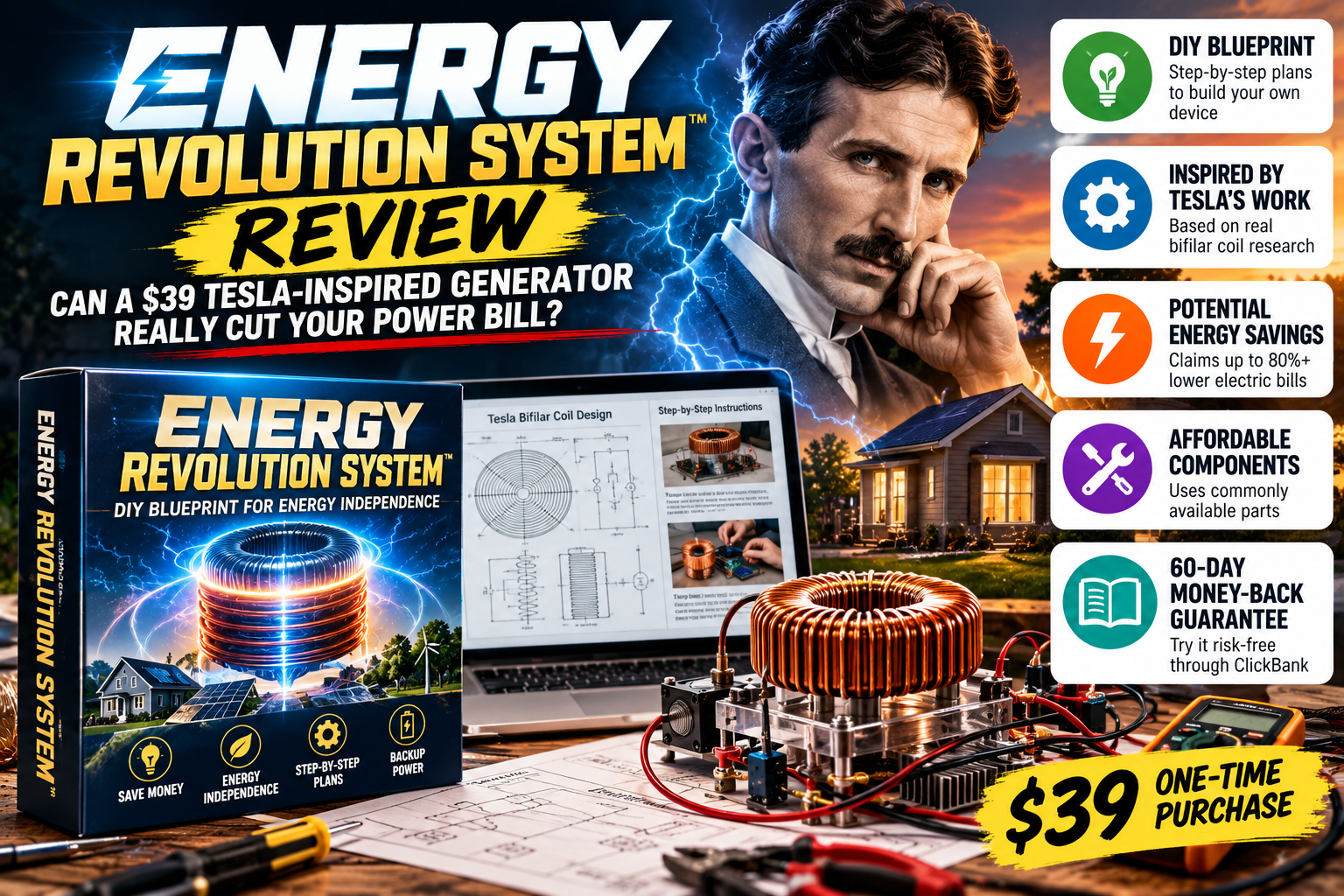
If you searched for an Energy Revolution System review after seeing an ad promising to slash your electricity bill with technology inspired by Nikola Tesla, there is one fact you should know before anything else:
Nikola Tesla’s bifilar coil patent is real.
But that does not automatically mean a modern DIY device built around a bifilar coil can generate enough net energy to cut a household electric bill by 80% or more.
Those are two completely different claims.
And that distinction became the most important part of our investigation.
The Energy Revolution System is currently one of the hottest products on ClickBank.
It is marketed as a low-cost digital blueprint showing ordinary homeowners how to build a compact electricity-generating device using affordable components and a design inspired by Tesla’s 1894 bifilar coil patent.
The current promotional price is commonly displayed as:
$39.
The marketing goes much further.
Depending on which promotional page or ClickBank description you encounter, you may see claims involving:
- dramatic reductions in electricity bills;
- energy independence;
- supplemental household electricity;
- backup power;
- and savings approaching 80% or even 88%.
Those are extraordinary performance claims.
So rather than asking only:
“Did Tesla invent a bifilar coil?”
we asked the more useful questions:
What did Tesla’s patent actually do?
Where does the energy entering this modern device come from?
How much usable power can the finished build actually produce?
And is there independent testing supporting the headline savings?
The answers are much more interesting than the sales story.
- Personally Tested
- NO
- Research Type
- COMMUNITY RESEARCHED
- Official / Public Product Materials Examined
- YES
- Official Affiliate Materials Examined
- YES
- ClickBank Data Examined
- YES
- Tesla Patent Examined
- YES
- Independent Physics Sources Examined
- YES
- Independent First-Hand Buyer Evidence
- LIMITED / DIFFICULT TO VERIFY
- Affiliate Relationship
- YES
- Vendor Provided Access
- NO
- Last Researched
- September 2026
Quick Answer: Does Energy Revolution System Work?
The Energy Revolution System is a real digital DIY product built around legitimate electromagnetic concepts, but we found no strong independent evidence establishing that its specific design can routinely reduce household electricity bills by 80–88%.
The underlying physics includes real concepts:
- electromagnetic induction;
- coils;
- capacitance;
- inductance;
- resonance;
- and energy conversion.
Nikola Tesla really did receive U.S. Patent No. 512,340 in 1894 for a special coil arrangement using adjacent insulated conductors.
That patent is real.
But the patent describes a:
“Coil for electro-magnets.”
It discusses capacitance and self-induction.
It does not describe a household generator that creates unlimited electricity from nothing.
That’s important because conservation of energy still applies.
A device can:
- store energy;
- transfer energy;
- transform energy;
- change voltage or current characteristics;
- or potentially improve aspects of a circuit’s performance.
But it cannot simply create net energy without an energy source.
The practical question therefore becomes:
What powers the Energy Revolution System, and how much usable output does it deliver after losses?
That requires actual independent measurements of:
- input power;
- output power;
- duration;
- load;
- component efficiency;
- and total household consumption.
We did not find robust independent laboratory testing establishing the headline household savings claims.
Our early conclusion:
Treat Energy Revolution System as an experimental DIY electrical project, not as a proven replacement for solar panels, the utility grid or a certified generator.
Check the Current Energy Revolution System Offer
What Is Energy Revolution System?
Energy Revolution System is a digital information product sold through ClickBank.
You are not buying a finished generator.
You are not receiving solar panels.
You are not receiving a battery bank.
You are not receiving a certified appliance that arrives ready to plug into your home’s electrical panel.
You are primarily buying:
instructions for a DIY build.
Current promotional descriptions include:
- step-by-step plans;
- blueprints;
- diagrams;
- component or material lists;
- assembly guidance;
- supplementary resources;
- and several bonuses.
The product is delivered digitally.
That means the $39 purchase price is only the price of the information.
You still need:
- components;
- tools;
- wiring;
- measuring equipment;
- and potentially professional electrical help depending on what you intend to connect.
This distinction matters because some promotional pages can make the purchase sound almost like you’re buying the power system itself.
You’re not.
You Are Buying the Blueprint, Not the Generator
If you’re comfortable with that, the $39 offer is easier to understand.
If you expect to pay $39 and receive a finished device capable of powering your house:
that is not what the product is.
How Popular Is Energy Revolution System on ClickBank?
Very.
The ClickBank vendor nickname is:
ENREV.
The latest marketplace snapshot we checked on September 27, 2026 showed:
Gravity: approximately 148.
with average affiliate earnings around:
$52 per sale.
It was also ranked at or near the top of ClickBank’s current hot-product reports.
ClickBank itself featured Energy Revolution System among its leading 2026 affiliate offers.
That tells us something important:
the offer converts.
It does not prove the electrical performance claims.
Gravity measures affiliate-market activity, not engineering validity.
A product can be extremely good at converting advertising traffic while still requiring independent verification of its technical claims.
Those are separate questions.
How Much Does Energy Revolution System Cost?
The current promotional price we found most consistently in September 2026 is:
$39 — one-time purchase
Many current promotional pages show a reference price around:
$149.
The $39 offer commonly includes:
- instant digital access;
- the primary blueprint;
- instructional material;
- several bonuses;
- and a 60-day money-back guarantee.
Some alternative funnels have displayed slightly different promotional prices.
That’s common with direct-response offers.
So:
verify the live ClickBank checkout before paying.
The checkout price is more important than whatever an older review says.
Is Energy Revolution System a Subscription?
The core front-end offer is currently tracked as:
a single-payment product.
Current ClickBank data shows:
$0 average rebill
for the primary offer.
That means the main product itself is not being presented as a required monthly subscription.
However:
the funnel has upsells.
We’ll return to that later.
What Did Nikola Tesla Actually Patent?
This is where the article becomes much more interesting.
The Energy Revolution System repeatedly invokes:
Nikola Tesla’s bifilar coil.
That isn’t fabricated history.
Tesla really did receive:
U.S. Patent No. 512,340
on January 9, 1894.
The title was:
“Coil for Electro-Magnets.”
Tesla described winding insulated conductors in a particular arrangement so that differences in potential between adjacent turns increased the coil’s effective capacitance.
The objective was related to the electrical behavior of coils, including:
- self-induction;
- capacity;
- potential difference;
- and oscillatory electrical systems.
That’s real electrical engineering history.
But notice what’s missing:
The patent does not say:
“This device creates more energy than is supplied to it.”
It does not say:
“This eliminates your household electric bill.”
It does not say:
“This is a self-powering generator.”
So the existence of Patent 512,340 proves:
Tesla invented and patented this coil configuration.
It does not prove:
every modern device marketed around that coil produces extraordinary net power.
Why a Real Tesla Patent Does Not Prove the Product
This logical mistake appears constantly in alternative-energy marketing.
The argument often works like this:
Tesla was a brilliant inventor.
True.
Tesla patented this coil.
True.
Our system uses a Tesla-style coil.
That’s the vendor’s description.
Therefore:
our system can slash your electricity bill by 80%.
That final step does not follow automatically.
A product’s actual performance must be measured.
We need to know:
- what energy enters the device;
- how energy is stored;
- how energy leaves;
- what losses occur;
- what electrical load is connected;
- and what output remains usable over time.
Historical attribution is not a substitute for measurement.
Can a Bifilar Coil Create Free Energy?
Not in the sense of creating energy from nothing.
The first law of thermodynamics is the conservation-of-energy principle:
energy can be transferred or transformed, but it cannot simply be created or destroyed.
This remains true whether a circuit contains:
- a conventional coil;
- a bifilar coil;
- a capacitor;
- a transformer;
- a motor;
- a generator;
- or any combination of those components.
A coil can alter electrical behavior.
It can store energy temporarily in a magnetic field.
Capacitance can store energy in an electric field.
A resonant system can exchange stored energy between electric and magnetic fields.
But the usable energy delivered over time still has to come from somewhere.
The Energy Source Is the Question That Matters
Whenever someone presents an electrical device that allegedly produces large amounts of useful power, ask:
“What is the energy source?”
Possible legitimate answers include:
- sunlight;
- wind;
- fuel;
- water;
- chemical energy stored in a battery;
- mechanical input;
- grid electricity;
- thermal differences;
- or some measurable environmental energy source.
If the answer is:
“the coil produces the energy by itself,”
we need extremely strong independent evidence.
What About Electromagnetic Induction?
Electromagnetic induction is absolutely real.
It’s how conventional electrical generators work.
Changing magnetic flux through a conductor can induce voltage.
But:
generating electricity by electromagnetic induction still requires energy.
In a conventional generator, mechanical energy turns the rotor.
That mechanical energy may originate from:
- a gasoline engine;
- a diesel engine;
- a steam turbine;
- falling water;
- wind;
- or another prime mover.
The generator converts that energy into electricity.
It does not manufacture energy from nowhere.
Can Resonance Create Extra Energy?
Resonance can create surprisingly large voltages or currents inside parts of a circuit.
That can look impressive.
But internal voltage magnification is not the same thing as producing extra net energy.
Imagine pushing a child on a swing at exactly the right timing.
The swing amplitude becomes large because your input arrives in sync with the natural motion.
You are still providing energy.
Resonance improves how energy accumulates or transfers within the system.
It does not eliminate conservation of energy.
Can Energy Revolution System Really Cut Electricity Bills by 80%?
This is the marketing claim that requires the most evidence.
ClickBank itself has promoted the product with claims as high as:
“up to 88%.”
Other promotional pages repeatedly use:
80%.
Those phrases are marketing claims.
They are not independent laboratory measurements.
For an ordinary household, an 80% reduction would be enormous.
Consider what that means.
If a home normally uses:
900 kWh per month,
an 80% reduction would represent:
720 kWh per month.
That isn’t a trivial amount of electricity.
Any DIY device claiming to replace that much utility energy should be able to demonstrate measurable sustained output under real household loads.
You would want:
- calibrated power measurements;
- input-energy measurements;
- output-energy measurements;
- long-duration testing;
- defined appliance loads;
- repeatable results;
- and independent verification.
We did not find that level of independent evidence.
Why a Lower Electricity Bill Does Not By Itself Prove Generation
This is another methodological problem with online testimonials.
Suppose someone says:
“My electric bill dropped from $200 to $160 after I built the system.”
That’s interesting.
But a utility bill can change because of:
- weather;
- air-conditioning use;
- heating use;
- occupancy;
- vacations;
- rate changes;
- appliance usage;
- billing periods;
- behavior changes;
- and energy-efficiency improvements.
To attribute the entire change to a generator, you need measurements of the device itself.
That’s why:
actual watt-hours delivered to a known load
are far more informative than:
“my bill seemed lower.”
What Does the Vendor Say About Testing?
This is one of the most important caveats around the offer.
Multiple current analyses reproducing the seller’s disclaimer report language describing the system as:
an experiment
that:
was not technically assessed.
They also reproduce language stating that results can vary and that some home modifications may conflict with local rules.
We were not able to consistently access one canonical vendor terms page during this investigation, so we would not pretend to have independently authenticated every line of every mirrored terms page.
However, the same experimental-status disclosure appears repeatedly across current analyses of the product.
That should affect expectations.
An Experimental DIY Project and a Certified Energy System Are Not the Same Thing
A certified commercial generator typically has:
- rated output;
- defined voltage;
- defined frequency;
- load limits;
- safety testing;
- warranty information;
- and installation requirements.
An experimental DIY build is different.
That doesn’t make experimentation worthless.
It means:
you should evaluate it as an experiment.
Who Is Michael Garnett?
The product is publicly associated with:
Michael Garnett.
The marketing story describes Garnett as an independent inventor or energy researcher who became interested in Tesla’s work and developed a modern DIY implementation inspired by the bifilar coil.
Some versions of the sales narrative go further and describe him spending years in:
Smiljan, Croatia — Nikola Tesla’s birthplace.
Some promotional pages describe local families allegedly preserving fragments of Tesla-related knowledge.
This is a compelling story.
But we did not find strong independent documentation establishing:
- Garnett’s engineering credentials;
- a published research history;
- patents for the modern Energy Revolution device;
- peer-reviewed testing;
- or independent documentation of the Smiljan story.
Some promotional pages explicitly identify Michael Garnett as a:
pen name.
For that reason, we would treat the detailed creator narrative primarily as:
vendor-provided marketing background.
The technical claims should stand or fall on measurements, not biography.
What Do Energy Revolution System Users Actually Say?
This was one of the messiest parts of the investigation.
Google currently returns large numbers of pages claiming:
- 21-day tests;
- 30-day tests;
- 60-day tests;
- 90-day tests;
- meter-tracked results;
- and personal DIY builds.
Some even publish extremely precise savings figures.
That sounds ideal.
Unfortunately, a large percentage of those pages appear in:
- unrelated forums;
- promotional sites;
- affiliate review pages;
- press-release style content;
- or pages whose methodology cannot be independently audited.
We found supposed users claiming:
15%, 20%, 25%, 50%, 70% and 80%+ electricity savings.
That spread alone should make a careful reader ask:
What exactly was measured?
Why We Don’t Trust Precise Online Success Percentages
One current review claims it analyzed complaints and determined that:
60% were expectation problems and 40% were product problems.
Another says a meter-tracked test found:
17.5% savings.
Another claims:
22%.
Another claims higher results.
Those numbers may or may not describe genuine tests.
But without access to:
- the actual device;
- the wiring;
- instrument calibration;
- input measurements;
- output measurements;
- test duration;
- and raw data,
we cannot treat the numbers as independently verified engineering results.
So TestimonialBlogs is not going to average them together and manufacture a:
“typical 23.7% savings.”
We don’t have trustworthy evidence for such precision.
The Biggest Problem With the Review Ecosystem
Energy Revolution System currently has an unusually aggressive affiliate ecosystem.
That makes sense.
Its ClickBank Gravity is extremely high.
Affiliates earn around $50 per conversion.
ClickBank actively promotes it.
The vendor provides:
- email swipes;
- banners;
- advertising copy;
- and promotional tools.
That creates powerful incentives to publish content around phrases such as:
“I tested it for 30 days.”
Again:
some of those experiences may be genuine.
But the financial incentive means they require verification rather than automatic trust.
Does Energy Revolution System Have Upsells?
Yes.
ClickBank’s own public affiliate coverage describes Energy Revolution System as having:
an optimized upsell funnel.
This is important because the vendor’s average payout can exceed the commission generated by a simple $39 front-end purchase.
The current CBSnooper listing also marks:
Upsell Available.
So buyers should expect additional offers after the primary purchase.
That doesn’t mean the $39 product is a subscription.
It means:
additional optional purchases may be offered after checkout.
Evaluate each separately.
The Real Project Cost Is Not $39
This is easy to overlook.
$39 buys the information.
It does not buy:
- wire;
- electrical components;
- hardware;
- tools;
- meters;
- enclosures;
- safety equipment;
- or professional installation.
Various promotional and review pages estimate material costs ranging from well under $100 to several hundred dollars depending on the build.
We were unable to verify one universal bill of materials because different versions and configurations are discussed online.
So before buying, think in terms of:
total project cost.
Not:
ebook price.
Can You Connect This to Your House?
This is where the distinction between a hobby project and a home-energy system becomes critical.
Producing electricity on a workbench is one thing.
Connecting a DIY source to household circuits is another.
A home electrical system involves:
- voltage requirements;
- current capacity;
- frequency;
- grounding;
- overcurrent protection;
- isolation;
- backfeed prevention;
- transfer equipment;
- local electrical codes;
- and potentially utility interconnection rules.
Improperly backfeeding household wiring can be dangerous.
It can expose:
- the homeowner;
- electricians;
- utility workers;
- and equipment
to serious electrical hazards.
A DIY Generator Should Not Be Treated Like a Power Strip
If a build is going anywhere near permanent household wiring:
qualified electrical review is appropriate.
A $39 digital guide does not override your local electrical code.
Electrical Safety Matters
DIY electrical projects can involve:
- electric shock;
- short circuits;
- overheating;
- fire;
- component failure;
- battery hazards;
- and damage to connected electronics.
Risk increases substantially as:
- voltage increases;
- current increases;
- stored energy increases;
- or the device becomes connected to household infrastructure.
Safety note: Energy Revolution System is a DIY electrical project, not a certified household generator supplied with professional installation. Do not connect experimental electrical equipment to household wiring or critical loads without appropriate technical knowledge, protective equipment and compliance with local electrical requirements.
What Could Energy Revolution System Realistically Be Good For?
Even if the headline household-savings claims remain unverified, that doesn’t mean the guide has zero potential value.
There is another way to evaluate it.
As an Electronics Project
Someone interested in:
- coils;
- resonance;
- electromagnetic induction;
- electrical measurement;
- and experimental circuits
may enjoy building and analyzing the device.
As a Learning Project
A hands-on build can teach more about electrical systems than simply reading theory.
Measuring:
- voltage;
- current;
- power;
- load response;
- and losses
can be educational even if the final device does not transform your utility bill.
As a Small Supplemental-Power Experiment
If the finished system produces useful measurable output, it may potentially serve certain small loads or demonstrations.
But output should be measured rather than assumed.
A device that can illuminate LEDs is not automatically a refrigerator backup system.
The Load Question Changes Everything
“It produces electricity” is not enough information.
Powering a:
5-watt LED
is fundamentally different from powering a:
1,500-watt space heater.
And appliances with motors or compressors can have large startup currents.
That’s why serious generator specifications include rated:
- continuous watts;
- surge watts;
- voltage;
- frequency;
- and runtime.
We would want similar practical specifications before treating an experimental DIY device as a major household power source.
How Would You Properly Prove the System?
A convincing independent test wouldn’t need dramatic testimonials.
It would need measurements.
At minimum, a technically useful test would document:
- exact component configuration;
- the external energy source;
- input voltage and current;
- output voltage and current;
- power factor where relevant;
- load characteristics;
- operating duration;
- temperature;
- and total watt-hours in versus watt-hours out.
Then:
independent builders should be able to reproduce the result.
That is much stronger evidence than a photograph of a spinning meter or a utility bill screenshot.
Could You Learn This Information for Free?
Much of the underlying electrical theory is freely available.
You can read Tesla’s original patent online for free.
You can study:
- electromagnetism;
- resonance;
- transformers;
- motors;
- generators;
- circuits;
- and energy conservation
through free textbooks, universities, technical videos and engineering resources.
You can also find countless DIY coil experiments online.
So you’re not paying $39 because the existence of Tesla’s bifilar coil is secret.
It isn’t.
The potential value of the product is:
organization.
Instead of designing an experiment from scratch, the guide gives you a specific project to follow.
For a hobbyist, that can still be valuable.
See What’s Included in Energy Revolution System
Energy Revolution System vs Solar Panels
These should not be treated as equivalent technologies.
Solar panels have:
- published wattage ratings;
- standard test conditions;
- certification systems;
- inverter specifications;
- manufacturer warranties;
- decades of field data;
- and predictable relationships between sunlight and output.
A Tesla-inspired experimental DIY build does not currently have the same evidence base.
Solar has disadvantages:
- high upfront cost;
- installation cost;
- roof or land requirements;
- weather dependence;
- and often permitting.
But:
its energy source is clear.
Sunlight.
Its output is measurable and predictable within known limits.
That’s a meaningful difference.
Energy Revolution System vs a Fuel Generator
A gasoline or propane generator also has an obvious energy source:
fuel.
The generator converts chemical energy into mechanical energy and then electrical energy.
You can look at its specifications and know approximately:
- continuous output;
- surge capacity;
- runtime;
- fuel consumption;
- and load limits.
That’s the practical standard we would use to evaluate any alternative electrical source:
Where does the energy originate, and how much usable electricity reaches the load?
The Biggest Positive We Found
The Energy Revolution System gives people a low-cost entry point into a genuinely interesting area of electrical experimentation.
The historical Tesla component isn’t invented.
The bifilar coil patent really exists.
Electromagnetic principles really matter.
The product itself is inexpensive compared with conventional home-energy systems.
And the marketplace history shows:
enormous consumer interest.
If somebody approaches it as:
“I want to build an experimental energy device, learn something and measure what it actually does,”
we can understand the appeal.
The Biggest Problem We Found
The marketing bridges a very large evidentiary gap.
It starts with:
a real Tesla patent.
Then moves toward:
massive household electricity savings.
Those claims require separate proof.
We found strong evidence for:
Tesla patented the coil.
We found strong evidence for:
Energy Revolution System is a real ClickBank product.
We found strong evidence for:
the offer is selling extremely well.
We did not find comparably strong independent evidence for:
routine 80–88% household electricity savings from the finished DIY build.
Those four statements can all be true simultaneously.
The Second Biggest Problem: The Reviews
Because the affiliate payout is strong and the Gravity is extremely high, Google is now filling with:
- “hands-on tests”;
- personal testimonials;
- Reddit-style reviews;
- forum posts;
- press releases;
- and sites calling themselves official.
Some appear to describe detailed experiments.
But we cannot independently authenticate most of them.
The same issue we found with other aggressive ClickBank offers appears here:
a large number of review pages does not automatically equal a large body of independent evidence.
Who Might Find Energy Revolution System Useful?
Electronics Hobbyists
The project may be genuinely interesting if you enjoy coils, circuits and experimentation.
DIY-Minded Preppers
Someone exploring multiple backup-power technologies may find value in learning another electrical concept.
People Who Enjoy Measuring and Testing
The healthiest way to approach the project is to build it and verify output rather than assuming the claims are true.
People Who View $39 as Education
If the educational experience itself is worth $39 to you, the purchase becomes much easier to justify.
Who Probably Shouldn’t Buy Energy Revolution System?
Someone Expecting a Finished Generator
You receive digital instructions, not finished power equipment.
Someone Expecting Guaranteed 80% Savings
We did not find independent evidence strong enough to support that expectation.
Someone Who Doesn’t Want to Build Anything
The product requires sourcing parts and performing a DIY project.
Someone Who Wants Certified Emergency Power
If electricity is mission-critical, choose equipment with defined ratings, testing and safety certifications.
Someone Planning to Wire It Directly Into Their Home Without Expertise
Household electrical integration carries risks that should not be approached casually.
Is Energy Revolution System Legit?
There are two separate questions here.
Is the Product Real?
Yes.
Energy Revolution System is an active digital product sold through ClickBank.
It has:
- a defined product format;
- an active vendor;
- affiliate infrastructure;
- a checkout funnel;
- digital delivery;
- and a published refund framework.
Are All the Technical Claims Proven?
No.
A real product can make claims that still require independent verification.
That’s exactly why we separate:
transaction legitimacy
from:
technical validation.
ClickBank listing the product does not mean ClickBank independently tested the generator or verified the savings claims.
Does Energy Revolution System Have a Refund Policy?
Current promotional pages advertise a:
60-day money-back guarantee.
The product is sold through ClickBank.
ClickBank’s current support documentation explains that qualifying returned purchases receive a 100% refund under its applicable return framework.
We recommend saving:
- your ClickBank receipt;
- the price shown at checkout;
- the refund language;
- and records of any additional upsells you accept.
Our Conclusion: Is Energy Revolution System Worth It?
The Energy Revolution System is a perfect example of why product research needs more than one question.
Is Nikola Tesla’s bifilar-coil patent real?
Yes.
Is electromagnetic induction real?
Yes.
Can coils, capacitance and resonance produce interesting electrical behavior?
Absolutely.
Does that automatically prove that a $39 DIY device can cut an ordinary household electricity bill by 80–88%?
No.
That final claim requires evidence from the actual device.
And that’s where the evidence becomes much weaker.
The first law of thermodynamics does not disappear because Tesla’s name appears in the marketing.
Any useful electricity delivered to a load must ultimately come from an energy source.
The meaningful technical questions are:
- where that energy originates;
- how much enters;
- how much leaves;
- what losses occur;
- and whether independent builders can reproduce the result.
We found huge affiliate-market traction.
We found a real historical Tesla patent.
We found a real digital DIY product.
We found a low entry price.
We found a 60-day refund offer.
What we did not find was strong independent engineering evidence establishing the most aggressive household-savings claims.
Our Simplest Conclusion
Energy Revolution System makes the most sense as a $39 experimental electronics project inspired by real Tesla coil research — not as a proven method for eliminating most of your electric bill.
If you’re buying because:
“I enjoy DIY electronics, I want to build the project and I will measure the results myself,”
the price may be reasonable simply for the structured project.
If you’re buying because:
“A forgotten Tesla secret is definitely going to replace 80% of the electricity entering my house,”
we think the available evidence does not justify that expectation.
The difference between those two expectations is probably the difference between finding the product interesting and finding it disappointing.
Check the Current Energy Revolution System Offer & Price
Affiliate disclosure: If you purchase through this link, TestimonialBlogs may earn a commission at no additional cost to you. Affiliate revenue helps fund future product investigations. It does not change what we report.
Energy Revolution System FAQ
What is Energy Revolution System?
Energy Revolution System is a digital DIY guide sold through ClickBank. It provides instructions for building an experimental electrical device inspired by Nikola Tesla’s bifilar-coil work. Buyers receive information and blueprints rather than a completed generator.
How much does Energy Revolution System cost?
The most common current promotional price we found in September 2026 is $39 as a one-time purchase. Some funnels may test different promotional prices, so verify the live checkout.
Is Energy Revolution System a subscription?
The core front-end offer is currently tracked as a single-payment product with no average recurring rebill. Optional upsells are available separately.
Does Energy Revolution System have upsells?
Yes. ClickBank’s own affiliate coverage describes an optimized upsell funnel, and current marketplace tracking identifies additional offers after the front-end purchase.
Does Energy Revolution System have a money-back guarantee?
Current promotional pages advertise a 60-day money-back guarantee through the ClickBank purchase ecosystem. Verify the exact terms shown at checkout and save your receipt.
Is Nikola Tesla’s bifilar coil real?
Yes. Nikola Tesla received U.S. Patent No. 512,340, “Coil for Electro-Magnets,” in 1894. The patent discusses a conductor arrangement designed to affect capacitance and self-induction.
Did Tesla patent a free-energy generator in Patent 512,340?
No. Patent 512,340 describes a coil for electromagnetic apparatus. The patent itself does not establish a self-powered household generator or claim unlimited energy creation.
Can a bifilar coil create energy from nothing?
No established physical principle allows a coil to create net energy from nothing. Coils can store, transfer and transform electrical energy, but energy conservation still applies.
Can Energy Revolution System cut electricity bills by 80%?
The vendor ecosystem has promoted savings in the 80–88% range. We did not find strong independent laboratory or long-term household testing sufficient to establish that result as typical or reliably reproducible.
Does Energy Revolution System generate electricity?
The product teaches construction of an experimental electrical system, but the amount of useful net output should be established by measuring the finished build’s input power, output power and load over time rather than relying on promotional claims.
Can Energy Revolution System power a refrigerator?
We would not assume that without measured continuous and startup output specifications for the exact build. Refrigerators contain compressors that can require significantly more power at startup than their normal running load.
Can Energy Revolution System power a whole house?
We found marketing suggesting substantial household use, but not independent engineering evidence sufficient to treat the system as a proven whole-house power source. Whole-home systems need clearly defined sustained output, surge capacity and safe electrical integration.
Do you receive a physical generator?
No. The core product is digital. You receive instructions and blueprints and must separately source the components needed for the project.
Is Energy Revolution System safe?
Any DIY electrical build can involve shock, fire, short-circuit and equipment-damage risks. Connecting experimental equipment to household electrical circuits raises additional safety and code issues. Professional electrical guidance may be appropriate.
Is Energy Revolution System worth $39?
It may be worth the price for a DIY electronics enthusiast who views it as an experimental learning project and understands that parts and tools cost extra. It is much harder to justify based solely on an expectation of guaranteed 80–88% utility savings because we did not find independent evidence establishing that result.
Sources and Methodology Notes
This investigation compared current Energy Revolution System promotional materials and affiliate information with ClickBank marketplace data, Nikola Tesla’s original U.S. patent, current physics references on conservation of energy and publicly available reviews and supposed hands-on user reports.
Representative sources examined include:
- ClickBank Top Offers – Energy Revolution System / vendor ENREV
- Energy Revolution System official affiliate center
- CBSnooper marketplace tracking for ENREV
- Nikola Tesla U.S. Patent 512,340 – Coil for Electro-Magnets
- OpenStax – First Law of Thermodynamics and Conservation of Energy
- current public Energy Revolution System sales and pricing pages
- current product disclaimer and terms analyses
- public Reddit, forum and affiliate-style hands-on reports
Why TestimonialBlogs Calls This “Community Researched”
We did not buy the Energy Revolution System, build the device, connect calibrated instruments and run a controlled 30-day electrical test before publishing this article.
So we are not going to tell you:
“Our bill dropped exactly 23.7%.”
We found lots of pages making claims like that.
What we didn’t find was enough independently auditable raw data to combine those claims into a reliable performance statistic.
Instead, we separated questions that are often incorrectly treated as one:
Is the ClickBank product real?
Yes.
Is Tesla’s bifilar-coil patent real?
Yes.
Are electromagnetic induction, capacitance and resonance real?
Yes.
Does proving those facts prove the Energy Revolution System cuts an ordinary home’s electricity use by 80–88%?
No.
That requires independent testing of the modern device.
We also examined:
- the actual product format;
- current price;
- ClickBank sales activity;
- affiliate incentives;
- upsells;
- the Tesla patent;
- conservation of energy;
- electrical-safety issues;
- and supposedly firsthand reports.
This is exactly the kind of product where separating:
historical fact
from:
vendor claim
from:
independent evidence
matters enormously.
Tesla’s name doesn’t invalidate the product.
It doesn’t validate the headline savings either.
The finished device still has to prove what it can do.