Disclosure: TestimonialBlogs may receive a commission if you purchase The Self-Sufficient Backyard through links in this article, at no additional cost to you. Affiliate revenue helps fund our product investigations. It does not determine what we publish.
Most homesteading products start with a story.
The Self-Sufficient Backyard starts with something considerably more useful: a documented history.
Ron and Johanna Melchiore say they have spent more than four decades living off-grid, growing food, producing energy, preserving harvests and building systems that reduced their dependence on conventional utilities.
Normally, that kind of biography would be difficult to verify.
In this case, it isn’t.
Ron was already writing publicly about their remote Saskatchewan homestead years before The Self-Sufficient Backyard became a ClickBank offer. Mother Earth News documented the couple’s off-grid lifestyle, their earlier homestead in Maine and their years living roughly 100 miles from the nearest supply point in northern Saskatchewan.
That’s unusual in a marketplace where many digital products are attached to authors whose backgrounds are almost impossible to confirm.
But having legitimate authors doesn’t automatically mean every promise around the book should be interpreted literally.
The current marketing presents a compelling idea:
Turn a relatively small piece of land into a productive system that supplies food, water, energy and greater independence.
So we investigated the book, the authors, current pricing, reader ratings, what the program actually teaches and how realistic the idea of a “self-sufficient backyard” really is.
TESTIMONIALBLOGS RESEARCH
Personally Tested: No
Research Type: Community Researched
Official Product Materials Examined: Yes
ClickBank Marketplace Data Examined: Yes
Independent Author History Examined: Yes
Goodreads Reader Data Examined: Yes
Independent Retailer Reviews Examined: Yes
Homesteading Community Discussions Examined: Yes
Affiliate Relationship: Yes
Vendor Provided Access: No
Last Researched: September 2026
Quick Answer: Is The Self-Sufficient Backyard Legit?
Yes, The Self-Sufficient Backyard is a real homesteading book written by identifiable authors with a documented history of actually living off-grid.
That is the clearest conclusion from our research.
The book is not simply an anonymous PDF attached to a dramatic sales page.
Ron Melchiore has an independent publishing history, wrote the earlier book Off Grid and Free: My Path to the Wilderness, and contributed extensively to Mother Earth News about subjects including:
- off-grid power;
- remote homesteading;
- gardening in northern climates;
- orchards;
- root cellars;
- wells;
- land selection;
- and building a homestead.
Mother Earth News also independently documented Ron and Johanna’s long-term off-grid lifestyle.
The current paperback edition is sold through established retailers including the Mother Earth News Store.
So the more interesting question is not whether the book exists or whether its authors have lived the lifestyle.
They have.
The better question is:
How much of their experience can realistically be transferred to your own backyard?
See the Current Self-Sufficient Backyard Offer →
What Is The Self-Sufficient Backyard?
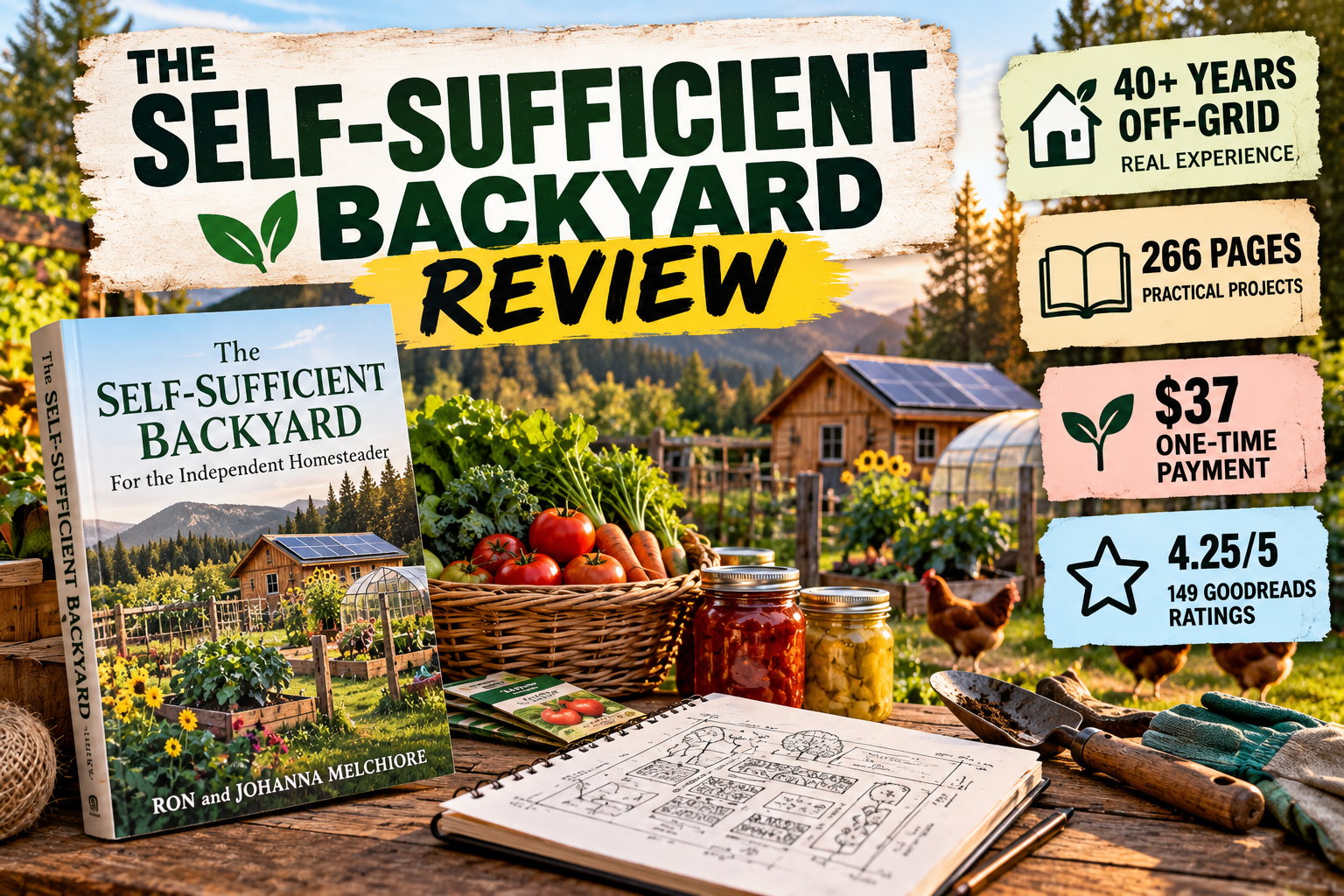
The Self-Sufficient Backyard: For the Independent Homesteader is a broad homesteading reference guide written by Ron and Johanna Melchiore.
The paperback edition currently listed by Mother Earth News contains approximately 266 pages.
Instead of focusing exclusively on gardening, it tries to show how multiple household systems can work together.
Topics include:
- planning a productive property;
- growing vegetables and fruit;
- extending the growing season;
- raising chickens and other small livestock;
- food preservation;
- root cellars;
- greenhouses;
- water collection;
- wells and water systems;
- solar and off-grid electricity;
- composting;
- orchards;
- medicinal plants;
- and numerous DIY projects.
That breadth is important.
This is not primarily a gardening book.
It’s closer to a road map for becoming progressively more self-reliant.
Who Are Ron and Johanna Melchiore?
This is one of the strongest aspects of the product.
According to their own story, Ron began pursuing a back-to-the-land lifestyle around 1979 or 1980.
Ron and Johanna later spent approximately two decades homesteading in northern Maine followed by many years at an extremely remote property in northern Saskatchewan.
In a 2016 Mother Earth News contribution, Ron described their Saskatchewan property as approximately 100 miles from the nearest supply point, accessible primarily by float plane.
By that point, he said the couple had already accumulated approximately 36 years of off-grid experience.
Later Mother Earth News coverage documented their move from Saskatchewan to Nova Scotia after roughly 39 years of off-grid homesteading.
This matters because it provides independent evidence that:
the lifestyle described in the book existed before the current marketing campaign.
Ron also published Off Grid and Free: My Path to the Wilderness before The Self-Sufficient Backyard became the product it is today.
In other words, their experience appears to be the source of the product rather than a biography created to sell it.
How Long Has The Self-Sufficient Backyard Been Sold Online?
ClickBank marketplace tracking currently dates vendor SBACKYARD to January 2020.
As of our September 2026 research, current Gravity is around 15.
That means affiliates are still generating recent sales more than six years after the offer entered the marketplace.
Again, Gravity does not measure customer satisfaction.
It simply indicates recent affiliate sales activity.
How Much Does The Self-Sufficient Backyard Cost?
The established price we found for the book is approximately $37.
Mother Earth News currently lists its paperback edition at a $37 list price.
The direct-response sales funnel has also historically offered digital and/or physical versions around this price, depending on the specific promotion.
Because different landing pages and format options exist, we recommend checking the exact price and format displayed on the current checkout before purchasing.
The important distinction is:
This is generally sold as a one-time purchase rather than a monthly subscription.
Current ClickBank marketplace tracking also categorizes the main offer as single-payment.
Is There a Physical Self-Sufficient Backyard Book?
Yes.
Unlike many ClickBank information products, The Self-Sufficient Backyard is available as an actual printed book.
Mother Earth News is an approved distributor and currently lists a 266-page paperback.
The official refund policy also specifically explains how physical products should be returned if a refund is requested.
That makes this product somewhat different from a downloadable guide that exists only behind a sales funnel.
What Do You Actually Learn?
The book’s central strength is the way it connects multiple areas of homesteading instead of treating each one separately.
Food Production
Gardening is a major component.
The Melchiores discuss subjects such as:
- property and garden layout;
- vegetable production;
- fruit trees;
- greenhouses;
- season extension;
- soil improvement;
- seed saving;
- and smaller-space growing strategies.
The idea is not simply to grow tomatoes for fun.
The goal is to make the property produce a meaningful portion of what the household consumes.
Food Preservation
Growing food is only useful for part of the year unless you can preserve it.
The book therefore also discusses:
- canning;
- root cellaring;
- fermentation;
- storage;
- and preserving harvests for colder months.
Water
The book discusses multiple approaches to household and garden water, including wells, pumping, storage and rainwater collection.
This is one area where readers need to adapt the information to local conditions.
Water rights, rainwater regulations, groundwater depth and filtration requirements vary substantially by location.
Energy
Ron has a technical background and decades of experience using off-grid energy systems.
The material includes discussion of solar power, batteries, controllers, inverters and ways to reduce dependence on conventional utilities.
That can be useful for understanding a system.
But electrical installations still need to comply with local codes and should involve qualified professionals where appropriate.
Chickens and Small-Scale Livestock
The book also incorporates animals into the overall homestead system.
Chickens, for example, can provide:
- eggs;
- meat;
- fertility;
- pest control;
- and a productive use for some food scraps.
Again, local zoning and animal-keeping regulations vary.
Can You Really Become Self-Sufficient on a Quarter Acre?
This is probably the biggest conceptual question surrounding the book.
Marketing around The Self-Sufficient Backyard frequently emphasizes becoming significantly more self-reliant on approximately one quarter acre or less.
We think the best way to interpret that claim is:
A relatively small property can produce far more food and resources than most homeowners realize.
That’s reasonable.
But “self-sufficient” is not a binary condition.
Real results depend on:
- climate;
- soil;
- sunlight;
- water availability;
- local laws;
- household size;
- diet;
- time;
- physical ability;
- money;
- and how much infrastructure already exists.
A quarter-acre backyard in a warm climate with excellent sun and reliable water is very different from a shaded property with a short growing season.
The book is therefore more useful as:
a model for increasing self-reliance
than as:
a mathematical guarantee that every household can become completely independent on exactly 0.25 acres.
What Homesteaders Say About the Quarter-Acre Idea
An organic discussion in Reddit’s self-sufficiency community around a layout associated with the book produced an interesting consensus.
Commenters generally liked the idea as an example of how much productive infrastructure can fit into a relatively small area.
But experienced users also pointed out that:
- the setup would require substantial initial work;
- startup costs could be significant;
- climate and hardiness zones matter;
- maintenance still requires time;
- water management matters;
- and the same layout would not work equally well everywhere.
That is probably the healthiest way to interpret the concept.
It’s a design framework, not a universal blueprint.
What Do Independent Readers Think?
This is another area where The Self-Sufficient Backyard differs from many ClickBank offers.
There is meaningful reader activity outside the vendor’s own website.
Goodreads
At the time of our research, Goodreads listed approximately:
4.25 out of 5 from 149 ratings
with 18 written reviews.
Positive readers commonly describe the book as:
- practical;
- broad;
- useful for planning;
- clearly informed by real experience;
- and a reference worth returning to.
A recurring theme is that the book works particularly well as a starting map.
Readers can identify which systems they want to pursue and then study specialized topics more deeply when necessary.
Mother Earth News Store
The Mother Earth News Store currently lists the paperback at approximately:
4.71 out of 5 from 7 reviews.
Seven reviews is a small sample, so we would not extrapolate that score to every buyer.
But it is useful independent retail evidence that real readers outside the affiliate funnel have purchased the book.
StoryGraph
StoryGraph also has independent reader activity, with an average around 4.29 when we checked.
One particularly useful theme from readers is:
the breadth is both a strength and a limitation.
The book introduces many areas of homesteading, but a specialized book on beekeeping, poultry, solar power or greenhouse construction will naturally go deeper into that one subject.
The Biggest Strength: It’s a Map of the Whole Homestead
This is where we think The Self-Sufficient Backyard makes the most sense.
Someone beginning their journey may not even know which questions to ask.
Do you start with:
- a greenhouse?
- an orchard?
- rainwater collection?
- solar panels?
- chickens?
- a root cellar?
- compost?
- or a larger vegetable garden?
The book allows readers to see how these systems connect.
For example:
chickens create manure → manure improves compost → compost improves soil → better soil improves vegetables → vegetables generate preservation needs → preservation creates storage requirements.
That system-level perspective is more valuable than simply collecting random DIY projects.
The Main Limitation: One Book Cannot Be a Masterclass in Everything
The book covers an enormous range of subjects.
That necessarily means some sections are introductions rather than complete professional manuals.
If you are installing an advanced solar system, for example, you may eventually want:
- specialized electrical references;
- equipment documentation;
- code information;
- and possibly a licensed installer.
If you’re starting a serious beekeeping operation, you’ll probably buy another dedicated beekeeping book.
If you’re designing a four-season commercial greenhouse, you’ll need considerably more engineering detail.
That does not make a broad homesteading reference less useful.
It simply means the best role for this book is:
orientation first, specialization second.
Are Ron and Johanna’s 40+ Years of Experience Verifiable?
To a meaningful degree, yes.
This was one of the most important things we checked.
Mother Earth News has published Ron’s off-grid writing for years.
Archived articles document:
- their Maine homestead;
- their remote Saskatchewan property;
- their move to Nova Scotia;
- garden development;
- wells;
- orchards;
- root cellars;
- solar and wind systems;
- and numerous aspects of remote life.
A Maine newspaper also profiled Ron and Johanna in 2016 and discussed their decades of self-sufficient living.
That external record substantially predates the current ClickBank funnel.
For us, that materially strengthens the credibility of the authorship.
Does The Self-Sufficient Backyard Have Bonuses?
Various current sales funnels advertise additional digital resources alongside the main book.
Commonly advertised bonuses have included resources about:
- aquaponics;
- traditional DIY projects;
- and land opportunities in the United States.
Because bonuses can change between funnels and promotions, we recommend checking exactly what is included on the current order page rather than purchasing based on an old review.
Check the Current Book, Format & Bonuses →
Does The Self-Sufficient Backyard Have Upsells?
Current ClickBank marketplace tracking indicates that the funnel does include upsells.
This means the main purchase may be followed by optional additional offers.
That does not mean those upgrades are required to use the book.
Treat every additional offer as a separate buying decision.
Is It a Subscription?
The main Self-Sufficient Backyard offer is currently categorized as a single-payment product, not a recurring subscription.
If an optional product is offered after checkout, verify its billing terms separately before purchasing.
What Is the Refund Policy?
The official Self-Sufficient Backyard refund policy currently states a 60-day, 100% money-back guarantee.
The policy says customers can request a refund during the first 60 days.
It also includes instructions for returning physical merchandise and says processed refunds may take up to approximately 10 business days to appear in the buyer’s account.
As always, keep your purchase receipt and save the terms shown at checkout.
What About the Medicinal Plant Information?
The book discusses medicinal plants the Melchiores say they have used during their off-grid life.
This is one area where readers should maintain an important distinction.
Traditional plant knowledge can be interesting and useful.
It should not automatically replace professional medical care, diagnosis, prescription medication or evidence-based treatment.
Potential interactions, allergies, dosage and individual health conditions matter.
We therefore view the medicinal-garden material as educational homesteading content rather than individualized medical advice.
How Much Does Becoming Self-Sufficient Actually Cost?
The book itself may cost around $37.
The projects obviously do not.
Building real infrastructure may involve:
- lumber;
- soil;
- seeds;
- fruit trees;
- fencing;
- greenhouse materials;
- water tanks;
- pumps;
- solar panels;
- batteries;
- tools;
- animal housing;
- feed;
- permits;
- and maintenance.
The book is a knowledge investment.
It is not a $37 shortcut to building an entire homestead.
Can The Self-Sufficient Backyard Save You Money?
Potentially.
Growing food, preserving harvests, collecting water and producing some electricity can reduce certain household expenses.
But there is usually an initial investment before savings appear.
For example:
a garden may require beds, soil, irrigation and tools before producing its first tomato.
A solar system requires equipment before reducing electricity purchases.
Fruit trees may take years to mature.
Chickens need housing and feed before producing eggs.
Self-sufficiency is therefore better understood as:
building productive household assets over time
rather than:
instant monthly savings.
Could You Learn All of This for Free?
Pieces of it, absolutely.
There is excellent free information available from:
- university extension programs;
- government agencies;
- homesteading websites;
- YouTube;
- forums;
- and experienced gardeners.
The value proposition of The Self-Sufficient Backyard is not that gardening, composting or rainwater collection are secret knowledge.
The value is:
decades of one family’s experience organized into one reference.
For some people, that organization is worth far more than $37.
Other people genuinely enjoy researching each system independently and may not need the book.
Who Is The Self-Sufficient Backyard Best For?
We think it makes the most sense for:
- beginning homesteaders;
- homeowners with unused yard space;
- gardeners interested in expanding beyond vegetables;
- people interested in off-grid systems;
- families wanting greater household resilience;
- people planning a future homestead;
- and readers who want one broad reference before buying specialized books.
Who May Need Something More Specialized?
A different resource may be more appropriate if you need:
- professional solar-system engineering;
- commercial-scale farming guidance;
- precise local building plans;
- advanced veterinary guidance;
- detailed medical treatment;
- or exhaustive coverage of one specialized homesteading skill.
The Self-Sufficient Backyard is broad by design.
Self-Sufficient Backyard vs. 4 Foot Farm
We’ve also investigated 4 Foot Farm, and the two products approach a similar desire from very different directions.
4 Foot Farm focuses heavily on extracting useful food production from very limited space.
The Self-Sufficient Backyard is substantially broader.
It combines:
- food;
- water;
- energy;
- preservation;
- livestock;
- and property systems.
If your main goal is starting a tiny productive garden, 4 Foot Farm is narrower and simpler.
If your long-term goal is understanding how an entire property could become progressively more self-reliant, The Self-Sufficient Backyard is the more comprehensive concept.
Is The Self-Sufficient Backyard Worth $37?
For the right reader, we think the value proposition is fairly straightforward.
You are getting a substantial homesteading reference from authors whose underlying experience can be independently documented.
The paperback edition alone is currently sold by Mother Earth News at approximately the same $37 price.
The book has years of public reader history and currently maintains a Goodreads rating above four stars.
More importantly, the product is broad enough that a beginning homesteader may refer back to it repeatedly as different projects become relevant.
That makes the $37 easier to justify than if the book solved only one tiny problem.
The main expectation we would adjust is the word:
“self-sufficient.”
You should not expect to buy a book today and eliminate the grocery store, power company and water utility next month.
The useful outcome is much more gradual:
grow more.
preserve more.
produce more.
learn more.
depend a little less on outside systems each year.
Our Conclusion After Researching The Self-Sufficient Backyard
The Self-Sufficient Backyard has one advantage that immediately separates it from many products in the off-grid and preparedness market:
Ron and Johanna appear to have actually lived the life they teach.
Their off-grid history is independently documented.
Ron published about remote homesteading years before the current sales funnel.
Mother Earth News has repeatedly published their work.
Independent readers have rated the book on platforms outside the seller’s website.
And an established homesteading publication currently sells the physical edition.
That doesn’t mean every technique will work unchanged on every property.
Climate, land, zoning, water, available time and budget still matter.
And because the book covers such a wide range of subjects, serious homesteaders will eventually need deeper specialized resources in some areas.
But that may actually reveal what the book does best.
It gives beginners a map of the entire territory.
Instead of promising one trick that somehow makes a household independent, it shows how food, water, power, animals, preservation and land management can gradually become one interconnected system.
At around $37, we think that makes The Self-Sufficient Backyard particularly interesting for someone who is serious about beginning or planning a homestead and wants to learn from people with decades of documented experience.
The realistic goal isn’t becoming completely independent overnight.
It’s becoming more capable and less dependent over time.
And on that more realistic promise, the book makes considerably more sense.
View the Current Self-Sufficient Backyard Offer →
Affiliate disclosure: TestimonialBlogs may receive a commission if you purchase through this link, at no additional cost to you. Affiliate revenue helps fund future investigations. It does not determine what we publish.
The Self-Sufficient Backyard FAQ
Is The Self-Sufficient Backyard legit?
Yes. It is a real homesteading book by Ron and Johanna Melchiore. Their long-term off-grid experience is independently documented through years of Mother Earth News articles and other public records.
Who wrote The Self-Sufficient Backyard?
The book is written by Ron and Johanna Melchiore, long-term off-grid homesteaders who previously lived in Maine and remote northern Saskatchewan before moving to Nova Scotia.
How much does The Self-Sufficient Backyard cost?
The established current price is around $37, although format, shipping and promotional offers may vary. Verify the exact amount shown on the current checkout.
Is there a physical Self-Sufficient Backyard book?
Yes. A paperback edition exists, and Mother Earth News currently sells a 266-page physical edition.
Is The Self-Sufficient Backyard a subscription?
The main product is currently sold as a one-time purchase rather than a monthly subscription. Optional additional offers may be presented separately.
Does The Self-Sufficient Backyard have upsells?
Current ClickBank marketplace data indicates that additional offers are available in the funnel. They should be evaluated separately and are not automatically required to use the main book.
Does The Self-Sufficient Backyard have a money-back guarantee?
The official refund policy currently provides a 60-day money-back period.
How many pages is The Self-Sufficient Backyard?
The paperback edition currently sold through Mother Earth News is listed at 266 pages.
Can you really become self-sufficient on a quarter acre?
A quarter acre can potentially produce a surprising amount of food and support multiple productive systems, but complete self-sufficiency depends on climate, water, household needs, local rules, available time and many other variables. The quarter-acre concept is best treated as a model rather than a universal guarantee.
Is The Self-Sufficient Backyard good for beginners?
Yes, particularly as a broad introduction and planning reference. Specialized projects may eventually require deeper resources or professional assistance.
Does the book cover solar power?
Yes. Off-grid electricity and solar systems are among the topics discussed. Electrical installations should still comply with local codes and professional requirements.
Does the book cover gardening?
Yes. Food production is a major part of the book, including garden planning, fruit trees, soil, greenhouses, preservation and related systems.
Does the book cover chickens?
Yes. Chickens and small-scale animal husbandry are incorporated into the broader homesteading system.
Can The Self-Sufficient Backyard save money?
Some systems can reduce recurring costs over time, but most require an initial investment in materials, tools or infrastructure. Results depend on which projects you implement and local costs.
Can I learn the same subjects for free?
Much of the individual information can be researched independently for free. The book’s value is primarily the way decades of experience across multiple systems have been organized into one reference.
Why TestimonialBlogs Calls This “Community Researched”
We did not personally transform a property using The Self-Sufficient Backyard before publishing this investigation.
So we do not describe ourselves as users of the product.
Instead, our research included:
- the current product and sales materials;
- ClickBank marketplace data;
- the official refund policy;
- the physical book listing;
- Goodreads ratings and written reviews;
- StoryGraph reader feedback;
- Mother Earth News coverage;
- Ron Melchiore’s archived homesteading articles;
- independent reporting about Ron and Johanna;
- and public homesteading community discussions.
In this case, one finding mattered more than any star rating:
the authors’ story exists outside the product’s sales funnel.
That does not guarantee that every reader will implement every project successfully.
But it gives us considerably stronger evidence about who created the material and where the knowledge came from.
That’s the kind of distinction TestimonialBlogs exists to investigate.