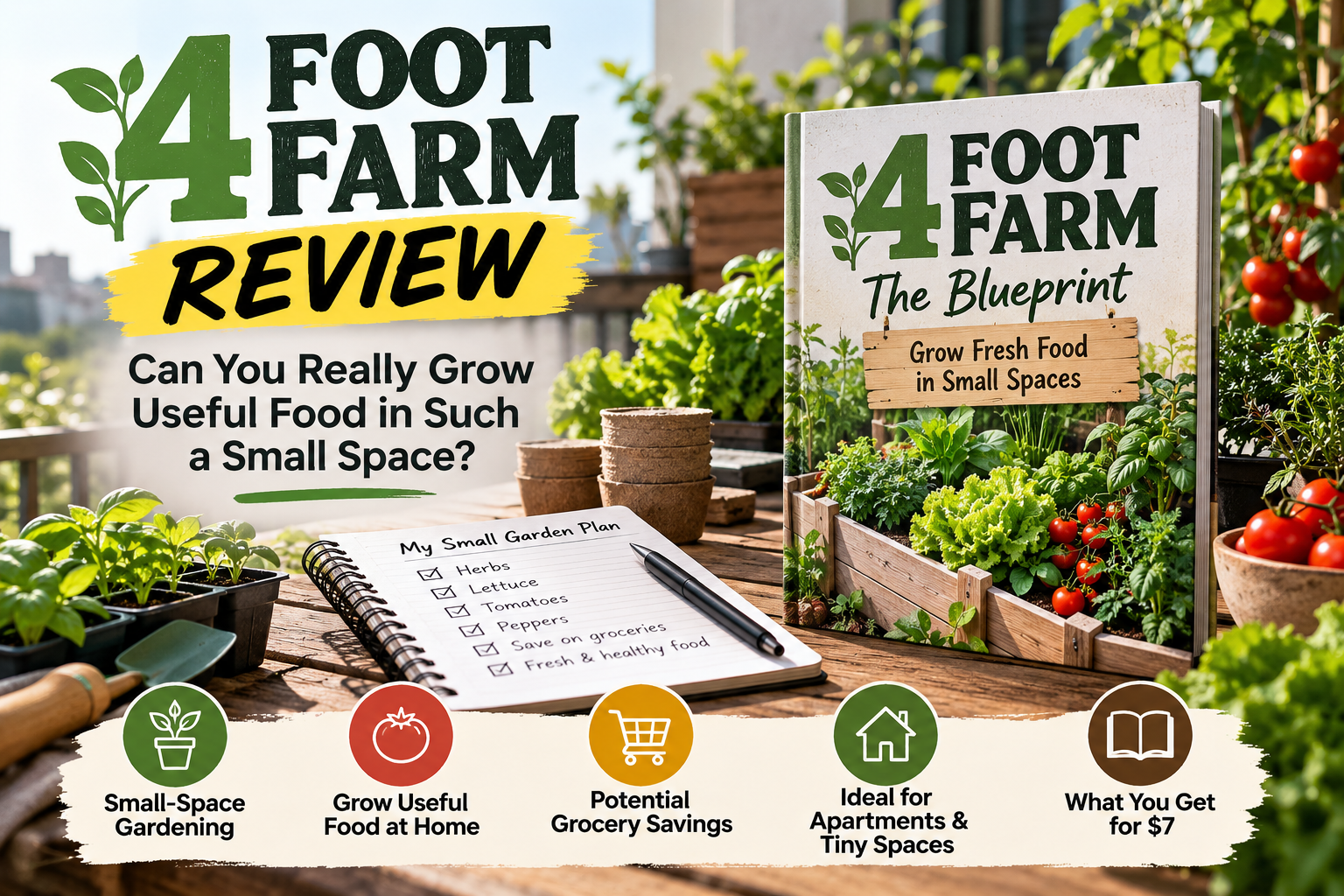
There is something immediately appealing about the idea behind
4 Foot Farm.
Groceries keep getting more expensive.
A lot of people would like to grow some of their own food.
But most of us don’t have acres of land, unlimited weekends or any
desire to become professional gardeners.
Then an advertisement appears saying you can start growing useful
food in “just 4 feet — or less” for a $7 one-time
payment.
Naturally, the next searches become:
Does 4 Foot Farm really work?
Is 4 Foot Farm legit?
Can four feet of growing space actually make a meaningful
difference to a grocery bill?
And once we started investigating, we discovered something else:
There
are actually two different 4 Foot Farm stories on the internet.
There is the original 2013 4 Foot Farm Blueprint,
which accumulated some fairly harsh customer reviews.
And there is the rebuilt digital edition currently being sold
in 2026, which is a substantially different package.
Mixing those two products together makes researching 4 Foot Farm much
more confusing than it needs to be.
So we separated them.
And then we investigated whether the gardening idea itself makes
sense.
See the Current 4 Foot Farm Blueprint
- Personally Tested
- NO
- Research Type
- COMMUNITY RESEARCHED
- Public Sources Examined
- Multiple; representative sources listed
- Independent First-Hand Accounts
- LIMITED
- Affiliate Relationship
- YES
- Vendor Provided Access
- NO
- Last Researched
- September 2026
TestimonialBlogs
Research Transparency
Personally Tested: No
Research Type: Community Researched
Public sources examined: 20+
Official product materials examined: Yes
ClickBank marketplace data examined: Yes
University horticulture sources examined: Yes
Current affiliate/review pages examined: Yes
Historical buyer reviews examined: Yes
Clearly independent buyer evidence for the current 2026
edition: Very limited
Historical buyer evidence for the original 2013
edition: Yes
Affiliate Relationship: Yes
Vendor Provided Access: No
Last Researched: September 24, 2026
Affiliate Disclosure
TestimonialBlogs may receive a commission if you purchase the 4 Foot
Farm Blueprint through links in this article, at no additional cost to
you.
That does not determine what we publish.
In this case, that distinction is particularly important because
there are already dozens of “4 Foot Farm reviews” online repeating
similar claims about enormous harvests, grocery savings and customer
ratings.
We were more interested in determining:
which claims we could actually verify.
Quick Answer: Is 4 Foot Farm
Legit?
The current 4 Foot Farm Blueprint appears to be a real
digital gardening information product actively sold through
ClickBank.
The official website currently advertises:
- 10 step-by-step chapters;
- picture-led instructions;
- build kits;
- printable gardening helpers;
- growing tools;
- instant online access;
- a $7 one-time front-end price;
- and a 60-day money-back guarantee.
ClickBank marketplace tracking also confirms that vendor
4FTFARM entered the marketplace in August 2026 and is
generating real affiliate sales. Current tracking showed Gravity around
6.96 when we checked on September 24, with a previous
high around 7.63.
So:
Is there a real product?
Yes.
Is
small-space vegetable gardening a legitimate concept?
Absolutely.
University horticulture programs explicitly teach container
gardening, vertical gardening and intensive square-foot growing for
people with limited space.
Does
that prove every savings or food-production claim in the marketing?
No.
That’s where expectations need to become much more realistic.
What Is the 4 Foot Farm
Blueprint?
4 Foot Farm is essentially a small-space food-growing system
for beginners.
Instead of starting with:
“How do I become a gardener?”
the product approaches the problem from:
“What
food do I already buy, and what portion of that could I reasonably grow
in the space I already have?”
The current official product emphasizes:
Cut-and-come-again crops
Plants such as certain greens and herbs that can produce repeated
harvests.
Container gardening
Growing useful crops in pots and other containers instead of
requiring a traditional garden.
Vertical growing
Using upward space for plants such as climbing beans and
cucumbers.
Companion planting
Planning different crops around one another.
Harvest and preservation
Keeping more of what you successfully grow.
Indoor and tiny-space growing
Using balconies, patios, windowsills and small corners rather than
assuming everyone owns a large backyard.
None of those concepts is unusual or scientifically questionable.
They are established gardening methods.
Does Small-Space
Gardening Actually Work?
Yes.
This is probably the strongest part of the entire product
concept.
The University of Maryland Extension says that nearly any vegetable
or herb can potentially be grown in containers, including:
lettuce,
peppers,
tomatoes,
beans,
chard,
beets,
radishes,
squash,
cucumbers,
and many herbs.
They specifically recommend compact, dwarf and bush varieties for
limited spaces.
Virginia Tech similarly notes that a windowsill, patio, balcony or
doorstep can provide enough space to grow fresh vegetables in
containers.
NC State Extension says people can grow vegetables on patios,
balconies or doorsteps as long as there is adequate sunlight.
So the central premise:
“I don’t
have a huge backyard, but I can still grow food”
is absolutely legitimate.
But Can Four Feet Really
Feed a Family?
This requires a much more careful answer.
The current 4 Foot Farm website has actually softened this claim
compared with the older product.
Its FAQ specifically says that “4 feet” does not necessarily
mean you need a literal 4-by-4-foot garden bed.
Instead, the phrase refers more generally to starting with a small
useful growing space such as a balcony, container, windowsill or compact
bed.
That’s an important distinction.
Because there is a huge difference between:
growing
meaningful amounts of produce in a small space
and:
completely
feeding an entire family from four square feet.
The first is realistic.
The second would require extraordinary assumptions.
What
University Gardening Research Says About Space
Square-foot gardening itself is well established.
University of Florida Extension describes a typical square-foot
garden as a 4 × 4-foot raised bed containing 16 individual
square-foot growing sections.
Depending on the crop, a single square can accommodate:
1 tomato or pepper plant,
4 lettuce plants,
9 beans,
or up to 16 radishes, carrots or onions.
West Virginia University Extension goes further and says a properly
managed 4 × 4-foot garden — 16 square feet total — can grow
enough vegetables for approximately one person, with additional
beds recommended for additional people.
Notice something important:
That’s 16 square feet, not four.
So whenever marketing language starts sounding as if four square feet
can completely replace a family’s grocery shopping, we would
dramatically lower expectations.
Small gardens can be highly productive.
They are not magic.
Sunlight Matters More Than
Marketing
Another limitation that deserves more attention is sunlight.
You can’t simply place a container anywhere and expect tomatoes.
NC State Extension says leafy vegetables may grow with around three
to six hours of direct sunlight, while fruiting vegetables such as
tomatoes, peppers and cucumbers generally require around six hours or
more.
University of Maryland similarly recommends approximately:
6–8 hours of direct sun for many warm-season
crops;
and:
3–5 hours for many cool-season leafy crops.
So if your only “four feet” happens to be a permanently shaded
apartment balcony, your options will be very different from someone with
a sunny patio.
No blueprint can change the amount of sunlight reaching your
home.
What Do You Get for $7?
The current official offer is considerably more developed than the
original 2013 booklet.
The current website describes:
10 Step-by-Step Chapters
The main Blueprint.
Picture-Led Instructions
Designed specifically to make setup easier for beginners.
Build Kits
Practical setup guidance rather than purely conceptual gardening
information.
Printable Helpers and
Planning Tools
Resources intended to simplify implementation.
The broader current product materials also describe resources
around:
cut-and-come-again growing,
companion planting,
year-round planting,
harvest and preservation,
recipes,
and a space-planning/visualization tool.
At the time of our research, the official website displayed:
$7 one-time
with a crossed-out regular price of $47.
But We
Found Something Important About Recurring Billing
The official front-end website says the $7 Blueprint itself
is a one-time purchase.
However, current ClickBank marketplace tracking also labels the
overall offer as:
Upsell Available
and:
Recurring Payment
and reports an average rebill amount around $3.71.
Those two facts do not necessarily contradict each other.
The most likely explanation is:
the
$7 front-end Blueprint is one-time, while some optional backend offer
includes recurring billing.
That’s common in ClickBank funnels.
But it means you should pay attention after the first purchase.
If another page offers:
a membership,
newsletter,
continuity program,
additional gardening material,
or some other upgrade,
check whether that purchase is:
one-time or recurring.
Do not assume every offer after the $7 Blueprint has the same billing
structure.
Check the Current $7 4 Foot Farm Offer
The
Original 2013 4 Foot Farm Is Important — But Don’t Confuse It With This
One
This is probably the most important piece of historical context.
A book called 4 Foot Farm Blueprint was published in
2013 under the name Sam McCoy.
Goodreads still lists the original 52-page paperback, first published
June 6, 2013.
Open Library similarly preserves the old version and describes
sections involving:
site preparation,
vertical gardening,
budgeting,
growing medium,
garden towers,
and bottle-based vertical systems.
So the story that 4 Foot Farm existed long before the current
ClickBank relaunch is independently verifiable.
But the reviews of that old product were not particularly
flattering.
What Did
Buyers Say About the Original 4 Foot Farm?
This is where things become interesting.
A retailer archive collecting historical customer reviews gives the
old paperback an average around 2.2/5 from 30 customer
reviews.
Recurring criticisms included:
Instructions were too vague.
Some readers said they could not follow the construction instructions
without additional research.
The illustrations were
inadequate.
Several complaints specifically mentioned diagrams that were
difficult to understand.
The content was too thin.
Some buyers felt the booklet did not contain enough information for
inexperienced gardeners.
Too much emphasis on
hydroponics.
Some customers expected a broader four-foot gardening system and felt
the original material focused too heavily on hydroponic setups.
The sales funnel was
frustrating.
Several historical reviews complained about upsell-heavy sales pages
before they could access the product.
Those are real criticisms from the older edition.
But this is where TestimonialBlogs needs to be careful.
They
are not reviews of the current 2026 digital product.
The modern sales page specifically says the Blueprint was brought
back with:
clear pictures,
simpler steps,
10 chapters,
build kits,
and printable helpers.
Interestingly, several of those updates directly address the problems
old buyers complained about.
That’s meaningful.
But without personally comparing both complete products, we cannot
say every historical weakness has been completely eliminated.
Who Is Sam McCoy?
The current product credits Sam McCoy as
creator.
There is independently verifiable evidence that a 2013 book under
that same name existed.
However, the current brand itself discloses that the creator uses a
pen name for safety purposes.
That means the historical product can be verified.
The legal identity behind “Sam McCoy” cannot easily be independently
verified.
We don’t consider the use of a pen name inherently problematic.
TestimonialBlogs itself understands perfectly well why people
publishing personal material may choose one.
But readers should distinguish:
an identifiable published product history
from:
an independently verified creator biography.
Did 4 Foot Farm
Really Sell 500,000 Copies?
The current website says that more than:
500,000 original copies
were sold.
The ClickBank marketplace description repeats that figure and
additionally claims more than $10 million in historical sales.
We found evidence that the product existed commercially more than a
decade ago.
We did not find an independent publisher sales
report or audit confirming the 500,000-copy figure.
So our classification is:
Brand-stated
claim, not independently verified.
That does not mean the figure is false.
It means we cannot prove it independently.
Can 4 Foot Farm
Really Save $2,000–$3,000 a Year?
This claim deserves skepticism.
Some versions of 4 Foot Farm marketing have promoted potential annual
grocery savings in the thousands of dollars.
Whether a garden saves money depends on:
what you grow,
local grocery prices,
seed prices,
containers,
soil,
fertilizer,
water,
pest control,
climate,
failed plants,
and how much produce your household actually eats.
Container gardening is not free.
Colorado State University Extension specifically notes that container
gardens often require frequent watering and
fertilization.
University of Maryland recommends choosing crops you already eat
frequently or that are expensive to purchase.
That’s a much more sensible savings strategy.
Growing:
fresh basil,
lettuce,
herbs,
peppers,
greens,
or specialty tomatoes
may provide considerably better economic value per square foot than
trying to grow inexpensive bulk foods.
Can home
gardening reduce some grocery spending?
Absolutely.
Can
we verify that this $7 Blueprint will save the average family
$2,000–$3,000 every year?
No.
The
Best Idea Inside the Marketing Is Also the Most Obvious
One part of the system actually makes excellent practical sense:
Grow what you already eat.
A surprising number of beginner gardeners plant vegetables because
they seem interesting rather than because anyone in the family regularly
eats them.
Then they produce food nobody really wants.
The current 4 Foot Farm philosophy starts with the grocery list and
works backward.
University of Maryland Extension independently gives almost identical
advice: grow crops you frequently eat or that are expensive or difficult
to find.
That isn’t revolutionary.
But it is sensible.
What Does “Cut and Come
Again” Mean?
The current program emphasizes repeat-harvest crops.
This generally refers to vegetables and herbs where you harvest part
of the plant while leaving enough growth for it to produce again.
Certain:
lettuces,
greens,
herbs,
chard,
and similar crops
can be useful for this approach.
For a tiny garden, that strategy makes sense because you’re trying to
maximize repeated output from limited soil and container space.
But it does not mean every plant regenerates indefinitely.
Plants still have:
life cycles,
seasonal limits,
temperature limits,
disease pressure,
and declining productivity.
“Never-ending food supply” is marketing language.
Gardening is still biology.
Is Vertical Gardening Legit?
Yes.
Vertical gardening is another well-established technique for limited
spaces.
Washington State University Extension recommends using trellises or
fences for crops including:
peas,
pole beans,
and cucumbers.
Growing upward frees ground space for additional crops.
University of Maryland also demonstrates tiered containers, hanging
baskets and vertical systems as legitimate methods for increasing
production in limited areas.
So again:
The underlying gardening concepts are real.
The debate is about the size of the marketing claims, not whether
vertical gardening exists.
What Are the
Current 4 Foot Farm Complaints?
For the current rebuilt edition, independent buyer
history is still extremely limited.
It only entered the current ClickBank marketplace in August 2026.
Most pages already ranking for “4 Foot Farm review” appear to be:
affiliate content,
SEO articles,
forum-style promotional posts,
or reviews that cannot demonstrate an independently authenticated
purchase.
We therefore would not take statements such as:
“4.7/5 from verified users”
at face value unless the underlying customer dataset is visible.
The concerns we can support are more practical.
1.
The marketing can oversell the amount of food possible from a tiny
space.
Small-space gardening works.
Replacing an entire family’s grocery supply from four square feet
does not align with the university guidance we found.
2. Results depend heavily
on location.
Sunlight, temperature, water, pests and growing season matter.
3. Setup costs more than $7.
The information product costs $7.
Your garden may still need:
containers,
soil,
seeds or seedlings,
fertilizer,
trellises,
watering equipment,
and pest control.
4.
The current edition is too new for a meaningful independent customer
history.
The absence of many complaints is not the same as proof of universal
satisfaction.
5. The funnel includes
upsells.
And marketplace tracking shows that some backend component can
involve recurring billing.
What About the Refund
Guarantee?
The current official homepage is much clearer than some older
versions we found indexed.
It now repeatedly advertises:
60-day money-back guarantee.
The FAQ says buyers have 60 days to examine and try the Blueprint and
request a refund if it isn’t useful.
Earlier indexed research found inconsistent wording between a sales
page and Terms — one implying a more open-ended guarantee while the
Terms specified 60 days.
The current homepage appears to have cleaned that up.
Our recommendation is still simple:
Treat
60 days as the operative window unless your actual ClickBank checkout
says otherwise.
And save the receipt.
Is 4 Foot Farm a
Subscription?
The core $7 Blueprint is currently advertised as a one-time
purchase.
But current ClickBank tracking also shows the funnel includes a
recurring-payment component somewhere in its backend.
So:
$7 front-end = advertised as
one-time.
Optional later
offers = inspect individually.
Do not click through additional purchase pages without checking their
billing terms.
Could You Learn This for
Free?
Absolutely.
This is an important criticism of almost every information
product.
Universities already publish excellent free material on:
container gardening,
square-foot gardening,
crop spacing,
sun requirements,
vertical gardening,
soil,
watering,
and pest management.
University of Maryland, NC State, Virginia Tech, Florida and many
other extension programs provide extensive free guidance.
So why pay $7?
The argument is not:
“4
Foot Farm contains secret gardening knowledge unavailable anywhere
else.”
The argument is:
“For
$7, somebody organized a beginner-oriented small-space growing plan into
one system.”
For some people, organization is worth more than information.
A person can watch 60 gardening videos for free.
That doesn’t necessarily mean they will ever plant anything.
The Biggest Positive We
Found
The underlying concept is grounded in legitimate horticulture.
This isn’t a supernatural product.
It isn’t promising plants that violate biology.
Container gardens work.
Vertical gardens work.
Square-foot gardening works.
Repeated harvests from appropriate crops work.
And people living in apartments or homes with tiny outdoor areas
genuinely can produce meaningful amounts of fresh herbs and
vegetables.
That’s a much stronger foundation than many digital products begin
with.
The Biggest Concern We Found
The language around:
“never-ending food supply”
and enormous grocery savings can create expectations that a tiny
growing area simply cannot guarantee.
The system makes much more sense when interpreted as:
“produce
useful fresh food from space you previously weren’t using.”
That’s realistic.
“Feed
your entire family indefinitely from essentially no space.”
That’s not a result we could substantiate.
Who Might Get the
Most Value From 4 Foot Farm?
Complete beginners
Someone staring at an empty balcony with no idea what to plant.
Apartment and townhouse
residents
Particularly people who assumed food gardening requires a
backyard.
Families
who already buy lots of fresh herbs and greens
High-value, repeatedly harvested crops can make limited space more
useful.
People who need structure
A single organized plan may be easier to execute than assembling
information from dozens of websites.
Older gardeners
or people who prefer containers
Raised containers can reduce bending and other accessibility
challenges.
Who Probably Doesn’t Need It?
Experienced gardeners
If you already understand container sizes, crop spacing, succession
planting, companion planting and preservation, much of the material may
be basic.
Someone with almost no
usable sunlight
The Blueprint cannot overcome a poor growing environment.
Anyone
expecting complete food independence from four feet
That’s the wrong expectation.
Someone who loves
researching
You can assemble much of the underlying information for free through
university extension programs.
Someone who doesn’t
actually want to garden
No guide waters plants for you.
Is 4 Foot Farm Worth $7?
At seven dollars, we think the question becomes relatively
simple.
You’re not deciding whether to invest $2,000 in a gardening
course.
You’re deciding whether an organized beginner blueprint is worth
approximately the cost of a small bag of potting soil.
For a complete beginner with limited space:
potentially yes.
For an experienced gardener:
probably much less
compelling.
The bigger expense is not the Blueprint.
It’s actually building and maintaining whatever garden you choose to
create.
Our Conclusion
After Researching 4 Foot Farm
4 Foot Farm is one of those products where the underlying idea is
considerably stronger than the most aggressive marketing around it.
Small-space gardening is real.
Container gardening is real.
Vertical growing is real.
Intensive square-foot planting is real.
Universities teach all of them.
The current 4 Foot Farm Blueprint packages those ideas into a
beginner-focused digital system currently priced at
$7.
The product also has something many brand-new ClickBank offers
don’t:
history.
A 4 Foot Farm book really existed more than a decade ago.
That old version also had real customer criticism.
Some buyers found it confusing, too thin and overly focused on
hydroponics.
The current product appears to have been deliberately rebuilt around
clearer pictures, more chapters, build kits and planning tools — exactly
the areas where the old version was weakest.
What we would not do is buy it expecting four feet
of space to make grocery stores obsolete.
A tiny garden can supplement your food.
It can produce herbs and vegetables you’d otherwise buy.
It can teach useful skills.
It can make a balcony productive.
And depending on what you grow, it may reduce some grocery
spending.
Those are meaningful outcomes without pretending a tomato planter is
going to make a family completely food-independent.
Our simplest conclusion:
4 Foot Farm appears to be a legitimate, low-cost beginner
guide built around proven small-space gardening methods — but the
realistic value is learning to grow some useful food efficiently, not
creating an unlimited grocery supply from four feet of
space.
For $7, that’s a much more reasonable proposition.
See the Current 4 Foot Farm Blueprint & $7 Offer
→
Affiliate disclosure: TestimonialBlogs may receive a commission
if you purchase through this link, at no additional cost to you.
Affiliate revenue helps fund future product research and investigations.
It does not change what we report.
4 Foot Farm FAQ
Is 4 Foot Farm legit?
The current 4 Foot Farm Blueprint appears to be a real digital
gardening product actively sold through ClickBank. The official website
offers instant access to a 10-chapter digital program and currently
lists the front-end price at $7.
Is 4 Foot Farm a scam?
We did not find evidence sufficient to characterize the current
product as a scam. A real product exists, a previous edition has existed
since 2013, and the gardening methods behind it are legitimate. However,
some marketing claims around food production and grocery savings should
be treated as estimates rather than guaranteed outcomes.
Does 4 Foot Farm really work?
Small-space food gardening absolutely can work. University extension
programs confirm that vegetables and herbs can be grown successfully in
containers, balconies, patios, small raised beds and vertical systems.
Your actual results depend on sunlight, crop selection, climate, water,
soil and maintenance.
Can four
feet really grow enough food for a family?
Four feet can grow useful food, but expecting it to replace an entire
family’s grocery supply would be unrealistic. West Virginia University
Extension estimates that a 4 × 4-foot intensive garden — 16 square feet
— can provide vegetables for roughly one person.
How much does 4 Foot Farm
cost?
The current official front-end offer was $7 one-time
when we researched it on September 24, 2026. Verify the actual amount
shown at checkout because digital-product pricing can change.
Is 4 Foot Farm a
subscription?
The $7 core Blueprint is advertised as a one-time purchase. However,
ClickBank tracking currently indicates that the broader funnel contains
an upsell and a recurring-payment component, so inspect any optional
offers presented after checkout carefully.
Does 4 Foot Farm
have a money-back guarantee?
The current official website states a 60-day money-back
guarantee.
Is 4 Foot Farm a physical
book?
The current core Blueprint is delivered digitally and can be opened
on a computer, tablet or phone. The official FAQ says a separate printed
Field Guide is available for customers who prefer a physical
companion.
Who is Sam McCoy?
Sam McCoy is the name credited to the original and current 4 Foot
Farm products. A 2013 paperback under that name is independently
documented, but the current brand also discloses that “Sam McCoy” is a
pen name.
Why are there
bad reviews of 4 Foot Farm online?
Many negative buyer reviews relate to the original 2013
edition, not necessarily the rebuilt digital edition now being
sold. Historical complaints focused on vague construction instructions,
weak diagrams, limited information and an aggressive sales funnel. The
current product has been expanded and redesigned, so those reviews
provide useful history but should not automatically be treated as
reviews of the 2026 edition.
Check the Current 4 Foot Farm Blueprint
Can I learn
small-space gardening for free?
Yes. University extension programs provide extensive free information
on container gardening, square-foot gardening, crop spacing and
small-space vegetable production. The main potential advantage of 4 Foot
Farm is organization and beginner-friendly structure rather than access
to otherwise secret gardening knowledge.
Can 4 Foot Farm
really save $2,000–$3,000 per year?
We could not independently validate that savings figure as a typical
result. Actual savings depend on input costs, crop selection, local
grocery prices, climate, yields and how much produce your household
normally buys.
Check the Current 4 Foot Farm Blueprint
Why
TestimonialBlogs Calls This “Community Researched”
We did not purchase and personally grow a garden using the current 4
Foot Farm Blueprint before publishing this investigation.
So we will not pretend we did.
Instead, we examined:
the current official product;
the ClickBank marketplace listing;
the original 2013 book;
historical customer reviews;
current affiliate reviews;
forum-style review pages;
university extension gardening resources;
container-growing recommendations;
square-foot gardening guidance;
current pricing;
refund information;
and marketplace billing data.
The unusual advantage of researching this product is that we have
more than ten years of history to examine.
But that history also requires context.
A negative review written in 2014 is evidence about the old
edition.
It is not automatically evidence about the rebuilt 2026 product.
Likewise, a glowing affiliate article published three weeks ago isn’t
automatically independent buyer testimony.
We separate the two.
That’s what TestimonialBlogs is supposed to do.
Real evidence where it exists.
Clear uncertainty where it doesn’t.
And no invented 4.9/5 rating just because everyone else has
one.